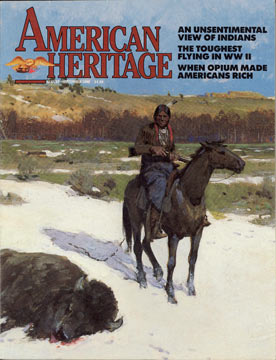
August/September 1986
Features
The vast jumble of objects that once brought solace to an eccentric heiress has become a great museum of the middle class
A trackside album of celebrities from the days when the world went by train
Did the Indians have a special, almost noble, affinity with the American environment—or were they despoilers of it? Two historians of the environment explain the profound clash of cultures between Indians and whites that has made each group almost incomprehensible to the other.
Forget football, basketball, and all the other sports that are artificially regulated by the clock. Only baseball can truly reveal our national character. Only baseball can light our path to the future.
The crisis swept over France and Germany and Britain alike—and they all nearly foundered. Now more than ever, it is important to remember it didn’t just happen here.
The urge to create literature was as strong in the mid-1800s as it is today, but rejections were brutal and the pay was even worse
Connoisseurs have long regarded him as the master of cold-turkey peddling. He’s been at it for eighty years.
Some of our finest public buildings were designed by a tormented young English architect whom the world has forgotten
These World War II airmen had one of the most dangerous missions of all, piloting unarmed cargo planes over the Hump—the high and treacherous Himalayas
The opium trade is remembered as a British outrage: English merchants, protected by English bayonets, turning China into a nation of addicts. But Americans got rich from this traffic—among them, a young man named Warren Delano. He didn’t talk about it afterward, of course. And neither did his grandson, Franklin Delano Roosevelt.
On Harvard’s 350th anniversary, a distinguished alumnus salutes his proud and often thorny alma mater
Departments
CORRESPONDENCE
EDITORS’ BOOKSHELF
LETTER FROM THE EDITOR
MATTERS OF FACT
READERS’ ALBUM
THE BUSINESS OF AMERICA
THE TIME MACHINE

American Heritage is proud to host the
National Portal to
Historic Collections
Recently added:
- American Revolution Center
- National Museum of Civil War Medicine
- National Museum of the U.S. Navy
- Manassas National Battlefield
- Maryland State House
In association with the
American Association for State and Local History
Why do we need a national nonprofit membership society for American history?
-
“Save America’s Treasures” has been totally eliminated—the largest Federal program supporting preservation of such treasures as the original Star Spangled Banner and George Washington’s tent.
-
65% of Americans don’t know what happened at the Constitutional Convention, according to a recent survey by Newsweek.
-
The “Teaching American History” grants—the largest Federal program supporting history education—have been completely eliminated.
-
Visits to the Top 20 Civil War battlefields have dropped in half from 1970 to 2009 according to official National Park Service statistics.
-
40% of Americans can’t identify whom we fought in World War II, according to a recent survey by Newsweek.
-
A quarter of Americans believe Congress shares power over U.S. foreign policy with the United Nations, according to a recent Annenberg survey.
-
“There is little that is more important for an American citizen to know than the history and traditions of his country,” John F. Kennedy wrote in American Heritage.
-
The “We the People Program,” which touched some 30 million students and 90,000 teachers over 25 years, has been completely eliminated.
-
Two-thirds of Americans could not correctly name Yorktown as the last major military action of the American Revolution, according to a recent national Gallup survey.
-
The National Heritage Areas and Scenic Byways program, the only major Federal program encouraging visits to historic places, has been completely eliminated in Congressional committee.