
Our greatest Western novelist deciphers Crazy Horse, Custer, and the hard year of the Little Bighorn
-
February/March 1999
15 years ago By admin Volume50Issue1
 -
Summer 2025
1 year ago By Edwin S. Grosvenor Volume70Issue3
By this time most of the major Indian leaders had made a realistic assessment of the situation and drawn the obvious conclusion, which was that their old way of life was rapidly coming to an end. One way or another they were going to have to walk the white man’s road—or else fight until they were all killed. The greatest Sioux warriors, Crazy Horse and Sitting Bull, were among the most determined of the hostiles; two others, Red Cloud and Spotted Tail, rivals at this point, both had settled constituencies. They were administrators essentially, struggling to get more food and better goods out of their respective agents. As more and more Indians came in and enrollment lists swelled, this became a full-time job, and a vexing and frustrating one at that.
There were of course many Indians who tried to walk a middle road, unwilling to give up the old ways completely but recognizing that the presence of whites in what had once been their country was now a fact of life. Young Man Afraid of His Horses, son of the revered Old Man Afraid of His Horses, was one of the middle-of-the-roaders.
The whites at first tried pomp and circumstance, bringing the usual suspects yet again to Washington, hoping to tempt them—Red Cloud, Spotted Tail, anyone—to sell the Black Hills. They would have liked to have had Sitting Bull and Crazy Horse at this grand parley, or even a moderate, such as Young Man Afraid of His Horses, but none of these men or any of the principal hostiles wanted anything to do with this mini-summit. Red Cloud and Spotted Tail had no authority to sell the Black Hills, or to do anything about them at all, a fact the white authorities should have realized by this time. There were still thousands of Sioux on the northern plains who had not given their consent to anything. The mini-summit fizzled.
Many Indians by this time had taken to wintering in the agencies and then drifting off again once the weather improved. Thousands came in, but when spring came, many of them went out again.
Crazy Horse, who was about thirty-five years old, enjoyed in 1875-76 what was to be his last more or less unharassed winter as a free Indian. How well or how clearly he realized that his time was ending, we don’t know. Perhaps he still thought that if the people fought fiercely and didn’t relent, they could beat back the whites, not all the way to the Platte perhaps, but at least out of the Powder River country. We don’t really know what he was thinking and should be cautious about making him more geopolitically attuned than he may have been. At this juncture nobody had really agreed to anything, but as the spring of 1876 approached, the Army directed a number of its major players toward the northern plains. To the south, on the plains of Texas, the so-called Red River War was over. The holdouts among the Comanches and the Kiowas had been defeated and their horse herd destroyed. Ranald S. Mackenzie and Nelson A. Miles both distinguished themselves in the Red River War and were soon sent north to help subdue the Cheyennes and the northern Sioux. Gen. George Crook was already in the field, and Col. John Gibbon, Gen. Alfred Terry, and, of course, George Armstrong Custer were soon on their way.
General Crook—also known as Three Stars, or the Grey Fox—struck first. He located what the scout Frank Grouard assured him was Crazy Horse’s village, made a dawn attack, captured the village, destroyed the ample provender it contained (some of which his own hungry men could happily have eaten), but killed few Indians. Where Crazy Horse actually was at this time is a matter much debated, but the camp Crook destroyed seems not to have been his. For Crook the encounter was more vexation than triumph. The Sioux regrouped that night and got back most of their horses, and the fight drove these peace-seeking Indians back north toward Sitting Bull. Crook continued to suppose that he had destroyed Crazy Horse’s village; no doubt some of the Indian’s friends were there, but the man himself was elsewhere.
A vast amount had been written about the great gathering of Indians who assembled in Montana in the early summer of 1876. It was to be the last mighty grouping of native peoples on the Great Plains of America. For the older people it evoked memories of earlier summer gatherings— reunions of a sort—such as had once been held at Bear Butte, near Crazy Horse’s birthplace. Many of these Indians probably knew that what was occurring was in the nature of a last fling; there might be no opportunity for such a grand occasion again. Most of the Indians who gathered knew that the soldiers were coming, but they didn’t care; their numbers were so great that they considered themselves invincible. Many Indians, from many tribes, remembered it as a last great meeting and mingling, a last good time. Historically, from this point on, there is a swelling body of reminiscence about the events of the spring and summer of 1876. Indeed, from the time the armies went into the field in 1876 to the end of the conflict, there is a voluminous memoir literature to be sifted through—most of it military memoirs written by whites. Much of this found its way into the small-town newspapers that by then dotted the plains. These memoirs are still emerging. In 1996 four letters written by the wife of a captain who was at Fort Robinson when Crazy Horse was killed were discovered and published. The woman’s name was Angie Johnson. It had taken more than a century for this literature to trickle out of the attics and scrapbooks of America, and it is still trickling. Of course it didn’t take that long for the stately memoirs of Generals Sheridan and Sherman and Miles and the rest to be published.
Though the bulk of this memoir literature is by white soldiers, quite a few of the Sioux and the Cheyennes who fought at the Little Bighorn managed to get themselves interviewed here and there. It is part of the wonder of the book Son of the Morning Star that Evan S. Connell has patiently located many of these obscurely published reminiscences from both sides of the fight and placed them in his narrative in such a way as to create a kind of mosaic of firsthand comment. These memoirs don’t answer all the questions, or even very many of them, but it is still nice to know what the participants thought happened, even if what we’re left with is a kind of mesquite thicket of opinion, dense with guessing, theory, and speculation. Any great military conflict—Waterloo, Gettysburg, et cetera—leaves behind a similar confusion, a museum of memories but an extremely untidy one. Did the general say that or do this? Was Chief Gall behind Custer or in front of him or nowhere near him? The mind that is troubled by unanswered and possibly unanswerable questions should perhaps avoid military history entirely. Battles are messy things. Military historians often have to resort to such statements as “it would at this juncture probably be safe to assume....” Stephen E. Ambrose is precisely right (and uncommonly frank) when he says plainly that much of the fun of studying the Battle of the Little Bighorn is the free rein it offers to the imagination. Once pointed toward this battle, the historical imagination tends to bolt; certainly the field of battle that the Indians called the Greasy Grass has caused many imaginations to bolt.
This buildup of confidence was capped by what was probably the best-reported dream vision in Native American history—namely, Sitting Bull’s vision of soldiers falling upside down into camp. This important vision did not come to the great Hunkpapa spontaneously; instead it was elaborately prepared for. Sitting Bull allowed a friend to cut one hundred small pieces of flesh from his arms, after which he danced, staring at the sun until he fainted. When he came out of his swoon, he heard a voice and had a vision of soldiers as numerous as grasshoppers falling upside down into camp. There were some who were skeptical of Sitting Bull—he could be a difficult sort—but this vision, coming as it did at the end of a great Sun Dance, convinced most of his people that if the soldiers did come, they would fall. (It is worth mentioning that Sitting Bull had mixed luck with visions. Not long before his death a meadowlark, speaking in Sioux, told him that his own people would kill him—which is what occurred.)
Shortly after this great vision of soldiers falling had been reported and considered, some Cheyenne scouts arrived with the news that General Crook was coming from the south with a lot of soldiers and a considerable body of Crow and Shoshone scouts. This was a sign that Sitting Bull had not danced in vain, although Crook never got very close to the great encampment, because Crazy Horse, Sitting Bull, and a large force immediately went south to challenge him on the Rosebud Creek, where the first of the two famous battles fought that summer was joined.
When the Indians attacked, Crook’s thousand-man force was very strung out, with soldiers on both sides of the river, in terrain that was broken and difficult. Crow scouts were the first to spot the great party from the north; by common agreement the Crows and Shoshones fought their hearts out that day, probably saving Crook from the embarrassment of an absolute rout. But Crazy Horse, Black Twin, Bad Heart Bull, and many others were just as determined. Once or twice Crook almost succeeded in forming an effective battle line, but Crazy Horse and the others kept dashing right into it, fragmenting Crook’s force and preventing a serious counterattack. There was much close-quarter, hand-to-hand fighting. In a rare anticipation of women in combat, a Cheyenne woman rushed in at some point and saved her brother, who was surrounded. (The Cheyennes afterward referred to the Battle of the Rosebud as the Battle Where the Girl Saved Her Brother.) Crook struggled all day, trying to mount a strong offensive, but the attackers were so persistent that they thwarted him. Finally the day waned, and shadows began to fall across the Rosebud. The Indians, having enjoyed a glorious day of battle, went home. They had turned Three Stars back, allowing him nowhere near the great gathering on the Little Bighorn.
At the end of the day, General Crook at last accepted the advice his scouts had offered him earlier, which was that there were too many Indians up ahead for him to fight.
Had the full extent of Crook’s difficulties on the Rosebud been known to the forces moving west into Montana, the sensible officers—that is, Gibbon and Terry—would have then proceeded with extreme caution, but it is unlikely that any trouble of Crook’s would have slowed Cluster one whit. Even if he had known that the Indians had sent Crook packing, it is hard to imagine that he would have proceeded differently. He had plenty of explicit—and, at the last, desperate—warnings from his own scouts, but he brushed these aside as he hurried the the Cavalry on to its doom. He plainly did not want to give his pessimistic scouts the time of day. He refused the offer of extra troops and also refused a Gatling gun, for fear that it might slow him down and allow the Indians to get away. It was only in the last minutes of his life that Custer finally realized that the Indians were fighting, not running. Custer was convinced that he could whip whatever body of Indians he could persuade to face him. He meant to win, he meant to win alone, and he meant to win rapidly, before any other officers arrived to dilute his glory.
Custer, that erratic egotist, has been studied more than enough; he has even been the subject of one of the best books written about the West, Evan Connell’ Son of the Morning Star. Historians have speculated endlessly about why he did what he did at the Little Bighorn on the twenty-fifth of June, 1876; and yet what he did was perfectly in keeping with his nature. He did what he had always done: push ahead, disregard orders, start a fight, win it unassisted if possible, then start another fight. He had seldom done otherwise, and there was no reason at all to expect him to do otherwise in Montana that summer.
It may be true, as several writers have suggested, that he was covertly running for President that summer. The Democratic National Convention was just convening; a flashy victory and a timely telegram might have put him in contention for the nomination. Maybe, as Connell suggests, he thought he could mop up on the Sioux, race down to the Yellowstone River, hop on the steamer Far West, and make it to the big opening of the Philadelphia Centennial Exposition on July 4. So he marched his men most of the night and flung them into battle when—as a number of Indians noted—they were so tired their legs shook as they dismounted. As usual, he did only minimal reconnaissance, and convinced himself on no evidence whatever that the Indians must be running away from him, not toward him. The highly experienced scouts who were with him—the half-breed Mitch Bouyer and the Arikara Bloody Knife and the Crow Half Yellow Face—all told Custer that they would die if they descended into the valley where the Indians were. None of them, in all their many years on the plains, had ever seen anything to match this great encampment. All the scouts knew that the valley ahead was for them the valley of death. Half Yellow Face, poetically, told Custer that they would all go home that day by a road they did not know. The fatalism of these scouts is a story in itself. Bouyer, who knew exactly what was coming, sent the young scout Curly away but then himself rode on with Custer, to his death.
In the week between the fight on the Rosebud and the one at the Little Bighorn, Crazy Horse went back to the big party. The great General Crook had been whipped; the Indians felt invincible again. Everyone knew that more soldiers were coming, but no one was particularly concerned. These soldiers could be whipped in turn.
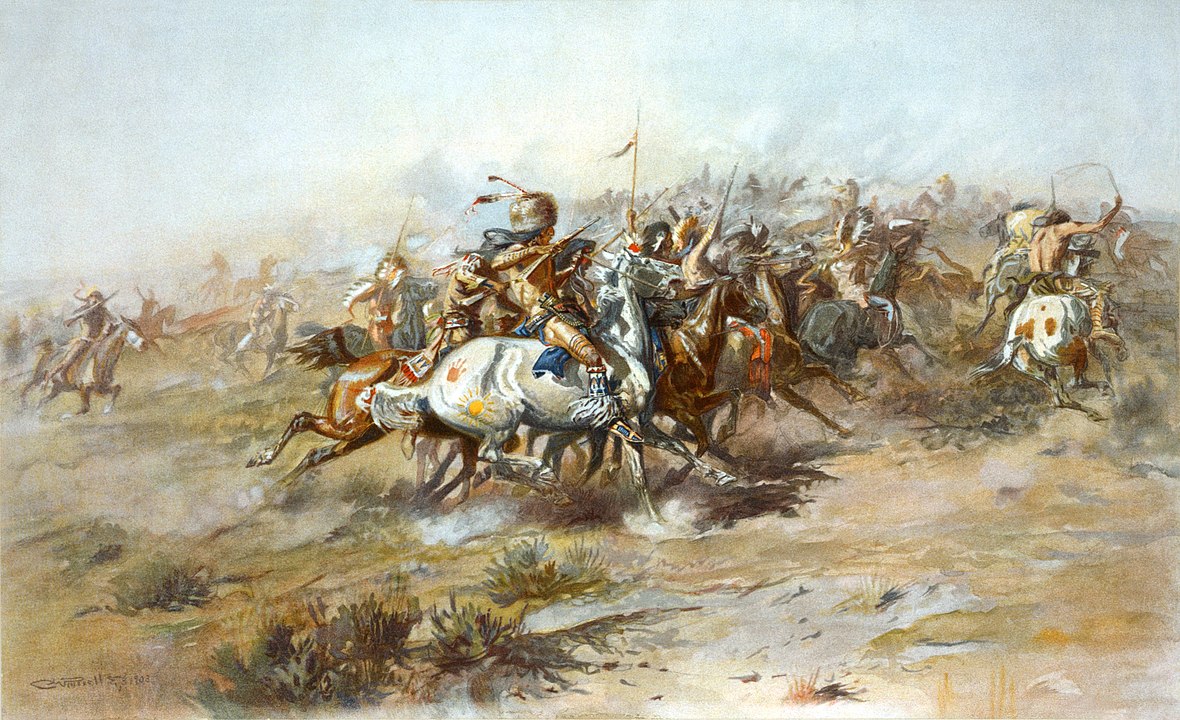
Some commentators have suggested that a sense of doom and foreboding hung over the northern plains during this fatal week; Indian and soldier alike were said to feel it. Something dark and terrible was about to happen—and yet it was high summer in one of the most beautiful places in Montana, the one time when that vast plain is usually free of rain clouds or snow clouds. But this summer, Death was coming to a feast, and many felt his approach. On the morning of the battle, when most of the Sioux and Cheyennes were happily and securely going about their domestic business, never supposing that any soldiers would be foolish enough to attack them, Crazy Horse, it is said, marked a bloody hand in red pigment on both of his horse’s hips and drew an arrow and a bloody scalp on both sides of his horse’s neck. Oglala scouts had been keeping watch on Custer, following his movements closely. Crazy Horse either knew or sensed that the fatal day had come.
A number of white historians have argued that one or another Indian leader made the decisive moves that doomed Custer and the 7th; for these historians the battle was decided by strategy and generalship, not numbers. Both Stephen Ambrose and Mari Sandoz have written many pages about the brilliance of Crazy Horse in flanking Custer and seizing the high ground—today called Custer Hill—thus ending Custer’s last hope of establishing a defensive position that might have held until reinforcements arrived. Others argue for their favorite chief, whether Gall, Two Moon, or another. Evan Connell, in his lengthy account of the battle, scarcely mentions Crazy Horse’s part in it. All these arguments, of course, depend on Indian memory, plus study of the battleground itself. To me they seem to be permanently ambiguous, potent rather than conclusive. It is indeed an area of study where historians can give free rein to their imaginations; what Stephen Ambrose doesn’t mention is that the Sioux and the Cheyennes, in remembering this battle, might be giving their imaginations a little running room as well. A world in which all whites are poets and all Indians sober reporters is not the world as most of us know it.
We are likely never to know for sure who killed Custer. He had his famous hair short for this campaign; had it still been long, many Indians might have recognized him. It is as well to keep in mind that as many as two thousand horses may have been in motion during this battle; between the dust they raised and the gun smoke, the scene would have become phantasmagorical; it would have been difficult for anyone to see well, or far. It is thus little wonder that no one recognized Custer. At some sharp moment Custer must have realized that his reasoning had been flawed. The Indians he had assumed were running away were actually coming to kill him, and there were a lot of them. Whether he much regretted his error is doubtful. Fighting was what Custer did, battle thrilled him, and now he was right in the dead thick of the biggest Indian fight of all. He may have enjoyed himself right up to the moment he fell.
For his men, of course, it was a different story. They had been marching since the middle of the night; a lot of them were so tired they could barely lift their guns. For them it was dust, weariness, terror, and death.
No one knows for certain how many Indians fought in this battle, but two thousand is a fair estimate, give or take a few hundred. Besides their overpowering numbers they were also highly psyched by the great Sun Dance and their recent victory over Crook. When Major Reno and his men appeared at the south end of the great four-mile village, the Indians were primed. Reno might have charged them and produced, at least, disarray, but he didn’t; the Indians soon chased him back across the Little Bighorn and up a bluff, where he survived, just barely. A lucky shot hit Bloody Knife, the Arikara scout, square in the head; Major Reno, standing near, was splattered with his brain matter. Some think this gory accident undid Major Reno, but we will never know the state of his undoneness, if any. Gall, the Hunkpapa warrior, who, by common agreement, was a major factor in this battle, soon had fifteen hundred warriors mounted and ready to fight. If Reno had charged the south end of the village, he might have been massacred as thoroughly as Custer.
Exactly when Crazy Horse entered the battle is a matter of debate. Some say he rode out and skirmished a little with Reno’s men; others believe he was still in his lodge when Reno arrived and that he was interested only in the larger fight with Custer. Most students of the battle think that when it dawned on Custer that he was in a fight for survival, not glory, he turned north, toward the high ground, hoping to establish a defensive redoubt on the hill, or rise, that is now named for him. But Crazy Horse, perhaps at the head of as many as a thousand warriors himself, flanked him and seized that high ground, sealing Custer’s doom while, incidentally, making an excellent movie role for Errol Flynn and a number of other leading men.
So Crazy Horse may have done, but it was Gall and his thousand or so warriors who turned back Reno and then harried Custer so hard that the 7th Cavalry—the soldiers who fell into camp, as in Sitting Bull’s vision—could never really establish any position. If Crazy Horse did flank Custer, it was of course good quarterbacking, but it hardly seems possible now to insist that any one move was decisive. Gall and his men might have finished Custer without much help from anyone; Gall had lost two of his wives and three of his children early in the battle and was fighting out his anger and his grief.
What I think of when I walk that battleground is dust. Once or twice in my life I rode out with as many as thirty cowboys; I remember the dust that small, unhurried group made. The dust of two thousand milling, charging horses would have been something else altogether; the battleground would soon have been a hell of dust, smoke, shooting, hacking; once the two groups of fighting men closed with each other, visibility could not have been good. Custer received a wound in the breast and one in the temple, either of which would have been fatal. His corpse was neither scalped nor mutilated. Bad Soup, a Hunkpapa, is said to have pointed out Custer’s corpse to White Bull. “There he lies,” he said. “He thought he was going to be the greatest man in the world. But there he is.”
Most of the poetic remarks that come to us from this battle are the work of writers who interviewed Indians, or those who knew Indians, who thought they remembered Bad Soup saying something, or Half Yellow Face making (probably in sign) the remark about the road we do not know, or Bloody Knife staring long at the sun that morning, knowing that he would not be alive to see it go down behind the hills that evening. All we can conclude now is that Bloody Knife and Bad Soup and Half Yellow Face were right, even if they didn’t say the words that have been attributed to them.
Hundreds of commentators, from survivors who fought in the battle to historians who would not be born until long years after the dust had settled in the valley of the Little Bighorn, have developed opinions about scores of issues that remain, in the end, completely opaque. Possibly Crazy Horse fought as brilliantly as some think—we will never really know— but he and Sitting Bull and Two Moon survived the battle and Custer didn’t. General Grant, no sentimentalist, put the blame for the defeat squarely on Custer, and said so bluntly. The Indians made no serious attempt to root out and destroy Reno, though they could have. Victory over Long Hair was enough; Custer’s famous 1868 dawn attack on the Cheyenne chief Black Kettle was well avenged.
The next day, to Major Reno’s vast relief, the great gathering broke up, the Indians melting away into the sheltering vastness of the plains.
What did the Sioux and Cheyenne leaders think at this point? What did they feel? Several commentators have suggested that once the jubilation of victory subsided, a mood of foreboding returned. Perhaps the tribes recognized that they were likely never to be so unified again, and they were not. Perhaps the leaders knew that they were likely never to have such a one-sided military victory again either—a victory that was thrown them because of the vainglory of one white officer.
Or perhaps they didn’t think in these terms at all—not yet. With the great rally over, the great battle won, they broke up and got on with their hunting. Perhaps a few did reckon that something was over now, but it is doubtful that many experienced the sense of climax and decline as poetically as Old Lodge Skins in Thomas Berger’s novel Little Big Man : “Yes, my son,” he says, “it is finished now, because what more can you do to an enemy than beat him? Were we fighting red men against red men—the way we used to, because that is a man’s profession, and besides it is enjoyable—it would now be the turn of the other side to whip us. We would fight as hard as ever and perhaps win again, but they would definitely start with an advantage, because that is the right way. There is no permanent winning or losing when things move, as they should, in a circle....
“But white men, who live in straight lines and squares, do not believe as I do. With them it is everything or nothing: Washita or Greasy Grass....Winning is all they care about, and if they can do that by scratching a pen across a paper or saying something into the wind, they are much happier....”
Old Lodge Skins was right about the Army’s wanting to win. Crook’s defeat at the Rosebud had embarrassed the Army, and the debacle at the Little Bighorn shamed it. The nation, of course, was outraged. By August of 1876 Crook and Terry were lumbering around with a reassuring force of some four thousand soldiers. Naturally they found few Indians. Crazy Horse was somewhere near Bear Butte, harrying the miners in the Black Hills pretty much as the mood struck him. There was a minor engagement or two, of little note. The Indians were not suicidal; they left the massive force alone. Crook and Terry were such respecters now that they were bogged down by their own might.
During this hard period, with the soldiers just waiting for spring to begin another series of attacks, Sitting Bull decided to take himself and his people to Canada. Crazy Horse perhaps considered this option and then rejected it because in Canada the weather was even colder, or maybe he just didn’t want to leave home. But in early May of 1877, he had eleven hundred people with him, and more than two thousand horses, when he came into Red Cloud’s agency at Fort Robinson in northwestern Nebraska. Probably neither the generals nor Crazy Horse himself ever quite believed that a true surrender had taken place, but this august event, the surrender of “Chief” Crazy Horse, was reported in The New York Times on May 8, 1877.