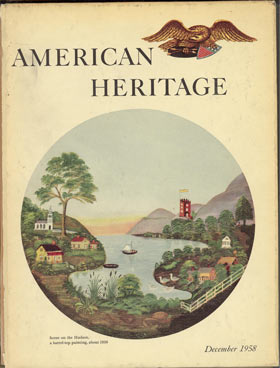
December 1958
Features
Discreet helpers have worked on the speeches and papers of many Presidents, but a nation in a time of trial will respond best “to the Great Man himself, standing alone”
Long after the Civil War was over, the Shenandoah’s die-hard skipper was still sinking Yankee ships
Scores of towns and counties all over the nation honor some heroics largely invented by Parson Weems
Snowshed crews on the Central Pacific, battling blizzards and snowslides, built “the longest house in the world”
No matter how busy he was, Theodore Roosevelt always found time for his children. The charming “picture” letters below, addressed to his thirteen-year-old son Archie from a Louisiana hunting camp, recall a man who for millions of Americans will always live on, forever vigorous, forever young.
A leading American historian challenges the long-entrenched interpretation originated by the late Charles A. Beard
Nathaniel was poor and sunk in his solitude; Sophia seemed a hopeless invalid, but a late-flower love gave them at last“a perfect Eden”
Over 350 years a mighty pageant of history has moved through the myth-haunted valley of the “Great River of the Mountains”
The most serious threat to white colonization of New England was the Indian uprising of 1675-76, known as King Philip’s War. What follows is the story of the tragic man who led that futile struggle, Philip, chief of the Wampanoags. But perhaps it is just as much the story of Philip’s erstwhile friend and resourceful pursuer, Benjamin Church. This account is taken from George Howe’s superb history of Bristol, Rhode Island, Mount Hope, due in February from the Viking Press.
Departments
READING, WRITING, AND HISTORY

American Heritage is proud to host the
National Portal to
Historic Collections
Recently added:
- American Revolution Center
- National Museum of Civil War Medicine
- National Museum of the U.S. Navy
- Manassas National Battlefield
- Maryland State House
In association with the
American Association for State and Local History
Why do we need a national nonprofit membership society for American history?
-
“Save America’s Treasures” has been totally eliminated—the largest Federal program supporting preservation of such treasures as the original Star Spangled Banner and George Washington’s tent.
-
65% of Americans don’t know what happened at the Constitutional Convention, according to a recent survey by Newsweek.
-
The “Teaching American History” grants—the largest Federal program supporting history education—have been completely eliminated.
-
Visits to the Top 20 Civil War battlefields have dropped in half from 1970 to 2009 according to official National Park Service statistics.
-
40% of Americans can’t identify whom we fought in World War II, according to a recent survey by Newsweek.
-
A quarter of Americans believe Congress shares power over U.S. foreign policy with the United Nations, according to a recent Annenberg survey.
-
“There is little that is more important for an American citizen to know than the history and traditions of his country,” John F. Kennedy wrote in American Heritage.
-
The “We the People Program,” which touched some 30 million students and 90,000 teachers over 25 years, has been completely eliminated.
-
Two-thirds of Americans could not correctly name Yorktown as the last major military action of the American Revolution, according to a recent national Gallup survey.
-
The National Heritage Areas and Scenic Byways program, the only major Federal program encouraging visits to historic places, has been completely eliminated in Congressional committee.