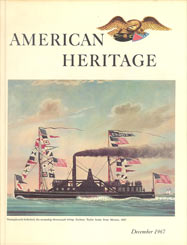
December 1967
Features
A soldier in the American army being unfortunately surprised at a game of cards by a sergeant who owed him an old grudge, was carried before the colonel of the regiment, that he might be punished for gaming, against which general orders were very severe.
It was the first time in history that British sovereigns had come to see what they lost in 1776. George and Franklin, Elizabeth and Eleanor, hit it off like old friends; even Texas congressmen melted under the royal charm. Brewing was a crucial World War II alliance
In the early days of the century, a fearless cowboy named Bill Pickett roused audiences on two continents by giving the fledgling sport of rodeo one of its most exciting events.
Forty years ago, American Marines tangled with a tough Latin-American guerrilla leader whose tactics against “the capitalists” would evoke an unhappy shock of recognition in Vietnam today.
We are not sure exactly what it is that married women tell their little sisters about marriage nowadays, but it is certainly not very much like the letter we publish here. It was written in a spidery hand from a home on the newly settled upper Mississippi to a young bride, Mrs. Oliver Ormerod, back in Liverpool, England, and the advice it gives says more than any long treatise about the apologetic, indeed timorous, position of women only a century and a half ago. Mrs. Ormerod was the greatgrandmother of our editor. She is shown in an old miniature about the time she married her Anglican minister, and before she reared a large family of sons.
Nineteenth-century American courage and resourcefulness carried our merchant flag to the world's harbors and our nation to world prominence. The proud affection of a sea-conscious nation is reflected in our portfolio of ships by artists of three continents. Our essay, by C. Bradford Mitchell, former editor of Steamboat Bill and information director of the Merchant Marine Institute, charts the curious historic twists of public attitude and official policy that have alternately fostered and stunted our merchant navy.
Had a tempest not thwarted his plans, George Washington might have lost the Revolution in the first major operation he commanded
Concerned lest history
overlook their triumphs, veterans of the Army of the Cumberland had them writ large -- on a canvas five hundred feet long.
of the Cumberland had them writ large—on a canvas
five hundred feet long
In Henry Bergh—a reformed dilettante who founded the A.S.P.C.A.—many saw a latter-day Saint Francis of Assisi. But others, especially the cruel or the thoughtless, regarded him as The Great Meddler.
Giacomo Beltrami’s discoveries were mostly illusory, but he had a glorious time making them, and the people of Minnesota have never forgotten his name.
Is it libel to say that the President of the United States tried to seduce his neighbor’s wife—even if he did? Thomas Jefferson tried to gag the venomous editor of upstate New York’s Wasp; Alexander Hamilton argued brilliantly in defense of journalistic candor.
Many a book, a magazine, a play, a movie, has been banned in Boston. But Christmas?

American Heritage is proud to host the
National Portal to
Historic Collections
Recently added:
- American Revolution Center
- National Museum of Civil War Medicine
- National Museum of the U.S. Navy
- Manassas National Battlefield
- Maryland State House
In association with the
American Association for State and Local History
Why do we need a national nonprofit membership society for American history?
-
“Save America’s Treasures” has been totally eliminated—the largest Federal program supporting preservation of such treasures as the original Star Spangled Banner and George Washington’s tent.
-
65% of Americans don’t know what happened at the Constitutional Convention, according to a recent survey by Newsweek.
-
The “Teaching American History” grants—the largest Federal program supporting history education—have been completely eliminated.
-
Visits to the Top 20 Civil War battlefields have dropped in half from 1970 to 2009 according to official National Park Service statistics.
-
40% of Americans can’t identify whom we fought in World War II, according to a recent survey by Newsweek.
-
A quarter of Americans believe Congress shares power over U.S. foreign policy with the United Nations, according to a recent Annenberg survey.
-
“There is little that is more important for an American citizen to know than the history and traditions of his country,” John F. Kennedy wrote in American Heritage.
-
The “We the People Program,” which touched some 30 million students and 90,000 teachers over 25 years, has been completely eliminated.
-
Two-thirds of Americans could not correctly name Yorktown as the last major military action of the American Revolution, according to a recent national Gallup survey.
-
The National Heritage Areas and Scenic Byways program, the only major Federal program encouraging visits to historic places, has been completely eliminated in Congressional committee.