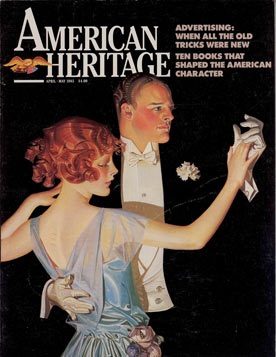
April/may 1985
Features
Magnificently impractical and obsolete almost as soon as they were built, the cable lines briefly dominated urban transportation throughout the country
It was a hundred years ago, and the game has changed a good deal since then. But there are plenty of people who still hold that cranky old Hoss Radbourn was the finest that ever lived.
One of the country’ more bizzarre labor disputes pitted a crowed of outraged newsboys against two powerful opponents—Joseph Pulitzer and William Randolf Hearst
After he was drafted in April 1941, Harvey Weber, a New York photographer, became a first lieutenant in charge of the 166th Signal Photo Company assigned to the Third Army. Landing at Utah Beach on June 14,1944, with the 79th Infantry Division, he ended up a year later with the V Corps in Czechoslovakia. “We roamed about freely within the boundaries of our division or corps,” Weber recalls, “and if you kept your nose clean, it was really possible to get around.” Now retired as director of photography at Newsday , Weber recently dug through his files to unearth this impressive personal record of the European war that ended forty years ago this May. Nearly all of these photographs, reproduced with Weber’s own captions, are published here for the first time.
Walden is here, of course; but so too is Fanny Farmer’s first cookbook
While a whole generation of artists sought inspiration in the wilderness, George Inness was painting the fields and farms of a man-made countryside
The twenties and thirties saw a host of new ways to separate customers from their money. The methods have not been forgotten.
Forty years ago, a tangle of chaotic events led to the death of Hitler, the surrender of the Nazis, and the end of World War II in Europe
Departments
CORRESPONDENCE
LETTER FROM THE EDITOR
MATTERS OF FACT
POSTSCRIPTS TO HISTORY
THE BUSINESS OF AMERICA
THE TIME MACHINE

American Heritage is proud to host the
National Portal to
Historic Collections
Recently added:
- American Revolution Center
- National Museum of Civil War Medicine
- National Museum of the U.S. Navy
- Manassas National Battlefield
- Maryland State House
In association with the
American Association for State and Local History
Why do we need a national nonprofit membership society for American history?
-
“Save America’s Treasures” has been totally eliminated—the largest Federal program supporting preservation of such treasures as the original Star Spangled Banner and George Washington’s tent.
-
65% of Americans don’t know what happened at the Constitutional Convention, according to a recent survey by Newsweek.
-
The “Teaching American History” grants—the largest Federal program supporting history education—have been completely eliminated.
-
Visits to the Top 20 Civil War battlefields have dropped in half from 1970 to 2009 according to official National Park Service statistics.
-
40% of Americans can’t identify whom we fought in World War II, according to a recent survey by Newsweek.
-
A quarter of Americans believe Congress shares power over U.S. foreign policy with the United Nations, according to a recent Annenberg survey.
-
“There is little that is more important for an American citizen to know than the history and traditions of his country,” John F. Kennedy wrote in American Heritage.
-
The “We the People Program,” which touched some 30 million students and 90,000 teachers over 25 years, has been completely eliminated.
-
Two-thirds of Americans could not correctly name Yorktown as the last major military action of the American Revolution, according to a recent national Gallup survey.
-
The National Heritage Areas and Scenic Byways program, the only major Federal program encouraging visits to historic places, has been completely eliminated in Congressional committee.