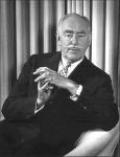
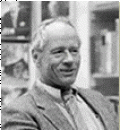
James Thomas Flexner
James Thomas Flexner (1908-2003) was most famous for his extensive writings on American art history and a four-volume biography of George Washington, for which he won a special Pulitzer citation. Flexner's other historical biographies include the one-volume Washington: The Indispensable Man, The Young Hamilton, Mohawk Baronet (Sir William Johnson, 1st Baronet), and The Traitor and the Spy: Benedict Arnold and John Andre. He wrote many books on the history of American art, including a highly-regarded life of the American painter John Singleton Copley, A Short History of American Painting, and The Light of Distant Skies: American Painting, 1760-1835. He co-authored William Henry Welch and the Heroic Age of American Medicine (1941) with his father, Simon Flexner, M.D.
Articles by this Contributor
February 1956
Fort Stanwix was doomed—until the Iroquois heard the ravings of Hon Yost Schuyler

August 1960
In the rural scenes and native landscapes of William Sidney Mount a naive young America saw itself reflected to the life
October 1962
In an age when art radiated nothing hut light and optimism, this self-taught painter from Pittsburgh saw another, more somber side of American life
December 1967
Had a tempest not thwarted his plans, George Washington might have lost the Revolution in the first major operation he commanded
October 1967
“Whom can we trust now?” cried out General Washington when he discovered his friend’s “villainous perfidy.”
December 1969
Mortally ill as his century dwindled to its close, Washington was helped to his grave by physicians who clung to typical eighteenth-century remedies. But he died as nobly as he had lived
February 1969
BEGINNING A SPECIAL SERIES ON WASHINGTON AFTER THE REVOLUTION
June 1969
Washington’s journey to his inauguration resembled a triumphal procession of royalty, but he felt like “a culprit who is going to the place of his execution”

American Heritage is proud to host the
National Portal to
Historic Collections
Recently added:
- American Revolution Center
- National Museum of Civil War Medicine
- National Museum of the U.S. Navy
- Manassas National Battlefield
- Maryland State House
In association with the
American Association for State and Local History
Civil War Chronicles
Breaking News & Real-time Coverage
From the Editors of American Heritage
-
March 12, 1862
JACKSONVILLE, FL—Union forces from the USS Ottawa, led by Lieutenant Thomas Stevens, land and seize Jacksonville unopposed.
-
March 9, 1862
HAMPTON ROADS, VA—The USS Monitor and CSS Virginia clash for nearly four hours in the first naval battle between ironclads. Neither ship could claim victory, but the battle revolutionized naval warfare.
-
March 8, 1862
BENTON COUNTY, AR—Union Brigadier General Samuel R. Curtis leads an outnumbered Union army to victory at the Battle of Pea Ridge. This victory ended the Confederate threat to Missouri and Federal soldiers secured northern Arkansas.
-
March 6, 1862
NEW YORK, NY—The USS Monitor leaves New York Harbor, accompanied by the USS Currituck and USS Sachem, headed for Hampton Roads, Virginia.
-
March 2, 1862
COLUMBUS, KY—Confederate General Leonidas Polk leaves Columbus, ending the Confederate defensive line of Kentucky. Polk initially violated Kentucky's neutrality by occupying Kentucky in September 1861.
-
February 24, 1862
NASHVILLE, TN—Following the Confederate defeat at Fort Donelson, Union forces under General Don Carlos Buell arrive in Nashville. Nashville was the first Confederate state capital to be captured, and would remain in Union hands for the remainder of the Civil War.
-
February 18, 1862
RICHMOND, VA—The Confederate Congress meets for the first time, where it hears about the surrender of Fort Henry and Fort Donelson.
-
February 12, 1862
FORT DONELSON, TN—General Ulyssess S. Grant moves his Union forces overland from Fort Henry on the Tennessee River to the outer defenses of Fort Donelson, on the Cumberland River. Flag Officer Andrew H. Foote would move his flotilla downstream to support Grant's advance.
-
February 6, 1862
FT HENRY, TN—A joint Union Army and Navy expedition captures Fort Henry along the Tennessee River, as Confederate General Lloyd Tilghman surrenders to Flag Officer Andrew H. Foote. The rising waters of the Tennessee condemned several of the defensive batteries, leaving it vulnerable to enemy fire.
-
February 5, 1862
LONDON, UNITED KINGDOM—Queen Victoria ends all export restrictions on munitions from Great Britain, opening up the market for both sides to import British gunpowder and firearms.