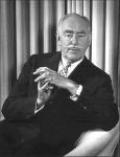
Wallace Stegner
Born in Iowa and raised in Saskatchewan, Wallace Stegner (1909-1993) was director of the creative writing program at Stanford University. He is the author of numerous books including the 1972 Pulitzer Prize for Fiction winner, Angle of Repose, The Spectacular Bird, a National Book Award winner, and Beyond the Hundreth Meridian: John Wesley Powell and the Second Opening of the West. Stegner passed away at age 84 in 1993, and Stanford has honored him with a two-year creative writing fellowship called the Stegner Fellowship.
Articles by this Contributor
June 1957
The old frontier began to die as the “medicine line” of the 49th Parallel was drawn
December 1969
Wise men like Thomas Jefferson have always known how to live with the earth instead of against it. We need to develop a land ethic, with wise stewardship and a respect for the earth.
February/March 1979
One hundred years ago, Congress created two agencies—the U.S. Geological Survey and the Bureau of Ethnology. Both, according to the author, have since “given direction, form, and stimulation to the science of earth and the science of man, and in so doing have touched millions of lives.”
February/march 1981
An exploration into the exploration of America
June/july 1981
Saltair, the stately pleasure dome that used to rise out of the waters of Great Salt Lake, was the Coney Island of the West.
August/september 1985
Much has changed in Utah since World War ll, but outside of the metropolitan center in the Salt Lake Valley, the addiction to rural simplicity and the idea of home is still strong.
December 1987
“Why hasn ‘t the stereotype faded away as real cowboys become less and less typical of Western life? Because we can Y or won Y do without it, obviously. ”
October 1955
How the Saskatchewan-Montana prairie country looked a generation ago, and what it meant to a youngster who lived there

American Heritage is proud to host the
National Portal to
Historic Collections
Recently added:
- American Revolution Center
- National Museum of Civil War Medicine
- National Museum of the U.S. Navy
- Manassas National Battlefield
- Maryland State House
In association with the
American Association for State and Local History
Why do we need a national nonprofit membership society for American history?
-
“Save America’s Treasures” has been totally eliminated—the largest Federal program supporting preservation of such treasures as the original Star Spangled Banner and George Washington’s tent.
-
65% of Americans don’t know what happened at the Constitutional Convention, according to a recent survey by Newsweek.
-
The “Teaching American History” grants—the largest Federal program supporting history education—have been completely eliminated.
-
Visits to the Top 20 Civil War battlefields have dropped in half from 1970 to 2009 according to official National Park Service statistics.
-
40% of Americans can’t identify whom we fought in World War II, according to a recent survey by Newsweek.
-
A quarter of Americans believe Congress shares power over U.S. foreign policy with the United Nations, according to a recent Annenberg survey.
-
“There is little that is more important for an American citizen to know than the history and traditions of his country,” John F. Kennedy wrote in American Heritage.
-
The “We the People Program,” which touched some 30 million students and 90,000 teachers over 25 years, has been completely eliminated.
-
Two-thirds of Americans could not correctly name Yorktown as the last major military action of the American Revolution, according to a recent national Gallup survey.
-
The National Heritage Areas and Scenic Byways program, the only major Federal program encouraging visits to historic places, has been completely eliminated in Congressional committee.