August/september 1985
Features
Two letters from a Navy lieutenant to his wife tell the story of the last hours of World War II
Artfully composed still-life photographs from a rare 1871 album transform brushes, sponges, and stationery supplies into symbols of a proud, industrial society
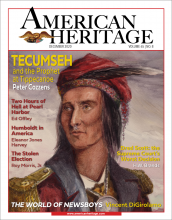
Four hundred years ago the first English settlers reached America. What followed was a string of disasters ending with the complete disappearance of a colony.
It might seem that building a mausoleum to the great general would be a serenely melancholy task. Not at all. The bitter squabbles that surrounded the memorial set city against country and became a mirror of the forces straining turn-of-the-century America.
Starting with thirty “liberated”
rifles, Augusto Sandino forced American troops out of Nicaragua in 1933
Much has changed in Utah since World War ll, but outside of the metropolitan center in the Salt Lake Valley, the addiction to rural simplicity and the idea of home is still strong.
The men and women who labored in the ghostly light of the great screen to make the music that accompanied silent movies were as much a part of the show as Lillian Gish or Douglas Fairbanks
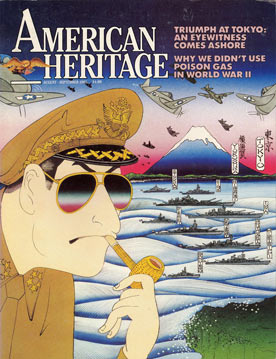
In a conflict that saw saturation bombing, Auschwitz, and the atom bomb, poison gas was never used in the field. What prevented it?
Departments
CORRESPONDENCE
LETTER FROM THE EDITOR
MATTERS OF FACT
THE BUSINESS OF AMERICA
THE TIME MACHINE

American Heritage is proud to host the
National Portal to
Historic Collections
Recently added:
- American Revolution Center
- National Museum of Civil War Medicine
- National Museum of the U.S. Navy
- Manassas National Battlefield
- Maryland State House
In association with the
American Association for State and Local History
Why do we need a national nonprofit membership society for American history?
-
“Save America’s Treasures” has been totally eliminated—the largest Federal program supporting preservation of such treasures as the original Star Spangled Banner and George Washington’s tent.
-
65% of Americans don’t know what happened at the Constitutional Convention, according to a recent survey by Newsweek.
-
The “Teaching American History” grants—the largest Federal program supporting history education—have been completely eliminated.
-
Visits to the Top 20 Civil War battlefields have dropped in half from 1970 to 2009 according to official National Park Service statistics.
-
40% of Americans can’t identify whom we fought in World War II, according to a recent survey by Newsweek.
-
A quarter of Americans believe Congress shares power over U.S. foreign policy with the United Nations, according to a recent Annenberg survey.
-
“There is little that is more important for an American citizen to know than the history and traditions of his country,” John F. Kennedy wrote in American Heritage.
-
The “We the People Program,” which touched some 30 million students and 90,000 teachers over 25 years, has been completely eliminated.
-
Two-thirds of Americans could not correctly name Yorktown as the last major military action of the American Revolution, according to a recent national Gallup survey.
-
The National Heritage Areas and Scenic Byways program, the only major Federal program encouraging visits to historic places, has been completely eliminated in Congressional committee.