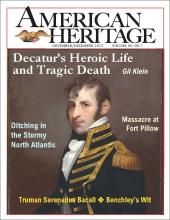
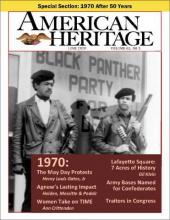
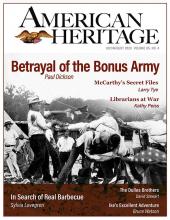
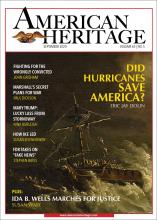
December 1983
Features
How Hadley, Massachusetts, (incorporated 1661) coped with wolves, drunks, Indians, witches, and the laws of God and man.
It was a great life being a contract writer for a major studio during the high noon of the American movie industry—but it could also be a nightmare. A survivor recalls the pleasures and ardors of working at 20th Century-Fox forty years ago.
Was the murdered President one of our best, a man of “vigor., rationality, and noble vision” or was he “an optical illusion,” “an expensively programmed waxwork”? A noted historian examines the mottled evolution of his reputation.
Harry Truman’s lifetime correspondence with his adored Bess opens a window on their time
Some of the best moments in hundreds of movies took place at Christmastime. And the author may have seen every one of them.
George Eastman didn’t think the posters the movie companies supplied were good enough for his theater. So he commissioned a local artist to paint better ones.
It was a suburb of orange blossoms and gardens, of gracious homes and quiet, dignified lives—until a regrettable class of people moved in.
A quarter-century of judicial history, as seen—and made—by our only retired Supreme Court justice, a man whose allegiance to the Constitution often forced him to act against his personal preferences.
The Normandie has been gone since World War II, but many people still remember her as the most beautiful passenger liner ever built. It is the saddest of ironies that she fled her native France to seek safety in New York Harbor.
With the Depression pushing the studio toward bankruptcy, Warner Brothers had to resort to crime—and crime paid so well that the company was able to recruit the toughest guys that ever shot up a sound stage.
With Epcot, Walt Disney turned his formidable skills to building a city where man and technology could live together in perfect harmony. The result is part prophecy, part world’s fair. Here, America’s leading authority on technological history examines this urban experiment in the light of past world’s fairs, and tells why it fails where they succeeded—and why that matters.
Departments
CORRESPONDENCE
LETTER FROM THE EDITOR
LETTERS TO THE EDITOR
MATTERS OF FACT
POSTSCRIPTS TO HISTORY
THE TIME MACHINE

American Heritage is proud to host the
National Portal to
Historic Collections
Recently added:
- American Revolution Center
- National Museum of Civil War Medicine
- National Museum of the U.S. Navy
- Manassas National Battlefield
- Maryland State House
In association with the
American Association for State and Local History
Why do we need a national nonprofit membership society for American history?
-
“Save America’s Treasures” has been totally eliminated—the largest Federal program supporting preservation of such treasures as the original Star Spangled Banner and George Washington’s tent.
-
65% of Americans don’t know what happened at the Constitutional Convention, according to a recent survey by Newsweek.
-
The “Teaching American History” grants—the largest Federal program supporting history education—have been completely eliminated.
-
Visits to the Top 20 Civil War battlefields have dropped in half from 1970 to 2009 according to official National Park Service statistics.
-
40% of Americans can’t identify whom we fought in World War II, according to a recent survey by Newsweek.
-
A quarter of Americans believe Congress shares power over U.S. foreign policy with the United Nations, according to a recent Annenberg survey.
-
“There is little that is more important for an American citizen to know than the history and traditions of his country,” John F. Kennedy wrote in American Heritage.
-
The “We the People Program,” which touched some 30 million students and 90,000 teachers over 25 years, has been completely eliminated.
-
Two-thirds of Americans could not correctly name Yorktown as the last major military action of the American Revolution, according to a recent national Gallup survey.
-
The National Heritage Areas and Scenic Byways program, the only major Federal program encouraging visits to historic places, has been completely eliminated in Congressional committee.