June 1963
Features
Who was the prosperous Negro in the long-lost painting? Scraps of evidence pieced together have revealed him to be
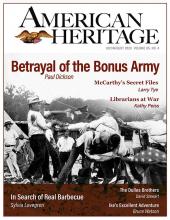
By frieght train, on foot, and in commandeered trucks, thousands of unemployed veterans descended on a nervous capital at the depth of the Depression—and were run out of town by Army bayonets
Sixty-five years before the bomb destroyed Hiroshima, a medicine man from Sf. Louis dreamed up a weapons system “so terrible and devastating” as to banish war forever. He would be, he modestly admitted, the savior of mankind
Could ironclads successfully attack land positions? No one knew. Into the very “nest of the rebellion,” sewn with mines and ringed by bristling forts, steamed the proud monitors of the Union fleet
An artist turned land agent used his paintings to promote paper townsites in Minnesota. Though most of these settlements failed to materialize, his charming record of an opening frontier remains
Of resorts and vacationers in the long ago, when the sports wore stiff collars and the dream girls five-piece bathing suits, and Americans became reacquainted with nature
The aged ex-President grew giddy and his family became alarmed as the mask-maker’s formula hardened around his venerable head
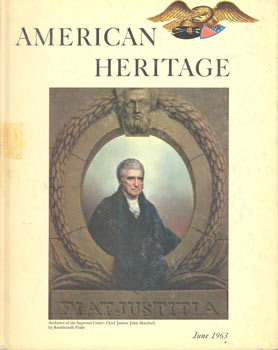
The Supreme Court has become the most powerful judicial body in the world. In a new series under the editorship of Professor John A. Garraty , AMERICAN HERITAGE examines the crucial, often bitterly fought cases that have helped define the Court s unique role as a shaper of the nation’s history
Long before Frémont, Jedediah Smith mapped huge regions between Salt Lake and California. He ranks beside Lewis and Clark in the annals of American exploration
Were the great business tycoons of the nineteenth century only that? A distinguished historian says no—most emphatically
The crusading conservationist thought he had saved the fur seal from extinction. Then from the Pribilofs, home of the last great herd, came an alarming telegram:
Departments
READING, WRITING, AND HISTORY

American Heritage is proud to host the
National Portal to
Historic Collections
Recently added:
- American Revolution Center
- National Museum of Civil War Medicine
- National Museum of the U.S. Navy
- Manassas National Battlefield
- Maryland State House
In association with the
American Association for State and Local History
Why do we need a national nonprofit membership society for American history?
-
“Save America’s Treasures” has been totally eliminated—the largest Federal program supporting preservation of such treasures as the original Star Spangled Banner and George Washington’s tent.
-
65% of Americans don’t know what happened at the Constitutional Convention, according to a recent survey by Newsweek.
-
The “Teaching American History” grants—the largest Federal program supporting history education—have been completely eliminated.
-
Visits to the Top 20 Civil War battlefields have dropped in half from 1970 to 2009 according to official National Park Service statistics.
-
40% of Americans can’t identify whom we fought in World War II, according to a recent survey by Newsweek.
-
A quarter of Americans believe Congress shares power over U.S. foreign policy with the United Nations, according to a recent Annenberg survey.
-
“There is little that is more important for an American citizen to know than the history and traditions of his country,” John F. Kennedy wrote in American Heritage.
-
The “We the People Program,” which touched some 30 million students and 90,000 teachers over 25 years, has been completely eliminated.
-
Two-thirds of Americans could not correctly name Yorktown as the last major military action of the American Revolution, according to a recent national Gallup survey.
-
The National Heritage Areas and Scenic Byways program, the only major Federal program encouraging visits to historic places, has been completely eliminated in Congressional committee.