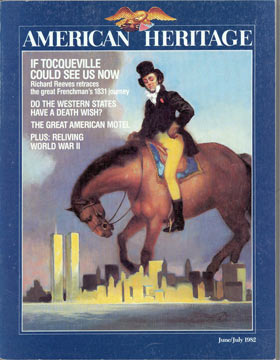
June/july 1982
Features
Victorian art, collected for patriotism and profit, finds a home in a New York hotel 19
Buried here, along with hundreds of congressmen and various Indian chiefs, are Mathew Brady, John Philip Sousa, and J. Edgar Hoover
Original documents tell the story of a Civil War steamboat captains sorrowful cruise with the most destructive cargo of all
Before there were Western states, there were public lands—over a billion acres irrevocably reserved for the people of the United States. The Sagebrush Rebels are the most recent in a series of covetous groups bent on “regaining” what was never theirs.
In a new book, the political journalist and columnist Richard Reeves retraces Alexis de Tocqueville’s remarkable 1831-32 journey through America. Reeves s conclusion: Tocqueville not only deserves his reputation as the greatest observer of our democracy—he is an incomparable guide to what is happening in our country now.
The victors divided the Germans into three groups: black (Nazi), white (innocent), and gray—that vast, vast area in between
Was it science, sport, or the prospect of a round-the-world railroad that sent the tycoon off on his costly Alaskan excursion?
How Juliette “Daisy” Low, an unwanted child, a miserable wife, a lonely widow, finally found happiness as the founder of the Girl Scouts of America
You’d never recognize it today. Perhaps this will refresh your memory.
… on its 200th anniversary. It took six years and seven tries—by such men as Franklin, Jefferson, and Adams—to come up with the official symbol of the United States. But what in the world does it mean?
A century after passage of the Fifteenth Amendment, many Southern blacks still were denied the vote. In 1965 Martin Luther King, Jr, set out to change that—by marching through the heart of Alabama.
A British schoolboy sees the quiet English countryside come alive with excitement toward the end of 1943 when …
Departments
AMERICAN CHARACTERS: F. O. MATTHIESSEN
CORRESPONDENCE
LETTER FROM THE EDITOR
NOW AND THEN
POSTSCRIPTS: MORE BATS
READERS’ ALBUM
TIME MACHINE

American Heritage is proud to host the
National Portal to
Historic Collections
Recently added:
- American Revolution Center
- National Museum of Civil War Medicine
- National Museum of the U.S. Navy
- Manassas National Battlefield
- Maryland State House
In association with the
American Association for State and Local History
Why do we need a national nonprofit membership society for American history?
-
“Save America’s Treasures” has been totally eliminated—the largest Federal program supporting preservation of such treasures as the original Star Spangled Banner and George Washington’s tent.
-
65% of Americans don’t know what happened at the Constitutional Convention, according to a recent survey by Newsweek.
-
The “Teaching American History” grants—the largest Federal program supporting history education—have been completely eliminated.
-
Visits to the Top 20 Civil War battlefields have dropped in half from 1970 to 2009 according to official National Park Service statistics.
-
40% of Americans can’t identify whom we fought in World War II, according to a recent survey by Newsweek.
-
A quarter of Americans believe Congress shares power over U.S. foreign policy with the United Nations, according to a recent Annenberg survey.
-
“There is little that is more important for an American citizen to know than the history and traditions of his country,” John F. Kennedy wrote in American Heritage.
-
The “We the People Program,” which touched some 30 million students and 90,000 teachers over 25 years, has been completely eliminated.
-
Two-thirds of Americans could not correctly name Yorktown as the last major military action of the American Revolution, according to a recent national Gallup survey.
-
The National Heritage Areas and Scenic Byways program, the only major Federal program encouraging visits to historic places, has been completely eliminated in Congressional committee.