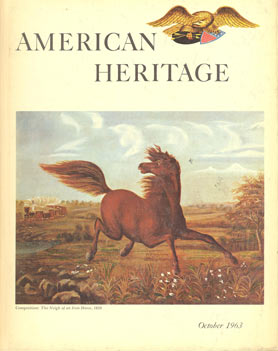
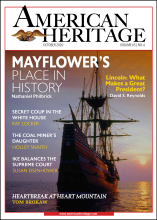
October 1963
Features
Jefferson and Madison led a revolutionary fight for complete separation of church and state. Their reasons probed the basic relation between religion and democracy
For a century Hawaii’s westernmost island has stubbornly resisted the tides of change
You entered it only rarely, and you weren’t meant to be comfortable there. But every house had to have one, no matter how high the cost
When Boston’s police walked out, a great city erupted in violence. By doggedly doing nothing, Governor Coolidge emerged as a national hero
Half a century before Jamestown, a Huguenot sea captain planted the flag of France on America’s South Atlantic coast. His hopes were as high as the odds against him
The song tells of John Henry, steel-drivin’ man, who fought a steam drill and won. Did he? Or was he just a myth?
So bellowed Ethan Allen as he took Fort Ticonderoga without a shot. Once again the brawling giant of the Green Mountains had lived up to a myth that was indeed mighty—but no greater, perhaps, than the actual man
The (mostly) true legend of a Wisconsin outfit’s mascot who dodged shells, whined about the chow, and became an honored veteran, living a life of ease at state expense
Departments
READING, WRITING, AND HISTORY

American Heritage is proud to host the
National Portal to
Historic Collections
Recently added:
- American Revolution Center
- National Museum of Civil War Medicine
- National Museum of the U.S. Navy
- Manassas National Battlefield
- Maryland State House
In association with the
American Association for State and Local History
Civil War Chronicles
Breaking News & Real-time Coverage
From the Editors of American Heritage
-
March 12, 1862
JACKSONVILLE, FL—Union forces from the USS Ottawa, led by Lieutenant Thomas Stevens, land and seize Jacksonville unopposed.
-
March 9, 1862
HAMPTON ROADS, VA—The USS Monitor and CSS Virginia clash for nearly four hours in the first naval battle between ironclads. Neither ship could claim victory, but the battle revolutionized naval warfare.
-
March 8, 1862
BENTON COUNTY, AR—Union Brigadier General Samuel R. Curtis leads an outnumbered Union army to victory at the Battle of Pea Ridge. This victory ended the Confederate threat to Missouri and Federal soldiers secured northern Arkansas.
-
March 6, 1862
NEW YORK, NY—The USS Monitor leaves New York Harbor, accompanied by the USS Currituck and USS Sachem, headed for Hampton Roads, Virginia.
-
March 2, 1862
COLUMBUS, KY—Confederate General Leonidas Polk leaves Columbus, ending the Confederate defensive line of Kentucky. Polk initially violated Kentucky's neutrality by occupying Kentucky in September 1861.
-
February 24, 1862
NASHVILLE, TN—Following the Confederate defeat at Fort Donelson, Union forces under General Don Carlos Buell arrive in Nashville. Nashville was the first Confederate state capital to be captured, and would remain in Union hands for the remainder of the Civil War.
-
February 18, 1862
RICHMOND, VA—The Confederate Congress meets for the first time, where it hears about the surrender of Fort Henry and Fort Donelson.
-
February 12, 1862
FORT DONELSON, TN—General Ulyssess S. Grant moves his Union forces overland from Fort Henry on the Tennessee River to the outer defenses of Fort Donelson, on the Cumberland River. Flag Officer Andrew H. Foote would move his flotilla downstream to support Grant's advance.
-
February 6, 1862
FT HENRY, TN—A joint Union Army and Navy expedition captures Fort Henry along the Tennessee River, as Confederate General Lloyd Tilghman surrenders to Flag Officer Andrew H. Foote. The rising waters of the Tennessee condemned several of the defensive batteries, leaving it vulnerable to enemy fire.
-
February 5, 1862
LONDON, UNITED KINGDOM—Queen Victoria ends all export restrictions on munitions from Great Britain, opening up the market for both sides to import British gunpowder and firearms.