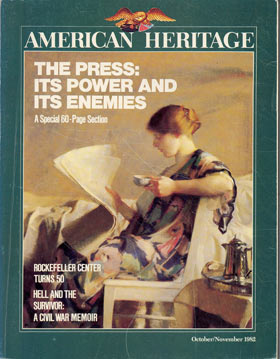
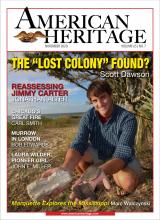
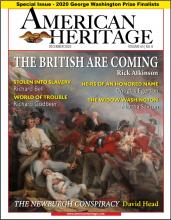
October/november 1982
Features
Americans don’t hesitate to say anything they please about a public performance. But the right to do so wasn’t established until the Cherry Sisters sued a critic who didn’t like their appalling vaudeville act.
If the facts were dull, the story didn’t get printed. So reporters made up the facts. It’s only recently that newspapers have even tried to tell the truth .
What do you do if there’s no photographer around when Valentino meets Caruso in Heaven?
The Supreme Court says the First Amendment gives newspapers the right to denounce the government, advocate revolution, attack public figures, and even be wrong. This may not be nice—but those who understand the strengths of a republic wouldn’t have it any other way.
A Union soldier had a better statistical chance of living through the Battle of Gettysburg than of surviving the prisoner-of-war camp called Andersonville. But Charles Hopkins did it and left this never-before-published record.
… you could battle for clean government, champion virtue, improve the public school, defend the consumer, arbitrate taste, and write lean, telling prose. Or at least that was the author’s dream. Here’s the reality.
The author recalls two generations of “Cliffie” life—hers and her mother’s—in the years when male and female education took place on opposite sides of the Cambridge Common and women were expected to wear hats in Harvard Square
J ohn Wenrich’s original drawings of Rockefeller Center helped attract tenants in the middle of the Depression. Fifty years later they survive as talismans of a golden moment in American architecture .
It exposed corruption. It hired drunks. Good writing was rewarded. No wonder every newspaperman wanted to work there.
Fifty years after FDR first took office, a British statesman and historian evaluates the President’s role in the twentieth century’s most important partnership
… is today’s newspaper. Here the executive editor of the Washington ‘Post’ takes us on a spirited dash through the minefields that await reporters and editors who gather and disseminate a most valuable commodity.
Departments
CORRESPONDENCE
LETTER FROM THE EDITOR
LETTERS TO THE EDITOR
POSTSCRIPTS
READERS’ ALBUM
TIME MACHINE

American Heritage is proud to host the
National Portal to
Historic Collections
Recently added:
- American Revolution Center
- National Museum of Civil War Medicine
- National Museum of the U.S. Navy
- Manassas National Battlefield
- Maryland State House
In association with the
American Association for State and Local History
Why do we need a national nonprofit membership society for American history?
-
“Save America’s Treasures” has been totally eliminated—the largest Federal program supporting preservation of such treasures as the original Star Spangled Banner and George Washington’s tent.
-
65% of Americans don’t know what happened at the Constitutional Convention, according to a recent survey by Newsweek.
-
The “Teaching American History” grants—the largest Federal program supporting history education—have been completely eliminated.
-
Visits to the Top 20 Civil War battlefields have dropped in half from 1970 to 2009 according to official National Park Service statistics.
-
40% of Americans can’t identify whom we fought in World War II, according to a recent survey by Newsweek.
-
A quarter of Americans believe Congress shares power over U.S. foreign policy with the United Nations, according to a recent Annenberg survey.
-
“There is little that is more important for an American citizen to know than the history and traditions of his country,” John F. Kennedy wrote in American Heritage.
-
The “We the People Program,” which touched some 30 million students and 90,000 teachers over 25 years, has been completely eliminated.
-
Two-thirds of Americans could not correctly name Yorktown as the last major military action of the American Revolution, according to a recent national Gallup survey.
-
The National Heritage Areas and Scenic Byways program, the only major Federal program encouraging visits to historic places, has been completely eliminated in Congressional committee.