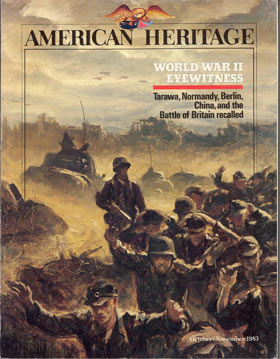
October/november 1983
Features
The great man’s daughter-in-law draws a portrait of the statesman at the top of his career and at the bottom
For almost four decades, Marshall Davidson, who pioneered a new genre of illustrated history, has worked with many thousands of pieces of American art. Out of them all he now selects fourteen images that have particularly enchanted him .
The ceaseless clatter of cheap pianos from a mid-Manhattan side street was once music to all America
Years after one of the bloodiest and most intense battles of the war in the Pacific, a Marine Corps veteran returns to Tarawa
It was built by Roebling, connects two cities, is a landmark of American engineering, and looks just like it but is…
Along this narrow stretch of sand, all the painstaking plans for the Normandy invasion fell apart. One of the men who was lucky enough to make it past the beachhead recalls a day of fear, chaos, grief—and triumph.
A thousand miles behind enemy lines, Liberator bombers struck Hitler’s Rumanian oil refineries, then headed home flying so low that some came back with cornstalks in their bomb bays
Whatever you were taught or thought you knew about the post-Civil War era is probably wrong in the light of recent study
On November 18, 1883, the nation finally settled on the method of synchronizing all clocks that we call standard time. Why did it take so long to figure that one out?
Over any extended period of time, the state of historical thinking about the great national topics changes in both subtle and dramatic ways. New facts and interpretations are being debated, written about, and taught. To keep you informed, AMERICAN HERITAGE introduces the first of a series.
After two false starts, the B-17s got through. A pilot relives the 8th Air Force’s first successful daylight raid on the German capital .
Departments
CORRESPONDENCE
LETTER FROM THE EDITOR:
NOW AND THEN
READERS’ ALBUM:
THE TIME MACHINE

American Heritage is proud to host the
National Portal to
Historic Collections
Recently added:
- American Revolution Center
- National Museum of Civil War Medicine
- National Museum of the U.S. Navy
- Manassas National Battlefield
- Maryland State House
In association with the
American Association for State and Local History
Why do we need a national nonprofit membership society for American history?
-
“Save America’s Treasures” has been totally eliminated—the largest Federal program supporting preservation of such treasures as the original Star Spangled Banner and George Washington’s tent.
-
65% of Americans don’t know what happened at the Constitutional Convention, according to a recent survey by Newsweek.
-
The “Teaching American History” grants—the largest Federal program supporting history education—have been completely eliminated.
-
Visits to the Top 20 Civil War battlefields have dropped in half from 1970 to 2009 according to official National Park Service statistics.
-
40% of Americans can’t identify whom we fought in World War II, according to a recent survey by Newsweek.
-
A quarter of Americans believe Congress shares power over U.S. foreign policy with the United Nations, according to a recent Annenberg survey.
-
“There is little that is more important for an American citizen to know than the history and traditions of his country,” John F. Kennedy wrote in American Heritage.
-
The “We the People Program,” which touched some 30 million students and 90,000 teachers over 25 years, has been completely eliminated.
-
Two-thirds of Americans could not correctly name Yorktown as the last major military action of the American Revolution, according to a recent national Gallup survey.
-
The National Heritage Areas and Scenic Byways program, the only major Federal program encouraging visits to historic places, has been completely eliminated in Congressional committee.