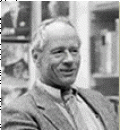
William Manchester
William Manchester lives in Middletown, Connecticut. His works have ranged from studies of John F. Kennedy and Douglas MacArthur to a history of the United States from the Great Depression to Watergate. The first volume of his Churchill life, The Last Lion: Winston Spencer Churchill; Visions of Glory: 1874–1932 , was published in 1984 by Little, Brown and Company. This article will be incorporated into his second volume, to appear this fall.
Articles by this Contributor
February/March 1987
An outstanding American historian follows Winston Churchill through a typical day during his political exile in the 1930s and uses that single twenty-four-hour period to reveal the character of the century’s greatest Englishman in all its complexity. See Churchill lay bricks, paint a landscape, tease his dinner guests, badger his secretaries, dictate a history, make up a speech, write an article (that’s how he earns his living), refuse his breakfast because the jam has been left off the tray, refight the Battle of Bull Run, feed his fish, drink his brandy, fashion a “bellyband” to retrieve a particularly decrepit cigar, recite all of “Horatius at the Bridge,” take two baths—and await with noisy fortitude the day when he will save the world.

American Heritage is proud to host the
National Portal to
Historic Collections
Recently added:
- American Revolution Center
- National Museum of Civil War Medicine
- National Museum of the U.S. Navy
- Manassas National Battlefield
- Maryland State House
In association with the
American Association for State and Local History
Why do we need a national nonprofit membership society for American history?
-
“Save America’s Treasures” has been totally eliminated—the largest Federal program supporting preservation of such treasures as the original Star Spangled Banner and George Washington’s tent.
-
65% of Americans don’t know what happened at the Constitutional Convention, according to a recent survey by Newsweek.
-
The “Teaching American History” grants—the largest Federal program supporting history education—have been completely eliminated.
-
Visits to the Top 20 Civil War battlefields have dropped in half from 1970 to 2009 according to official National Park Service statistics.
-
40% of Americans can’t identify whom we fought in World War II, according to a recent survey by Newsweek.
-
A quarter of Americans believe Congress shares power over U.S. foreign policy with the United Nations, according to a recent Annenberg survey.
-
“There is little that is more important for an American citizen to know than the history and traditions of his country,” John F. Kennedy wrote in American Heritage.
-
The “We the People Program,” which touched some 30 million students and 90,000 teachers over 25 years, has been completely eliminated.
-
Two-thirds of Americans could not correctly name Yorktown as the last major military action of the American Revolution, according to a recent national Gallup survey.
-
The National Heritage Areas and Scenic Byways program, the only major Federal program encouraging visits to historic places, has been completely eliminated in Congressional committee.