
In a hard war, theirs may have been the hardest job of all. Along with Army doctors and nurses, they worked something very close to a miracle in the European theater.
-
November 1997
15 years ago By admin Volume48Issue7
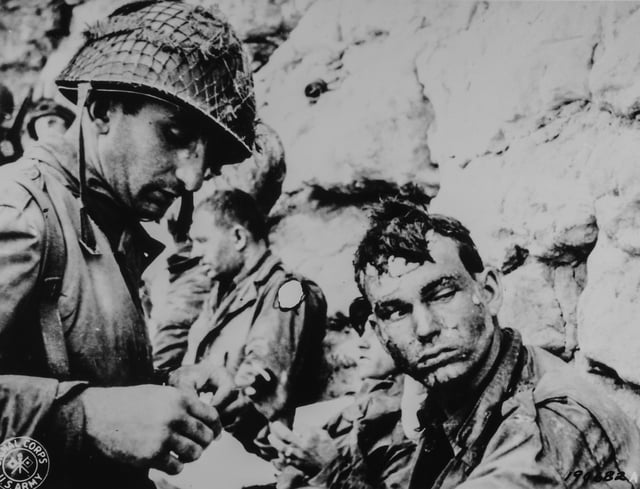
It wasn’t any different getting killed in World War II than in the Civil War, but if the shrapnel, bullet, or tree limb wounded a GI without killing him, his experience as a casualty was infinitely better. The medical team, from the medics in the field to the nurses and doctors in the tent-city hospitals, compiled a remarkable record. More than 8 percent of the soldiers who underwent emergency operations in a mobile field or evacuation hospital survived. Fewer than 4 percent of all patients admitted to a field hospital died. In the Civil War it had been more like 50 percent.
Wonder drugs and advanced surgical techniques made the improvements possible, but it was people who had to get the wounded into a hospital before it was too late for the nurses and the drugs and surgeons to do their work. Those people were the medics.
In an infantry battalion of twelve platoons, or about five hundred men, there were 30-40 medics. After time on the line, whether a week or a month, most units were down to one medic per platoon. The medics varied as much in motivation as in size and shape, but they shared a refusal to kill coupled with a desire to serve.
Private Ralph (“Preacher”) Davis of the Rangers, a hero in some of the hardest fighting on D-day, asked four months later to be transferred to the Medical Corps for religious reasons. He was accepted immediately because volunteers for the medics were hard to find. On a night patrol Preacher got hit in the back by a sniper and was paralyzed below the waist. (After the war he achieved his ambition of becoming an ordained minister, before he died of complications from the wound.)
The experience of combat brought forth from Preacher a strong moral reaction. Others had strong responses, too, but sometimes in the opposite direction. Preacher couldn’t bring himself to kill anymore; some men who started out as medics because of religious conviction changed on encountering the reality of war: They requested transfers to line companies, meaning they wanted to pick up rifles and shoot back.
The medics had gone through the same training as any infantryman, except for weapons. In training camp they had been segregated into their own barracks and kept away from the men they were learning to save, apparently for fear of contaminating the real soldiers. The rifle-carrying enlisted men and the medics developed little mutual camaraderie. One lieutenant confessed that he and his platoon “mildly despised” the men of the Medical Corps for being conscientious objectors. Their mere presence cast a moral shadow over what the infantrymen were training to do. The nascent medics were ridiculed, called such names as Pill Pusher, and the tourniquets and bandages they put on imagined wounds in field exercises were joked about. So was their only real work, treating blisters and the like.
But, once in combat, they were loved. “Overseas,” the medic Buddy Gianelloni recalled, “it became different. They called you Medic, and before you know it, it was Doc. I was 19 at the time.”
On countless occasions when I have asked a veteran during an interview if he remembered any medics, the old man would say something like “Bravest man I ever saw. Let me tell you about him.. . .” Here’s a typical account: Private Mike DeBello got hit by a machine-gun bullet that ripped through the upper muscle of his right arm. “Doc Mellon was the bravest kid I ever saw. He came running right through the machine-gun fire and put a tourniquet on my arm.” Mellon got smashed by the concussion from an 88. His shoulder was out of its socket. He should have gone back to the aid station, but as he later explained, he felt “there were just too many wounded guys to work on, so I took some codeine and morphine. I couldn’t raise my arm beyond the waist, so here I was trying to work on these wounded guys with one hand.”
To preserve their non-combatant status under the Geneva Convention, the War Department did not give any medics combat pay (ten dollars extra a month) or the right to wear the combat Infantryman Badge. This was bitterly resented. In some divisions riflemen collected money from their own pay to give their medics the combat bonus. As for their right to wear the badge, five enlisted medics in the European Theater of Operations (ETO) were awarded the Medal of Honor, and hundreds won Silver or Bronze Stars.
Medic Ed Grazcyck of the 4th Division earned a Bronze Star. When his company underwent a shelling in the Hürtgen Forest, one of the sergeants was killed by shrapnel in the neck, and Grazcyck took a large fragment in the back of his head. He was unconscious and looked gone. Beside him a third man was screaming for a medic. Lieutenant George Wilson ran to the wounded man and found him “frantically gripping what was left of one arm with his remaining hand. The arm was gone, almost to the shoulder.”
As Wilson stared helplessly, Medic Grazcyck came to. He told Wilson to get a tourniquet on the man, handed him some morphine, explained how to use it, then gave instructions as Wilson sprinkled sulfa powder on the raw stump and bandaged the wound. As Wilson completed the job, both the wounded man and Grazcyck passed out. Wilson got a jeep to carry them back to the aid station. Both survived.
Medics served in the line companies. They were in the foxholes in static situations, but when the Americans went on the offensive, medics sometimes had to stay behind with the wounded, feeling lonely and abandoned. On other occasions, when an attack failed and the men fell back, medics had to go between the lines to deliver aid and start the wounded men on their way to the field hospital.
Private Byron Whitmarsh of the 99th Division described what it was like for the medics during a barrage. “There are worse things than being a rifleman in the infantry, not many, but being a medic is one of them. When the shelling and shooting gets heavy it is never long until there is a call for ‘Medic!’ That’s when your regular GIs can press themselves to the bottom of their hole and don’t need to go out on a mission of mercy.”
Once the medic reached the wounded man, he did the briefest examination, put on a tourniquet if necessary, injected a vial of morphine, cleaned up the wound as best he could, sprinkled sulfa, slapped on a bandage, and dragged or carried the patient toward the rear. Private Robert Phillips, a medic with the 28th Division, came to dread the sound of incoming shells and the invariable “Medic!” cry that forced him to leave his hole. As he worked, shell fragments whittled down the trees and casualties increased. He remembered for the rest of his life the job of examining a wounded man at night, cutting away clothes in the darkness, feeling for the wound: “It’s like putting your hand in a bucket of wet liver.”
Private Benedict Battista, a medic with the 90th Division, went the whole way from Utah Beach to Central Europe, “trying to save lives.” After the war he reflected: “I don’t regret what I did but if I had to do it all over again I wouldn’t want to be a medic. I have seen too much blood. I would want to be in a maintenance outfit.”
If the medic didn’t do the job right and fast, he lost the patient. And sometimes he had to deliver his first aid while under aimed enemy fire, because occasionally Germans would fire on a medic at work between the lines. Private Phillips was wounded while tending to a wounded man. On Christmas Day, Private Louis Potts of the 26th Division was fired on while attending a wounded soldier. He stayed in the snow-covered field and went to work on another casualty. This time the German sniper got him in the forehead.
I’ve heard dozens of similar stories, from German and American veterans—usually, however, from men who heard about such a thing as opposed to seeing it themselves. Albert Cowdrey of the U.S. Army’s Center of Military History insists such incidents were uncommon: “The Germans by and large were following the Geneva Convention.” Although men wearing their Red Cross armbands did get shot, sometimes it was because the red crosses had not been seen. The response of the medics is conclusive: It was to make themselves more visible, not less. They began to wear two armbands and paint a red cross in a white square on their helmets. They were confident that most Germans or GIs would respect the symbol if only it could be seen. (Cowdrey contrasts this with the Pacific war, where medics were special targets of the Japanese and responded by taking off the armbands and even dyeing their bandages jungle green.)
Lieutenant Wenzel Andreas Borgert, who commanded a German antitank unit in Normandy, described an American attack in which ten of his fifteen men were wounded. He radioed for an ambulance. “And this much I acknowledge,” Borgert said in an interview, “that at the very second that the big Red Cross flag came over the hill behind me, the Americans stopped firing immediately. I can honestly say that made a big impression on me, because there was no such thing as the Red Cross on the Russian front.”
Both sides tended to their wounded. Borgert noticed an American officer and crossed no man’s land to talk. The American opened the conversation in German.
“Where did you learn such good German?” Borgert asked.
“My family is German,” the American said. Then he asked Borgert if he didn’t want to surrender, as “Germany has lost the war in any case.” No, Borgert replied; he would continue to fight. But he let the American know that as soon as dark came, he intended to pull back from his present position.
“Then I won’t attack you till dark,” the American replied, and it was done.
In the bloody chaos of Falaise, Lt. Hans-Heinrich Dibbern, of Panzer Grenadier Regiment 902, set up a roadblock outside Argentan. “From the direction of the American line came an ambulance driving toward us,” he remembered. “The driver was obviously lost. When he noticed that he was behind German lines, he slammed on the brakes.” Dibbern went to the ambulance. “The driver’s face was completely white. He had wounded men he was responsible for. But we told him, ‘Back out of here and get going. We don’t attack the Red Cross.’ He quickly disappeared.”
An hour or so later, “here comes another Red Cross truck. It pulls up right in front of us. The driver got out, opened the back, and took out a crate. He set it down on the street and drove away. We feared a bomb, but nothing happened and we were curious. We opened the box and it was filled with Chesterfield cigarettes.”
On the other hand, Americans sometimes shot medics. Major John Cochran of the 90th Division remembered a forward observer who would call for a barrage when he knew the Germans were eating; he had a sixth sense about it, according to Cochran. After calling for a cease-fire, he would say, “Get ready to do it again.” He explained to Cochran that in five or ten minutes “their medics will come out to treat the casualties and we’ll get them too.”
Sergeant Robert Bowen of the 101st recalled that on December 23, in the Bulge, two men from his platoon were wounded. “They lay in the snow, one babbling incoherently and the other screaming.” Bowen tried to get to them, but German fire drove him off. Medic Evertt Padget said he would try, explaining that the Germans would honor his Red Cross patch. “He went out there. It was one of the bravest acts I had ever witnessed. Enemy bullets were plowing up the snow around him until he reached the wounded men. Then the German fire slackened, and he tended the two men. Although both were beyond rescue, at least Padget gave them some morphine. Then he returned to the American line and the firing resumed.” Bowen confessed, “I thought of the wounded Germans who had lain in the road the day before and our guys had tried to kill whomever went out to help them.”
Too often, when the medic arrived, the man was dead. In that case it was the medic’s responsibility to oversee the retrieving and hauling of the body back to the graves-registration crew. Bill Mauldin described one such group. Its personnel, he said, “could have played the gravediggers in Hamlet .” They were usually drunk, perhaps a necessary condition for their work.
They became callous. Private Kurt Gabel of the 17th Airborne described the day he had participated in the gruesome job of finding and piling up the dead from his outfit following a failed attack in a snow-covered field. The bodies were frozen. After a morning’s work Gabel and his comrades had a large stack. A graves-registration crew drove up in a deuce-and-a-half truck. Two guys got into the back of the truck, and two others went to the pile. The two on the ground grabbed a body by shoulders and legs and swung it three times to gain momentum, chanting, “One . . . two . . . three . . . heave . ” The body flew through the air and landed with a thump. The men on the truck dragged the corpse to the far end and got ready for the next. They did it again.
Gabel and a few of his buddies stepped forward looking like the combat infantrymen they were. One of them touched his rifle lightly, and said in a matter-of-fact voice, “You do that once more and I’ll blow your goddamn heads off.”
For a moment, no one moved. Then the men on the truck slowly climbed down, and the four-man crew gently lifted the next body.
The men killed in action were buried as soon as possible in small temporary cemeteries, later dug up and taken to a division or Army cemetery in the rear. This too was temporary. After the war ended, the family had the right to have the body brought home. Many parents or widows decided, however, to leave their loved ones where they fell. Those bodies went into one of the beautifully landscaped military cemeteries maintained by the American Battle Monuments Commissions. The largest are in Normandy and Luxembourg.
Robert Bradley of the 30th Infantry Division had been a medical student before the war. A religious man, he preferred to save rather than to kill. He went into Omaha Beach on June 10 and slept that night along a hedgerow. Starting at dawn, through to the end of the war, he set about saving lives.
His instruments were crude. He tied scissors to one of his wrists with a shoestring in order to have them handy to cut away bloody clothing. He carried extra compresses in his gas-mask container. His raincoat had many patches cut out of the tail because he had learned to slap a piece of raincoat on a sucking chest wound, then cover it with a compress.
In Normandy, Bradley learned how to get to his patients in a hurry. In basic training he had detested learning to turn somersaults, but he found that the best way to go over a hedgerow was in a dive, headfirst. Then he would dash to the wounded man in the open field, a man who had been abandoned and was utterly dependent on the medic. Bradley remembered “the unspeakable light of hope in the eyes of the wounded as we popped over a hedgerow.”
Sergeant Frank South, a medic in the Rangers, noticed something that also struck other medics: “During training it was not uncommon to hear one say, ‘If I lose a leg (arm or whatever) please shoot me. I don’t want to go home a cripple.’ Never, in combat, did I, or anyone I know, hear this, no matter how bad the wound.”
“The medic could do more with less to do it with than anyone,” said Ken Russell of the 82d Airborne. He seldom had much, and often not enough. Morphine was most important, because it would relax the wounded man and help keep him from going into shock. In the Bulge, to keep the drug from freezing, the medics kept it next to their bodies. One man carried his in his underwear top, others under their arms.
Carrying so much morphine around a battlefield proved to be a temptation at least one medic could not resist. During a shelling Medic Gianelloni heard the cry “Medic!” “I said, oh shit, got up and went in the direction of the call for help.” It took him into the next platoon’s area. He asked who was hurt. “Doc, look over there,” said one of the GIs. There was a platoon medic, walking like a zombie among the shell bursts. Gianelloni tackled him and discovered he had given himself morphine when the shelling began. It turned out he had become an addict.
Once the wounded man was behind the main line of foxholes, four litter bearers from the forward aid station a few hundred yards to the rear, summoned by radio or telephone, would come forward to evacuate him. That usually took about fifteen minutes. They would haul the soldier back to wherever they had parked their jeep, load him into one of the four slots on the jeep, and drive as rapidly as possible to the battalion aid station, a kilometer or so to the rear.
In early August, Lieutenant Stockell of the 2d Infantry Division was hit badly in the leg—twenty deep shrapnel wounds. A medic got to him, did some patch work, and helped him to the rear. There a jeep awaited. “I am laid across the hood,” Stockell wrote in his diary, “like a slaughtered deer.”
At the aid station, “It is a blur. I did wake up in a field hospital to find my two doctors taking my combat boots off and stealing my Luger pistol. I protest but then the fog closes in again.”
In that field hospital, doctors gave Stockell more morphine and plasma and an anti-tetanus shot. They removed his bandages and cleaned up the wounds, put on fresh bandages, made a tentative diagnosis of his case, and labeled him for evacuation. An ambulance took him to Omaha Beach—he remained unconscious—where he was transferred by landing craft to an LST, then taken to Portsmouth and by rail to the hospital.
“I next woke up in England.” It took twenty hours from the time he was wounded until he was in a modern hospital across the Channel. There he recovered, as did more than 99 percent of the men evacuated from Normandy to England.
The remarkable rate of recovery for wounded GIs was based on massproduction assembly-line practices. How well it worked, from the medic to the aid station to the field hospital to England, can be judged by the reaction of the men of the front line, who were almost certain to get caught up in the process, with their lives depending on it. As one lieutenant put it, “We were convinced the Army had a regulation against dying in an aid station.”
Most patients came back to consciousness, groggy from the morphine, in the field or evacuation hospital. The first thing many of them saw was a nurse from the Army Nurse Corps (ANC). She was harassed, wearing fatigues, exhausted, and busy. But she was an American girl, and she had a marvelous smile, a reassuring attitude, and gentle hands. To the wounded soldier she looked heaven-sent.
The first nurses to enter the Continent came in on June 10 at Omaha. Members of the 42d and 45th Field Hospitals and the 91st and 128th Evacuation Hospitals, they were the vanguard of the 17,345 ANC who served in the ETO in 1944-45. That was seventeen times as many ANC personnel as existed in the entire Army in 1942. By 1945 total ANC strength stood at nearly 60,000.
These pioneers had to overcome many obstacles. The first was the act of volunteering, for there was a nationwide slander campaign about women in uniform. The jokes were gross. They were told by rear-echelon soldiers and civilians. No one who had ever seen an Army nurse in action in a field hospital, or any wounded soldier, ever told those jokes. Nevertheless they slowed recruitment down to a trickle. A questionnaire showed that of those nurses who did volunteer, 41 percent had to overcome the opposition of close relatives. Only half said their closest male friends were supportive, whereas 80 percent of their closest female friends supported their decisions.
To speed up recruitment, the Army made the Army Nurse Corps more attractive. From June 1944 onward, nurses got officers’ commissions, full retirement privileges, dependents’ allowances, and equal pay. The government also paid for the education of nursing students.
In his January 1945 State of the Union Address, President Roosevelt referred to the critical shortage of nurses in Western Europe and proposed that the nurses be drafted. A bill to do so passed the House and came within one vote of enactment in the Senate.
The continuing shortage meant that those nurses who did serve at field or evacuation hospitals were badly overworked. The experiences of the 77th Evacuation Hospital were typical. By mid-1944, the 77th was a veteran outfit. It had been in England in the summer of 1942, then to Oran in November, on to Constantine in January 1943, Tebessa in February, La Meskiana in March, Tebessa again, Bône in April, Palermo in September, to Licata in October, and in November back to England to get ready for D-day. Clearly the battalion-sized team knew how to pick up and move in a hurry.
On July 7, 1944, the 77th entered Normandy at Utah Beach. It set up at Ste.-Mère-Église. It was open within a day. During the first 12 hours, it treated 1450 patients, or two per minute. In the first six days the 77th handled 6304 patients in triage. For the first week patients came in at an aroundthe-clock rate of one per minute.
The ambulances coming from the battalion aid stations had to pull up, three abreast, in lines stretching back two hundred yards. The six doctors worked as rapidly as possible but were only just able to keep up with the litter bearers carrying patients in from the ambulance and out the back of the receiving tent. Not only were litters coming and going, but there was space for only one hundred of them in the tent, which was nearly always filled, while litters bearing wounded men lay in open spaces on the ground outside the tent. Along the sides of the tent sat the walking wounded, clutching their souvenirs. A tag showed whether and how much morphine the casualty had received from the medic. The doctors went from patient to patient, asking questions, scanning each record, lifting the dressing to check each wound.
The nurses changed dressings, administered medications, checked records, and monitored the vital signs, and while they were doing those jobs, they rearranged the blankets and gave the soldier a smile. They were too busy to do much more. As Lt. Aileen Hogan described her experiences in Normandy, “I have never worked so hard in my life. I can’t call it nursing. The boys get in, get emergency treatment, penicillin and sulfa, and are out again. It is beyond words.”
Lieutenant Hogan was forty-two years old when she volunteered for the ANC a few days after Pearl Harbor. She was with the 2d General Hospital Unit in Normandy. She described her duties on the penicillin team: “At seven [1900 hours], all the penicillin needed for the first round is mixed and two technicians and one nurse make the rounds of the hospital giving penicillin to the patients. One loads the syringes and changes needles, the other two give the hypos. At the rate of sixty to a tent, one gets groggy. It is an art to find your way around at night, not a glimmer of light anywhere, no flashlights of course, the tents just a vague silhouette against the darkness, ropes and tent pins a constant menace, syringes and precious medications, balanced precariously on one arm.”
After its month in Ste.-Mère-Église, the 77th Evacuation Hospital moved forward first to St.-Lô, then Le Mans, next Chartres, where it arrived on August 24, close behind the advancing line. That winter, outside Verviers during the Bulge, the 77th underwent a heavy artillery bombardment and deliberate strafing from German fighters. Two dozen nurses were wounded. Even as the strafing planes returned, most of the injured nurses were being tended to; they had become patients.
During the Bulge, the hospital was all but overwhelmed. The capacity was supposed to be 750 patients, but by late December more than double that number were being treated. Despite the overload, the Red Cross workers and nurses managed to put up some Christmas decorations and provide wrapped presents to the patients— candy, books, toilet articles. And the cooks produced a Christmas dinner for all, featuring turkey and the works, plus grapes and apples.
In a letter home, the nurse Ruth Hess described setting up and opening a field hospital that had moved forward in the wake of the American sweep through France: “We arrived late in the evening and spent all nite getting ready to receive patients. We worked until 3:00 P.M. Then started nite duty, 12 hours at 7:30 P.M. For nine days we never stopped. 880 patients operated; small debridement of gun shot and shrapnel wounds, numerous amputations, fractures galore, perforated guts, livers, spleens, kidneys, lungs,—etc. everything imaginable. We cared for almost 1500 patients in those nine days.” Then the hospital packed up and moved forward.
Like many of the nurses, Hess found herself full of admiration for the wounded men. Lieutenant Frances Slanger of the 45th Field Hospital expressed the feeling in an October letter addressed to Stars and Stripes but written to the troops: “You G.I.’s say we nurses rough it. We wade ankle deep in mud. You have to lie in it. We have a stove and coal. . . . In comparison to the way you men are taking it, we can’t complain, nor do we feel that bouquets are due us.. . . It is to you we doff our helmets.
“We have learned about our American soldier and the stuff he is made of. The wounded don’t cry. Their buddies come first. The patience and determination they show, the courage and fortitude they have is sometimes awesome to behold. It is a privilege to receive you and a great distinction to see you open your eyes and with that swell American grin, say, ‘Hi-ya, babe.’”
Slanger was killed the following day by an artillery shell.
“Doctors in all military hospitals did a great job,” Ken Russell of the 82d Airborne remarked. He knew; he had been their patient. “The doctor in the forward field hospital was one of the most dedicated people you could meet. He would work long hours without adequate supplies—and the wonderful nurses did the same thing. They did not even have decent lighting. I have heard of them picking shrapnel out of a wounded man by flashlight.”
Their patients were often mangled beyond imagining. Dr. William McConahey was a battalion surgeon in the 90th Division in Normandy. “I’ve never seen such horrible wounds, before or since,” he wrote. “Legs off, arms off, faces shot away, eviscerations, chests ripped open and so on. We worked at top speed, hour after hour, until we were too tired to stand up—and then we still kept going.”
Dr. Joseph Gosman was an orthopedic surgeon with the 109th Evacuation Hospital. He got to Normandy in time for the St.-Lô battle. “I was floored by the turmoil,” he recalled. One patient had been in a jeep when it set off a mine. X rays showed “undamaged bolts, washers, bushing in the muscle as on a workbench.” Another man had been shot in the side. The bullet entered a large vein and “floated” in its current into the right ventricle of the heart and then into the left auricle. The X ray showed it bobbing in the heart chamber. A third soldier had been carrying a Swiss army knife in his pants pocket. Shrapnel had hit it, and bits of knife and shell entered his thigh together. “X-ray picture looked like a table setting with knife, fork and spoon and other stuff.” A fourth man was crouched beside a manure pile when a shell landed on it, “filling his thigh from knee to buttocks with manure, all tightly packed as into a sausage.” These were a few of the almost two hundred thousand battle-wounded men treated in the hospitals in 1944.
Gosman noticed a look among survivors of such wounds. It was “an appearance of naked bankruptcy, the stunned emptiness ... of men whom death had breathed on and passed by.” He was especially struck by a GI lying on his bunk, silent, who looked “like somebody rescued from the ledge of a skyscraper.” He read the chart and was astonished to learn that the soldier had been shot in the neck. The bullet had entered on the left, missed the nerves, carotid artery, and jugular vein, drilled a neat hole in the spinal column without touching the spinal cord, and exited. The man needed no surgery; his chief symptom was a sore neck.
The doctors had to be shrinks as well as surgeons. Some of the patients— as many as 25 percent when the fighting was heavy—were uninjured physically but were babbling, crying, shaking, or stunned, unable to hear or talk. These were the combat exhaustion casualties. It was the doctors’ job to get as many as possible back to normal—and back to the lines—as soon as possible.
In the field hospitals, the American doctors treated the men as temporarily disabled soldiers rather than mental patients, normally categorizing them with the diagnosis “exhaustion.” For the sake of both prevention and cure, the doctors tried to treat such patients as close to the line as possible. Typically the doctors at battalion level kept the exhaustion cases at their aid stations for twenty-four hours of rest, often under sedation. The men got hot food and a change of clothing. For as many as three-quarters of the cases, that was sufficient, and the soldier went back to his foxhole.
Good company commanders already knew that to be the case. Captain Winters of the 101st commented that he learned during the Bulge “the miracle that would occur with a man about to crack if you could just get him out of his fox hole and back to the CP (command post) for a few hours. Hot food, hot drink, a chance to warm up—that’s what he needed to keep going.”
Men who needed more than a quick visit to the CP or battalion aid station were sent back to division medical facilities, where the division psychiatrist operated an “exhaustion center” that could hold patients for three days of treatment. The bulk of these men also returned to the line. Those who had not recovered went on to the neuropsychiatric wards of general hospitals for seven days of therapy and reconditioning. The extreme cases were air-evacuated to the States.
The system worked. Ninety of every hundred men diagnosed as exhaustion cases in the ETO were restored to some form of duty—usually on the line. As they had done with the men wounded by bullets and shrapnel, so the medics, nurses, and docs did for the exhausted casualties: under the worst possible circumstances, superb medical care.