July/August 1987
Features
A picture taken the day before President Roosevelt’s death has been hidden away in an artist’s file until now
The penitentiary was invented in the United States as a more rational and humane way of punishing. It quickly ran into problems that still overwhelm us.
Born in response to the shoddy, machine-made goods available in the marketplace, the Arts and Crafts movement in America began in isolated workshops and spread to the public at large, preaching the virtues of the simple, the useful, and the handmade
In July 1911 the author’s father climbed a remote ridge in Peru to discover, amid an almost impenetrable jungle, the fabled lost city of Machu Picchu, last capital of the Inca Empire. Or so the story goes.
Their High Command abandoned them. Their enemy thought they wouldn’t fight. But a few days after Pearl Harbor, a handful of weary Americans gave the world a preview of what the Axis was up against.
She played the war, learning to creep through the woods without leaving footprints or snapping twigs. She read and dreamed about the war, lying on her bed, limp with horror and delight. The history of the war was a drug and she was an addict.
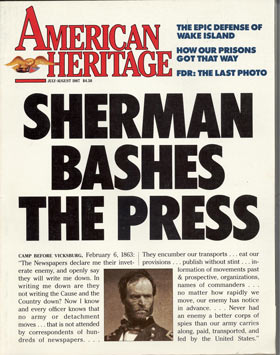
Extraordinary correspondence, never published before, takes us inside the mind of a military genius. Here is William Tecumseh Sherman in the heat of action inventing modern warfare, grieving the death of his little boy, struggling to hold Kentucky with levies, rolling invincibly across Georgia, and—always—battling the newspapermen whose stories, he believes, are killing his soldiers.
During the Depression, itinerant photographers hawked their services from town to town. All we know about this one is that he passed through Corpus Christi, Texas, in 1934. And that he was very good indeed.
Departments
CORRESPONDENCE
EDITORS’BOOKSHELF
HISTORY HAPPENED HERE
LETTER FROM THE EDITOR
POSTSCRIPTS TO HISTORY
THE BUSINESS OF AMERICA
THE TIME MACHINE
THEN AND NOW

American Heritage is proud to host the
National Portal to
Historic Collections
Recently added:
- American Revolution Center
- National Museum of Civil War Medicine
- National Museum of the U.S. Navy
- Manassas National Battlefield
- Maryland State House
In association with the
American Association for State and Local History
Why do we need a national nonprofit membership society for American history?
-
“Save America’s Treasures” has been totally eliminated—the largest Federal program supporting preservation of such treasures as the original Star Spangled Banner and George Washington’s tent.
-
65% of Americans don’t know what happened at the Constitutional Convention, according to a recent survey by Newsweek.
-
The “Teaching American History” grants—the largest Federal program supporting history education—have been completely eliminated.
-
Visits to the Top 20 Civil War battlefields have dropped in half from 1970 to 2009 according to official National Park Service statistics.
-
40% of Americans can’t identify whom we fought in World War II, according to a recent survey by Newsweek.
-
A quarter of Americans believe Congress shares power over U.S. foreign policy with the United Nations, according to a recent Annenberg survey.
-
“There is little that is more important for an American citizen to know than the history and traditions of his country,” John F. Kennedy wrote in American Heritage.
-
The “We the People Program,” which touched some 30 million students and 90,000 teachers over 25 years, has been completely eliminated.
-
Two-thirds of Americans could not correctly name Yorktown as the last major military action of the American Revolution, according to a recent national Gallup survey.
-
The National Heritage Areas and Scenic Byways program, the only major Federal program encouraging visits to historic places, has been completely eliminated in Congressional committee.