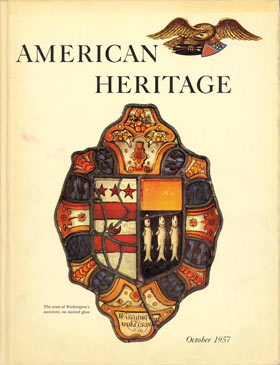
October 1957
Features
American sea captain George Coggeshall tells of his experiences evading the British navy during the War of 1812 and spending over half a century at sea.
In the wild Southwest, Archbishop Lamy of Santa Fe contended with savage Indians, ignorance, and a recalcitrant clergy.
Professing humanitarian motives, he gave gangsters a word for their artillery and the world its first practicable machine gun.
The river that disappointed him bears his name, but Alexander Mackenzie’s great achievement in slogging to the Pacific is now almost forgotten.
Nicholas Roosevelt’s fire canoe transformed the Mississippi.
The great historian who so eloquently described the taking of Mexico and Peru won a great private victory of his own in the quiet of his study on Beacon Hill.
Even when death struck suddenly, the starry-eyed Indian agent was still dreaming of turning his Ute wards into white men overnight.
General Washington wanted Benedict Arnold taken alive, right in the heart of British-held New York.
Missives, one by Mark Twain, the other by Walt Whitman, reflect the impact of the Civil War on the nation.
While panic gripped the nation in 1893, Grover Cleveland suffered his own secret ordeal on a yacht in Long Island Sound.
In five dramatic allegorical paintings, Thomas Cole echoed the fear of Americans, over a century ago, that all civilizations, our own included, must someday perish.
Departments
READING, WRITING, AND HISTORY

American Heritage is proud to host the
National Portal to
Historic Collections
Recently added:
- American Revolution Center
- National Museum of Civil War Medicine
- National Museum of the U.S. Navy
- Manassas National Battlefield
- Maryland State House
In association with the
American Association for State and Local History
Why do we need a national nonprofit membership society for American history?
-
“Save America’s Treasures” has been totally eliminated—the largest Federal program supporting preservation of such treasures as the original Star Spangled Banner and George Washington’s tent.
-
65% of Americans don’t know what happened at the Constitutional Convention, according to a recent survey by Newsweek.
-
The “Teaching American History” grants—the largest Federal program supporting history education—have been completely eliminated.
-
Visits to the Top 20 Civil War battlefields have dropped in half from 1970 to 2009 according to official National Park Service statistics.
-
40% of Americans can’t identify whom we fought in World War II, according to a recent survey by Newsweek.
-
A quarter of Americans believe Congress shares power over U.S. foreign policy with the United Nations, according to a recent Annenberg survey.
-
“There is little that is more important for an American citizen to know than the history and traditions of his country,” John F. Kennedy wrote in American Heritage.
-
The “We the People Program,” which touched some 30 million students and 90,000 teachers over 25 years, has been completely eliminated.
-
Two-thirds of Americans could not correctly name Yorktown as the last major military action of the American Revolution, according to a recent national Gallup survey.
-
The National Heritage Areas and Scenic Byways program, the only major Federal program encouraging visits to historic places, has been completely eliminated in Congressional committee.