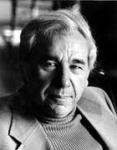
Alfred Kazin
Alfred Kazin (1915–1998) was an author and literary critic who often wrote on the immigrant experience in early twentieth century America. Philip Roth called him “America’s best reader of American literature in this century.” Kazin's most acclaimed book was On Native Grounds, published in 1942. His memoir, A Walker in the City, recalled a childhood in Brooklyn.
Articles by this Contributor
February/march 1983
The city has been a lure for millions, but most of the great American minds have been appalled by its excesses. Here an eminent observer, who knows firsthand the city’s threat, surveys the subject.
April/May 1984
The work of Ernest Hemingway and F. Scott Fitzgerald virtually defined what it meant to be American in the first half of this century
October/november 1985
He re-created with perfect pitch every tone of voice, every creak and rattle of an America that was disintegrating even as it gave birth to the country we inhabit today
April 1987
A journey through a wide and spellbinding land, and a look at the civilization along its edges.
December 1987
His speech was called “our intellectual Declaration of Independence.” Its theme was the universe itself; its hero, Man Thinking. Now, one hundred and seventy-five years later, a noted scholar sees Emerson’s great vision as both more beleaguered and more urgent than ever.
September 1998
The Novel of the Century
In William Faulkner’s greatest work, a bitter epic of violence and despair resolves itself on a note of love and longing

American Heritage is proud to host the
National Portal to
Historic Collections
Recently added:
- American Revolution Center
- National Museum of Civil War Medicine
- National Museum of the U.S. Navy
- Manassas National Battlefield
- Maryland State House
In association with the
American Association for State and Local History
Why do we need a national nonprofit membership society for American history?
-
“Save America’s Treasures” has been totally eliminated—the largest Federal program supporting preservation of such treasures as the original Star Spangled Banner and George Washington’s tent.
-
65% of Americans don’t know what happened at the Constitutional Convention, according to a recent survey by Newsweek.
-
The “Teaching American History” grants—the largest Federal program supporting history education—have been completely eliminated.
-
Visits to the Top 20 Civil War battlefields have dropped in half from 1970 to 2009 according to official National Park Service statistics.
-
40% of Americans can’t identify whom we fought in World War II, according to a recent survey by Newsweek.
-
A quarter of Americans believe Congress shares power over U.S. foreign policy with the United Nations, according to a recent Annenberg survey.
-
“There is little that is more important for an American citizen to know than the history and traditions of his country,” John F. Kennedy wrote in American Heritage.
-
The “We the People Program,” which touched some 30 million students and 90,000 teachers over 25 years, has been completely eliminated.
-
Two-thirds of Americans could not correctly name Yorktown as the last major military action of the American Revolution, according to a recent national Gallup survey.
-
The National Heritage Areas and Scenic Byways program, the only major Federal program encouraging visits to historic places, has been completely eliminated in Congressional committee.