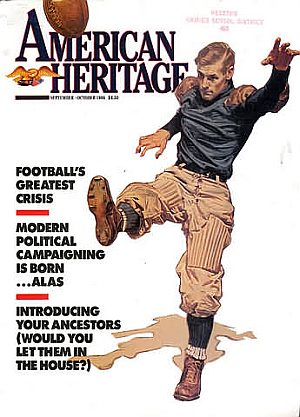
September/October 1988
Features
To keep Upton Sinclair from becoming governor of California in 1934, his opponents invented a whole new kind of campaign
SMU isn’t playing this season; men on the team were accepting money from alumni. That’s bad, of course; but today’s game grew out of even greater scandal.
It’s never a bad thing question how well you’re doing; the problem is to find a judicious observer who is determined neither to flatter nor to condemn
For generations it was the mainspring, the proof, and the reward of a civilized social life. Now, a fond student of the ritual looks back on the golden age of the dinner party and tells you just how you should have behaved.
Forget your conventional picture of America in 1810. In the first half of the nineteenth century, we were not at all the placid, straitlaced, white-picket-fence nation we imagine ourselves to have been. By looing at the patterns of everyday life as recorded by contemporary foreign and native observers of the young republic and by asking the questions that historians don't think to ask of another time—what were people really like? how did they greet one another in the street? how did they occupy their leisure time? what did they eat?—Jakc Larking brings us a portrait of another Americna, an America that was so different from both our conception of its past life and its present-day reality as to seem a foreign country.
Departments
EDITORS’ BOOKSHELF
HISTORY HAPPENED HERE
LETTER FROM THE EDITOR
THE BUSINESS OF AMERICA
THE LIFE AND TIMES
THE TIME MACHINE

American Heritage is proud to host the
National Portal to
Historic Collections
Recently added:
- American Revolution Center
- National Museum of Civil War Medicine
- National Museum of the U.S. Navy
- Manassas National Battlefield
- Maryland State House
In association with the
American Association for State and Local History
Why do we need a national nonprofit membership society for American history?
-
“Save America’s Treasures” has been totally eliminated—the largest Federal program supporting preservation of such treasures as the original Star Spangled Banner and George Washington’s tent.
-
65% of Americans don’t know what happened at the Constitutional Convention, according to a recent survey by Newsweek.
-
The “Teaching American History” grants—the largest Federal program supporting history education—have been completely eliminated.
-
Visits to the Top 20 Civil War battlefields have dropped in half from 1970 to 2009 according to official National Park Service statistics.
-
40% of Americans can’t identify whom we fought in World War II, according to a recent survey by Newsweek.
-
A quarter of Americans believe Congress shares power over U.S. foreign policy with the United Nations, according to a recent Annenberg survey.
-
“There is little that is more important for an American citizen to know than the history and traditions of his country,” John F. Kennedy wrote in American Heritage.
-
The “We the People Program,” which touched some 30 million students and 90,000 teachers over 25 years, has been completely eliminated.
-
Two-thirds of Americans could not correctly name Yorktown as the last major military action of the American Revolution, according to a recent national Gallup survey.
-
The National Heritage Areas and Scenic Byways program, the only major Federal program encouraging visits to historic places, has been completely eliminated in Congressional committee.