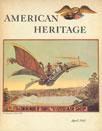
April 1962
Features
An eyewitness re-creates the wonderful, wacky day in August, 1944, when Hemingway, a handful of Americans, and a senorita named Elena helped rekindle the City of Light. Champagne ran in rivers, and the squeals inside the tanks were not from grit in the bogie wheels
Minnesota’s Sioux uprising began with senseless murder on a peaceful Sunday afternoon. Before it ended, the smell of death was everywhere
Cross-country touring was difficult, half a century ago, but if you could make it, you really had an adventure
Almost simultaneously two men claimed to have attained a goal that explorers had striven toward for centuries. There were strong hints that one of them was an impostor
BEING
A narrative of some of the adventures, dangers and sufferings of a revolutionary soldier, interspersed with anecdotes of incidents that occurred within his own observation.
The Confederacy did not spring into life full-blown. First a few states seceded, and then, one by one, others followed them out of the Union. Some wavered but never took the final leap. This surge to rebellion is reflected in the rare and colorful southern patriotic envelopes shown here, which come from the collection of Captain T. S. Dukeshire of Washington, D.C.
“You may marry anybody you please & I don’t care.” Thus the famous English author to wild, pretty Sally Baxter of New York; which is to say that he—and his American love—never got over it at all.
The powerful Speaker of the House missed not one but two chances to invest in AT&T in the early days
A hundred years ahead of his time, the fiery abolitionist Benjamin Lay assaulted the consciences of Philadelphia slaveowners—and won
To a wide-eyed public Buffalo Billpresented a group of matchless marksmen —and one unforgettable girl—whose prowess with a rifle was wonderful to see
Departments
READING, WRITING, AND HISTORY

American Heritage is proud to host the
National Portal to
Historic Collections
Recently added:
- American Revolution Center
- National Museum of Civil War Medicine
- National Museum of the U.S. Navy
- Manassas National Battlefield
- Maryland State House
In association with the
American Association for State and Local History
Why do we need a national nonprofit membership society for American history?
-
“Save America’s Treasures” has been totally eliminated—the largest Federal program supporting preservation of such treasures as the original Star Spangled Banner and George Washington’s tent.
-
65% of Americans don’t know what happened at the Constitutional Convention, according to a recent survey by Newsweek.
-
The “Teaching American History” grants—the largest Federal program supporting history education—have been completely eliminated.
-
Visits to the Top 20 Civil War battlefields have dropped in half from 1970 to 2009 according to official National Park Service statistics.
-
40% of Americans can’t identify whom we fought in World War II, according to a recent survey by Newsweek.
-
A quarter of Americans believe Congress shares power over U.S. foreign policy with the United Nations, according to a recent Annenberg survey.
-
“There is little that is more important for an American citizen to know than the history and traditions of his country,” John F. Kennedy wrote in American Heritage.
-
The “We the People Program,” which touched some 30 million students and 90,000 teachers over 25 years, has been completely eliminated.
-
Two-thirds of Americans could not correctly name Yorktown as the last major military action of the American Revolution, according to a recent national Gallup survey.
-
The National Heritage Areas and Scenic Byways program, the only major Federal program encouraging visits to historic places, has been completely eliminated in Congressional committee.