
Written in haste, on an April midnight in 1803, the unedited text of the message that led to the Louisiana Purchase is printed for the first time.
-
April 1955
15 years ago By admin Volume6Issue3
Editor's Note: AMERICAN HERITAGE herewith publishes one of the most significant letters in American history—the letter which led to the great Louisiana Purchase. It was written to Secretary of State, James Madison, in the spring of 1803, by Robert R. Livingston, the American minister to France; of it came the vast continental expansion.
When Spain transferred Louisiana to France in 1801, the United States took alarm; France was too strong a nation for a neighbor. President Jefferson was even ready to conclude an alliance with Great Britain. He requested Minister Livingston to negotiate with Napoleon, the First Consul, for a port on the lower Mississippi, and he sent James Monroe to Paris to help in the negotiations.
But Napoleon, in the spring of 1803, his forces in Haiti defeated and a war with Great Britain pending, suddenly decided to sell—not only New Orleans, but the whole tremendous territory known as Louisiana.
Word of this decision came to Livingston from Tailleyland, French Foreign Minister, and from Barbie Marabous, French Finance Minister: and what follows on the succeeding pages is the fateful letter in which Livingston told Secretary Madison how the offer was made and how he responded.
An edited version of the letter was published a century or more ago, in Peter Force’s American State Papers, and it was summarized in Henry Adams’ History of the United States, but this is the first time the full text of the letter, with original spelling and punctuation, has been printed. Words in italics were in code in the original. The letter, recently discovered by Ralph Newman, of the Abraham Lincoln Bookshop, Chicago, is printed with the permission of the present owner.
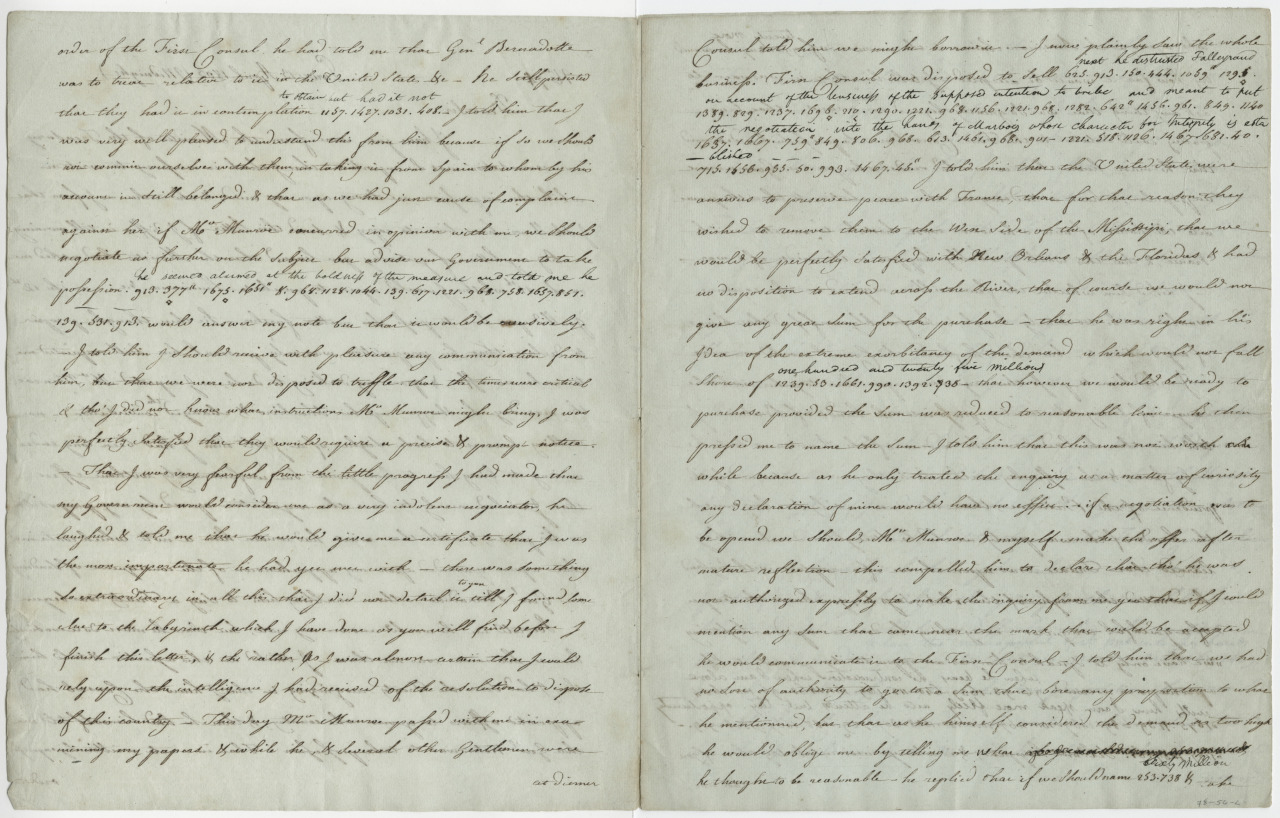
No. 74
Paris, 13 April 1803 (Midnight)
Dear Sir,
I have just come from the Minister of the Treasury. Our conversation was so important that I think it necessary to write it while the impressions are strong upon my mind, & the rather as I fear that I shall not have time to copy & send this letter if I differ it till morning.
By my letter of yesterday you learned that the Minister had asked me on the 11th whether I would agree to purchase Louisiana &c. On the 12th I called upon him to press this matter further. He then thought proper to declare that his proposition was only personal but still requested me to make an offer, & upon my declining to do so as I expected Mr. Munroe the next day he shrugged up his shoulders & changed the conversation. Not willing however to loose sight of it, I told him I had been long endeavouring to bring him to some point but unfortunately without effect, that I wished merely to have the negotiation opened by any proposition on his part, & with that view had written him a note which contained that request grounded upon my apprehension of the consequence of sending out Genl. Bernadotte without enabling him to say a treaty was begun.
He told me he would answer my note, but that he must do it evasively because Louisiana was not theirs. I smiled at this assertion & told him that I had seen the Treaty recognizing it, that I knew the Consul had appointed officers to govern the country, & that he had himself told me that Genl. Victor was to take possession. That in a note written by express order of the First Consul he had told me that Genl. Bernadotte was to treat relative to it in the United States &c. He still persisted that they had it in contemplation to obtain but lnitl it not. I told him that I was very well pleased to understand this from him because if so we should not commit ourselves with them in taking it from Spain to whom by his account it still belonged & that as we had just cause of complaint against her if Mr. Munroe concurred in opinion with me, we should negotiate no further on the subject but advise our government to take possession. He seemed alarmed at the boldness of the measure find told me he would answer my note but that it would be evasively.
I told him I should receive with pleasure any communication from him, but that we were not disposed to trillle, that the times were critical & tho' I did not know what instructions Mr. Munroe might bring, I was perfectly satisfied that they would require a precise & prompt notice. That I was very fearful from the little progress I had made that my Government would consider me as a very indolent negociator, he laughed & told me that he would give me a certificate that I was the most importunate he had yet met with. There was something so extraordinary in all this that I did not detail it to you till I found some clue to the labyrinth which I have done as you will find before I finish this letter, & the rather as I was almost certain that I could rely upon the intelligence I had received of the resolution to dispose of this country. This day Mr. Munroe passed with me in examining my papers & while he, & several other gentlemen were at dinner with me, I observed the Minister of the Treasury walking in my garden. I sent out Col. Livingston to him, he told him he would return when we had dined. While we were taking coffee he came in, & after being some time in the room, we strolled into the next room, when he told me he heard that I had been at his house two days before when he was at St. Cloud, that he thought I might have something particular to say to him & had taken the first opportunity to call on me. I saw that this was meant as an opening to one of those free conversations which I frequently had with him; I accordingly began on the subject of the debt & related to him the extraordinary conduct of the Minister (1) &c. He told me that this lead to something important that had been cursorily mentioned to him at St. Cloud but as my house was full of Company he thought I had better call upon him any time before eleven that night. He went away & little after Mr. Munroe took leave, I followed him. He told me that he wished me to repeat what I had said relative to Mr. Talleyrand requesting a proposition from me as to the purchase of Louisiana I did so and concluded with the extreme absurdity of his evasions of the day and stated the consequence of any delay on this subject as it would enable Britain to take possession—who would readily relinquish it to us—he said that this proceeded upon a supposition of her making so successful a war as to be enabled to retain lier conquests. I told him that it was probable that the same idea might suggest itself to the United States, in which case it would be their interest to render her successful, & asked whether it was prudent to throw us into her scale. This led to long discussions of no moment to repeat, we returned to the point. He said that what I had told him led him to think that what the Consul had said to him on Sunday at St. Cloud (the day on which I told you the determination had been taken to sell) had more of earnest than he thought at the time that the Consul had asked him what news from England? As he knew he read the papers attentively, he told him that he had seen in the London papers the proposition for raising 50,000 men to take New Orleans. The Consul said he had seen it too, & he had also seen that some thing was said about 2,000,000 of £ being disposed among the people about him to bribe them &c then left him. That afterwards when walking the garden, the Consul came again to him & spoke to him about the troubles that were excited in America & enquired how far I was satisfied with his last note. Here some civil things were introduced for which I presume I am more indebted to the Minister’s politeness than to his veracity, so let them sleep. He (Marbois) then took occasion to mention his sorrow, that any cause of difference should exist between our countries.
The Consul told him in reply, “will you have the charge of the treasury let them give you one hundred million & pay their own claims (2), & take the whole country." Seeing by my looks that I was surprised at so extravagant a demand, he added that he considered the demand as exorbitant, & had told the First Consul that the thing was impossible, that we had not the means of raising it, that the Consul told him we might borrow it. I now plainly saw the whole business. First Consul was disposed to sell, next he distrusted Talleyrand on account of the business of the supposed intention to bribe and meant to put the negotiation into the hands of Marbois whose character for integrity is established. I told him that the United States were anxious to preserve peace with France, that for that reason they wished to remove them to the West Side of the Mississippi, that we would be perfectly satisfied with New Orleans & the Floridas & had no disposition to extend across the River, that of course we would not give any great sum for the purchase, that he was right in his idea of the extreme exorbitancy of the demand which would not fall short of one hundred and twenty five millions that however we would be ready to purchase provided the sum was reduced to reasonable limits. He then pressed me to name the sum. I told him that this was not worth while because as he only treated the enquiry as a matter of curiosity any declaration of mine would have no effect. If a negotiation was to be opened we should, Mr. Munroe & myself make the offer after mature reflection. This compelled him to declare that tho’ he was not authorized expressly to make the inquiry from me yet that if I coidd mention any sum that came near the mark that could be accepted he would communicate it to the First Consul. I told him that we had no sort of authority to go to a sum that bore any proportion to what he mentioned, but that as he himself considered the demand ;ts too high he would oblige me by telling me what he thought to be reasonable. He replied that if we should name sixty million & take upon us the American claims to the amount of twenty more he would try how far it would be accepted. I told him that it was vain to ask any thing that was so greatly beyond our means, that true policy could dictate to the First Consul not to press such a demand that he must know that it would render the present government unpopular, & have a tendency at the next election to throw the power into the hands of men who were more hostile to connection with France, & that this would probably happen in the midst of a war. I asked him whether the few millions acquired at this expense would not be too dearly bought? He frankly confessed that he was of my sentiments, but that he feared the Consul would not relax. I asked him to press this argument upon him together with the danger of seeing the country pass into the hands of Britain. I told him that he had seen the ardour of the Americans to take it by force, & the difficulty with which they were restrained by the prudence of the President, that he must easily see how much the hands of the war party would be strengthened when they learned that France was upon the eve of a rupture with England. He admitted the weight of this, “but, says he, you know the temper of a youthful conqueror—everything he does is rapid as lightening; we have only to speak to him as an opportunity presents itself, perhaps in a crowd when he bears no contradiction; when I am alone with him I can speak more freely and fie attends, but this opportunity seldom happens, & is always accidental. Try then if you can not come up to my mark. Consider the extent of the country, the exclusive navigation of the River, & the importance of having no neighbors to dispute with you, no war to dread. I told him that I considered all these as important considerations, but there was a point beyond which we could not go, & that fell far short of the sum he mentioned.
I asked him in case of a purchase whether they could stipulate that France would never possess the Floridas, & that she would aid us to procure them & relinquish all right that she might have to them. He told me that she would go thus far. I added that I could now say nothing more on the subject but that I would converse with Mr. Munroe, & that I was sure I should find him disposed to do everything that was reasonable or could be expected to remove every cause of difference between the two countries, that, however, if any negotiations should go on, I could wish that the First Consul would depute some body to treat with us who had more leisure than the Minister for foreign affairs (I said this to see whether my conjectures relative to him were well founded) he told me that as the First Consul knew our personal friendship, he having several times had occasion to speak of me & my family, & the principles that we held he believed, that there would be no difficulty when the negotiation was some what advanced to have the management of it put into his hands . He earnestly pressed me to make some proposition that was so near the First Consul’s as to advise his mentioning it to him. T told him that I would consult Mr. Munroe, but that neither he nor I could acceed to his ideas on the subject—thus, Sir, you see a negotiation is fairly opened and upon grounds I prefer to all other commercial privileges and always to some simple money transaction is infinitely preferable. As to the quantum I have yet made no opinion; the field opened to us is infinitely larger than our instructions contemplated, the revenue increasing and the land more than adequate to sink the capital, should we even go the proposed by Mr. Marbois; nay, I persuade myself that the whole sum may be raised by the sale of the Territory West of the Mississippi, but with the right of sovereignty to some power in Europe whose vicinity we should not fear .
I speak now without reflection & without having seen Mr. Monroe, as it was midnight when I left the treasury office, it is now three o’clock. It is so very important that you should be apprized that a negotiation is actually opened even before Mr. Munroe has been presented in order to calm the tumult which the news of war (3) will renew, that I have lost no time in communicating it. We shall do all we can to cheapen the purchase, but my present sentiment is that we shall buy I trust it will be necessary to put some proposition tomorrow; the Consul goes in a few days to Brussels & every moment is precious.
Mr. Monroe will be presented to the Minister tomorrow when we shall press for as early an audience as possible from the First Consul.
I am Dear Sir, with the most respectful consideration.
Your most Ob't hum. Serv't Rbt. R. Livingston
The hon'ble James Madison Esq.
1. In this remark to Barbe Marbois, Livingston refers to Foreign Minister Talleyrand, whose evasive attitude is described in the letter.
2. Obviously, Napoleon means one hundred million francs—approximately §20,000,000 at that time. The word “claims” refers to debts owed by the French government to U.S. citizens. In the final settlement, the United States paid $15,000,000, of which 83,750,000 covered the expense of the assumption of these claims.
3. Outbreak of war between England and France was expected at any moment.