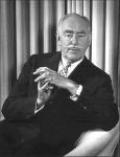
Richard B. Morris
Richard B. Morris (1904 - 1989) was an American historian who focused on the constitutional, diplomatic, and political history of the American Revolution and the making of the U.S. Constitution. He was the Gouverneur Morris Professor of History at Columbia University and the author of many books.
In 1966 Morris won the Bancroft Prize in History for his book on the diplomacy of the American Revolution, The Peacemakers: The Great Powers and American Independence (1965). He edited the papers of John Jay and published a biography, John Jay, the Nation, and the Court, focusing on Jay's work as a diplomat and as the first Chief Justice of the United States.
Morris's 1966 book The American Revolution Reconsidered, which he followed in 1970 with his The Emerging Nations and the American Revolution. In 1973, preparing for the impending bicentennial of the American Revolution, he published a collection of biographical essays in Seven Who Shaped Our Destiny: The Founding Fathers as Revolutionaries.
Prof. Morris also co-chaired Project ’87, a group of historians, political scientists, and jurists formed to encourage a thorough examination of the Constitution for its bicentennial year.
Articles by this Contributor
February 1956
The Albany Plan of Union might have made the Revolution unnecessary

April 1960
In Pierre Landais the Continental Navy had its own real-life Commander Queeg. His tour as master of the Alliance was a nightmare wilder than any a novelist could invent
February 1962
Long before Lexington, James Otis’ fight for civil liberties gave heart to the rebel cause. But why did he behave so strangely as the Revolution neared? Which side was he on?
December 1968
States they were, united they were not; while their Secretary for Foreign Affairs sought to pull them together, Europe waited for them to fall apart
December 1971
“So convenient a thing it is to be a reasonable creature , since it enables one to find or make a reason for everything one has a mind to do’
August/september 1984
The Founding, Fathers never did agree about the proper relationship between church and state. No wonder the Supreme Court has been backing and filling on the principle ever since.
May/June 1987
The framers of the Constitution were proud of what they had done but might be astonished that their words still carry so much weight. A distinguished scholar tells us how the great charter has survived and flourished.

American Heritage is proud to host the
National Portal to
Historic Collections
Recently added:
- American Revolution Center
- National Museum of Civil War Medicine
- National Museum of the U.S. Navy
- Manassas National Battlefield
- Maryland State House
In association with the
American Association for State and Local History
Why do we need a national nonprofit membership society for American history?
-
“Save America’s Treasures” has been totally eliminated—the largest Federal program supporting preservation of such treasures as the original Star Spangled Banner and George Washington’s tent.
-
65% of Americans don’t know what happened at the Constitutional Convention, according to a recent survey by Newsweek.
-
The “Teaching American History” grants—the largest Federal program supporting history education—have been completely eliminated.
-
Visits to the Top 20 Civil War battlefields have dropped in half from 1970 to 2009 according to official National Park Service statistics.
-
40% of Americans can’t identify whom we fought in World War II, according to a recent survey by Newsweek.
-
A quarter of Americans believe Congress shares power over U.S. foreign policy with the United Nations, according to a recent Annenberg survey.
-
“There is little that is more important for an American citizen to know than the history and traditions of his country,” John F. Kennedy wrote in American Heritage.
-
The “We the People Program,” which touched some 30 million students and 90,000 teachers over 25 years, has been completely eliminated.
-
Two-thirds of Americans could not correctly name Yorktown as the last major military action of the American Revolution, according to a recent national Gallup survey.
-
The National Heritage Areas and Scenic Byways program, the only major Federal program encouraging visits to historic places, has been completely eliminated in Congressional committee.