
Their High Command abandoned them. Their enemy thought they wouldn’t fight. But a few days after Pearl Harbor, a handful of weary Americans gave the world a preview of what the Axis was up against.
-
July/August 1987
15 years ago By admin Volume38Issue5
The Japanese attack on Pearl Harbor on December 7, 1941, was only one blow in an offensive without parallel in warfare. Within hours after the first bombs had crashed into Battleship Row, Japanese forces struck at twenty-nine targets along a three-thousand-mile front that stretched from the central Pacific to the South China Sea. Destroyers shelled American installations on Midway Island, and airplanes spilled their bombs over Clark and Iba airfields in the Philippines, wiping out half the American air forces there in a single raid.
On December 8 the Japanese army seized the international settlement in Shanghai, invaded Malaya in a drive toward Singapore, and marched into Thailand. Bangkok fell without opposition on the following day just as Japanese troops were landing on Tarawa and Makin in the Gilbert Islands. The operational plans of the Japanese High Command called for the swift occupation of the Philippines, Guam, Hong Kong, Malaya, Burma, the Bismarck Archipelago, Java, Sumatra, Borneo, Celebes, and Timor as its first major conquests.
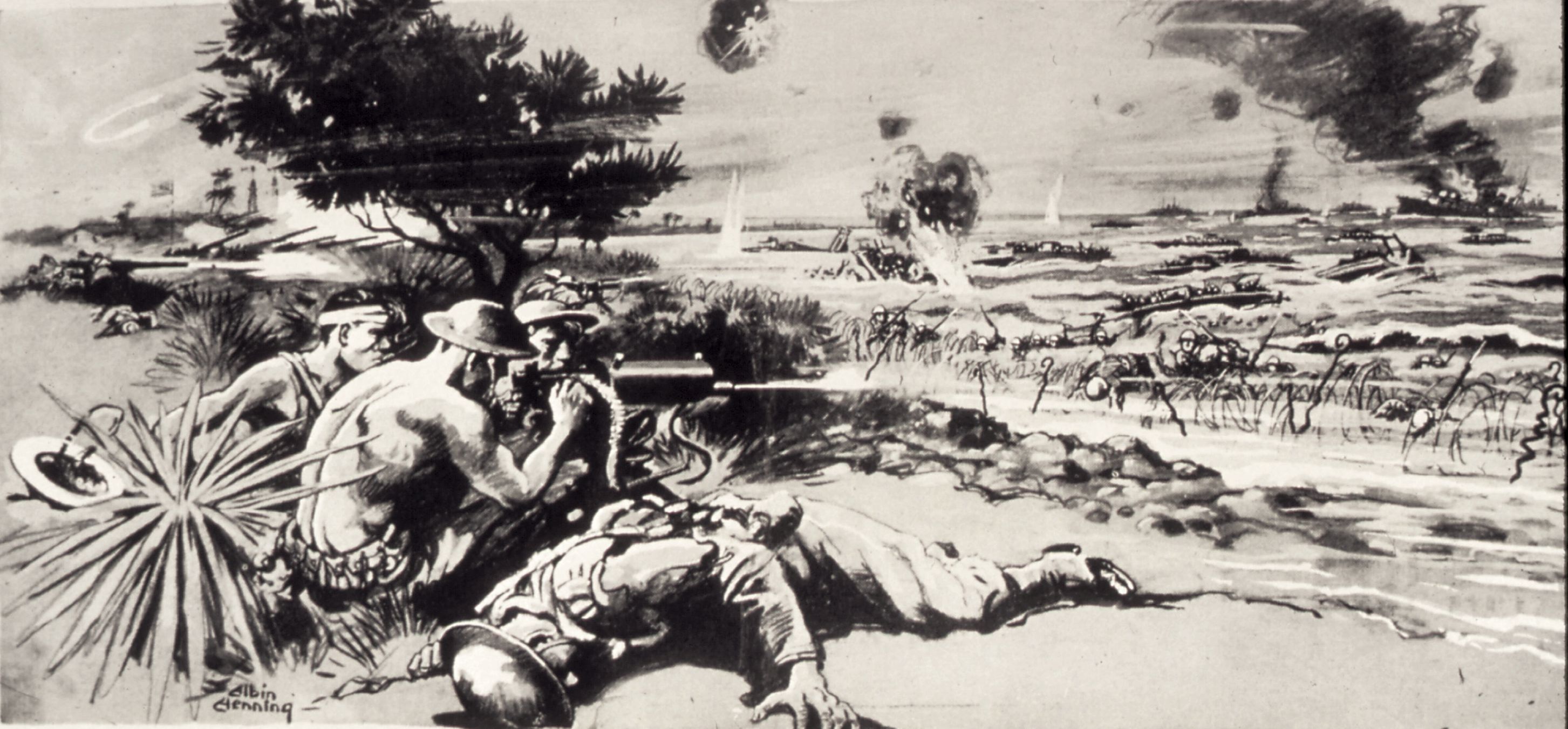
Well down on the list of secondary objectives was Wake, a scruffy atoll in the central Pacific that the Japanese planned to use as an advanced base for patrol planes to support their thrust at Midway. In allotting forces to the task, the Japanese assigned 450 assault and garrison troops under the command of Rear Adm. Sadamichi Kajioka. If the force was small, it was considered adequate. Wake’s three square miles were known to be manned by a scattering of inexperienced Marines. And throughout the Far East the Americans were not putting up much of a fight. The Marine detachments at Peking and Tientsin in China had already been herded off to detention camps without firing a shot.
The 153 Marines on Guam, having nothing heavier with which to defend themselves than four .30-caliber machine guns, had surrendered after a few hours of disorganized scuffling. On the same day that Guam had toppled into the Japanese harvest basket, two landings on Luzon in the Philippines had been virtually unopposed. The Japanese naval command, which had not suffered a reversal or lost a ship of the line since the Russo-Japanese War, expected the reduction of Wake to be little more than a brisk afternoon’s work.
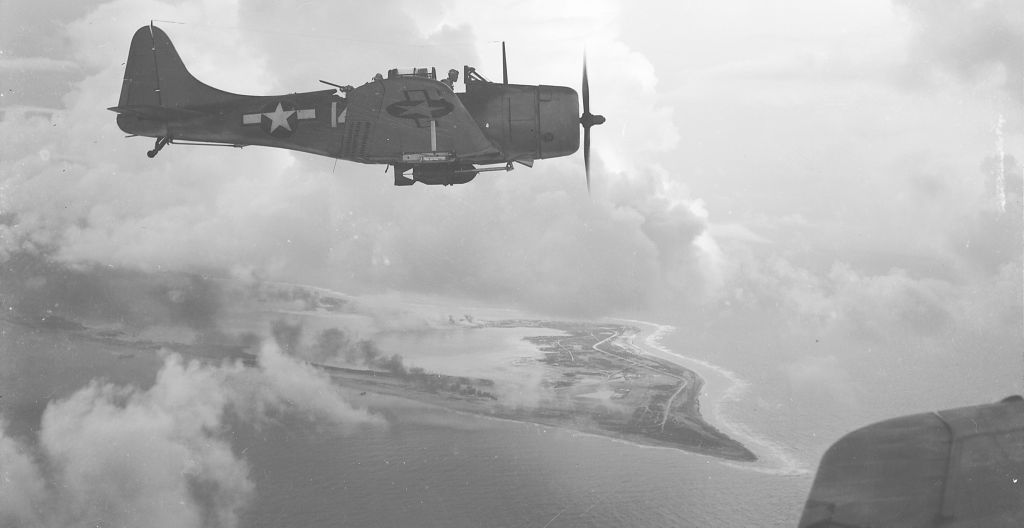
Until the development of the long-range airplane, Wake was a desolate point of land in the central Pacific that held scant interest for a major, internationally minded power. Formed by the rim of a submerged volcano, Wake consists of three tiny atolls: the main island, shaped like a ragged V, with two smaller spits trailing a few yards behind the northern and southern ends. Seen from the air, Wake gives the appearance of a broken wishbone tossed aside after Thanksgiving dinner. It has a mean altitude of twelve feet and affords neither fresh water nor edible vegetation. It was discovered in 1586 by the Spanish explorer Álvaro de Mendaña, who apparently thought so little of his find that he did not bother to name it.
That honor was left to a British sea captain named William Wake, who came upon the main island in 1796. The smaller atolls, Wilkes on the north and Peale on the south, were named after members of an American expedition that conducted a brief geological survey there in 1841. (This article follows military usage: “Wake” refers to the grouping while “Wake Island” refers only to the main island.) The United States claimed this dreary triptych for itself in 1899, when the gunboat Bennington sent a landing party ashore, raised the flag, fired off a cannon, and sailed away. Except for the occasional party of Japanese hunters shooting birds or the storm-lost mariner searching for water he would not find, Wake, in the three and a half centuries since its discovery, heard only the roar of the surf.
Useless to vessels of sail or steam, Wake, located 1,025 miles from Midway and 1,300 miles from Guam, suddenly emerged as an important link in the American air route across the Pacific. Pan American Airways obtained a permit to build a seaplane refueling stop there for the China Clipper traffic to the Philippines. By the time Pan American started flying passengers between San Francisco and Manila in 1936, the airline had built a twenty-four-room hotel, put in a system of catchments to store rainwater, and started work on a “bathtub garden” for growing fresh vegetables. The accommodations were crude, and to help its overnight passengers kill time, Pan American provided air rifles and ammunition for shooting the particularly hardy breed of long-legged rats that throve on the island.
If Wake was an essential element in America’s western reach to the Orient, it was also neatly situated on a line from Tokyo through Iwo Jima and Marcus Island for Japan’s anticipated thrust into the central Pacific. In the prewar planning of both Japanese and American strategists, Wake increasingly represented a risk and an opportunity. By 1941 the U.S. Navy had wheedled sufficient money from a parsimonious Congress to build a permanent airfield there. A civilian construction team of 80 men arrived on January 8 to start building an airstrip and base facilities.
The crew, which eventually grew to 1,150, was a tough and experienced bunch, many of whom had learned their trade putting up the dams at Boulder and Bonneville. The project foreman was an ex-football player from the University of Washington named Dan Teters. He was reckoned a good boss who kept the work moving with a dollop of Irish charm or a clenched fist, whichever seemed appropriate at the time. Most of the men agreed they had a sweet deal. At a time when a Marine corporal with five years of service was paid twenty-eight dollars a month, a workman could plan on banking at least two hundred dollars.
There were morale problems, however. Wake was a desperately lonely place with few pleasures. Liquor was effectively forbidden, and women were generally seen only on the screen at the outdoor movies that were shown six nights a week. Almost every supply ship that left Wake carried workers who had broken their contracts to get off the island. One man went berserk and drowned himself in the ocean.
During February of 1941, Adm. Husband E. Kimmel, an experienced battleship sailor who had been jumped over thirty-two more senior officers to get the job, took command of the Pacific Fleet. A meticulous, by-the-book officer, Kimmel insisted on neat sailing formations and precise drills. He was not an officer given to great leaps of imagination, but he could recognize a ripe tactical opportunity when he saw one. Wake, with its new and undefended airstrip, was a prize the Japanese would surely reach for in the first days of a war. Kimmel calculated that if an invasion force could be held long enough in the waters off Wake, it would offer a rewarding target for counterattack. At his direction a Marine defense battalion was authorized to be assembled at Wake with orders to dig in and wait.
The battalion commander was Maj. James P. S. Devereux, an eighteen-year veteran of the corps who had seen garrison service in China and Nicaragua. With his balding pate, floppy ears, and a moustache that drooped under a beaked nose, Devereux did not cut a figure out of an enlistment poster. Indeed, he admitted he had been a poor student in school and had enlisted in the Marines because he fancied the red stripe that ran down the trouser leg of the uniform. Nevertheless, Devereux was a tough, no-nonsense commander who bore down on details. One fellow officer said, “He’s the kind of guy who would put all the mechanized aircraft detectors into operation and then station a man with a spyglass in a tall tree.”
At Wake there were no mechanized aircraft detectors — radar had been assigned, but the equipment never got there — and no tall trees. Devereux made do with what he had. He put his men to work twelve hours a day, building up the tactical defenses of Wake, until his troops said the first three initials of his name stood for “Just Plain Shit,” a sobriquet that did not disturb Devereux in the slightest.
Throughout the autumn of 1941 personnel arrived at Wake like officials summoned to a hastily arranged meeting whose function was not clear to the participants. Even Devereux may have been misdirected as to his real mission. Kimmel obviously had a major operation in mind for Wake, but Devereux had been briefed only to prepare against small raiding parties. Although there were no planes based at Wake, by November the buildup had progressed to such a state that the complex was officially designated a naval air station and required a Navy officer as commandant.
On the twenty-ninth, with his golf clubs among his luggage, Comdr. Winfield Scott Cunningham landed at Wake to take charge. Cunningham was a somewhat unprepossessing officer who had so little time to familiarize himself with his new command that many Marines never knew he was there until long after the war was over. This unfortunate failure to make his presence felt later led to a bitter and needless dispute among the survivors of Wake in allotting credit for its defense. Officially Cunningham was in overall command of Wake, while Devereux and his battalion were charged with its tactical defense. But in such a small operation, especially when there was nothing to do but fight off the enemy, the niceties of command structure became blurred. As a practical matter the main burden for the defense of Wake fell to Devereux.
On December 4 Wake became as operationally ready as it was going to become with the arrival of Marine Fighting Squadron 211, a dozen Grumman Wildcats under the command of Maj. Paul Putnam. VMF-211 was a microcosm of American military preparedness in 1941. Although the Wildcats had the stubby, pugnacious look that was to become a famous American fighting image of the war, these F4F-3 models were not ready to wage serious battle. They were both new and obsolescent at the same time. Just issued to the fleet, they were strange beasts to the pilots, who were still learning their flight characteristics on the trip out. They did not carry armor plating or self-sealing fuel tanks. The retractable landing gears had to be operated by old-fashioned hand cranks, an annoyance that on a routine flight could fracture a pilot’s wrist but something that might kill him in combat.
Once the planes had touched down on Wake’s crushed coral runway, there were other deficiencies to deal with. The bomb racks did not accommodate the ordnance stored there. No spare parts had been sent ahead, and there were no experienced mechanics in the ground crews. There were no revetments or dispersal areas for the aircraft, and the underground storage area for aviation fuel had not been completed. Putnam could do little but park his planes in the middle of an open runway and complain.
There was much to complain about throughout the command: the list of Wake’s inadequacies was a long and dispiriting one. Communications wire had been strung, but most of it was old and frayed. Worse, it was above ground and vulnerable to attack. A fair amount of defensive weaponry had been positioned. It included six five-inch coastal guns, two at each end of the Wake triangle, and a dozen three-inch antiaircraft batteries. But none of these guns had been test-fired or calibrated.
Although Wake was supposed to be an observation post for the Pacific Fleet, no long-range reconnaissance aircraft had yet been assigned. But the most debilitating shortage was simple manpower. On paper a battalion called for 43 officers and 939 men. Devereux had less than half of that: 27 officers and 422 men. As a result, much of Wake’s armament was useless. The antiaircraft batteries were only partly manned, and there were crews for only half the machine guns. Still, Devereux could take pride in what his men had accomplished. From being defenseless in August, Wake could now muster the firepower equivalent to that of a Navy destroyer.
Following a particularly sharp drill on December 6, Devereux felt he could let up on the seven-day-a-week schedule that had been in effect since he arrived. Sunday, December 7 (Wake, being on the opposite side of the international date line, was twenty-two hours ahead of Pearl Harbor), was holiday routine.
A few minutes before 7:00 A.M. on December 8, Devereux was shaving in his tent when he heard that the Japanese were bombing Pearl Harbor. As he raced to his office, he ordered the battalion bugler to sound general quarters. Alvin Waronker was, by all accounts, an indifferent bugler. He had gone to music school just to avoid being shipped to Alaska. Waronker rarely got the notes right, and this morning he couldn’t remember them at all. He went through the whole catalog of Marine music, including pay call, church call, and fire call, until he happened on the correct one. The Marines turned out in considerable disarray, and a few appeared with sand buckets and fire fighting equipment. But Devereux passed the word that this was no drill, and within thirty minutes all posts reported ready for action.
The men at Wake were in the war, but no one knew when or how that war would reach them. Devereux and Teters did not want to halt vital construction because of an unconfirmed radio broadcast, so military and civilian work parties resumed while Marine guards stayed on alert. Major Putnam faced the hardest decision. He had twelve new Wildcats bunched on the runway. If he dispersed his planes onto open ground, some of them would certainly be damaged, and without any spare parts a damaged Wildcat was no different from a destroyed one. He took the risk of leaving eight planes on the runway while four stayed aloft, patrolling the area. If Putnam had had a week, even a few days, he might have been able to protect his planes on the ground. He had less than four hours.
In war, bad luck is the inevitable lot of the ill-prepared. Shortly before noon, as four Wildcats, commanded by Capt. Henry Elrod, were beginning the northern leg of their scouting run at twelve thousand feet, thirty-six Japanese medium bombers, unseen by anyone in the air or on the ground, broke through the clouds at two thousand feet. To achieve maximum surprise, the Japanese cut their engines and glided silently toward the target. They need not have bothered. The crashing of the surf on Wake was so constant that no one ever heard an approaching airplane until it was upon him. As the Japanese came in over the airstrip, they found a bombardier’s delight waiting for them: eight parked Wildcats stuffed with aviation gas. On their first pass the Japanese tripped their bombs and transformed the airfield into a fire storm of exploding planes and burning gasoline.
Several Marine pilots tried to take off, but it was futile. Lt. Frank Holden was cut down before he got more than a few feet. Lt. Robert Conderman almost got to his plane before he was hit by machine-gun fire. Knowing he was dying, Conderman refused aid, telling the medics to look after men who had a chance of surviving. Lt. George Graves managed to climb into his plane, but before he could get the Wildcat cranked up, it exploded from a direct hit. The Japanese raiders split up and methodically began laying waste the island. They leveled the Pan American hotel and touched off stores of aviation gas maintained above ground. As at Pearl Harbor, the Japanese bombing was surgical in its neatness. The bomb craters were a systematic fifty feet apart, but almost none of the bombs landed on the runway. Clearly the Japanese wanted to use it for themselves once they occupied Wake in force.
It was all over in a few minutes. Without suffering a single casualty, the bombers reformed, waggled their wings in a banzai sign of triumph, and headed back to their home base in the Marshall Islands.
The air section suffered most heavily. Of its fifty-five officers and men, twenty-three were killed outright or died by the next morning. Eleven more were wounded. Whatever tools, tires, and assorted parts had been around had been blown away. Bad luck continued to plague the airmen of Wake even after the raid was over. When the flight patrol returned, still unaware of the attack, Captain Elrod badly jarred his plane on landing and skewed the propeller. Four days before, Marine Fighting Squadron 211 had arrived with twelve new planes. Now the entire air defense of Wake consisted of three serviceable Wildcats, two damaged ones, and seven flaming wrecks.
Wake faced an enormous damage control job and turned to Dan Teters’s work crew. The record of the civilians at Wake is mixed. Most of the workers did what untrained, unarmed men usually do when they suddenly find themselves in the middle of a battlefield. They hid. Figures are imprecise, but it appears that at least 700 civilians sat out the Battle of Wake hunkered down in the scrub, coming out only to steal food. But immediately after the first raid, about 185 civilians volunteered to serve in any capacity. Some offered themselves for combat duty and scoured the wreckage of the Pan American hotel, looking for weapons with which to arm themselves. Eventually perhaps as many as 400 offered to take their chances along with the Marines at least some of the time. Their contribution was invaluable. Working all day and through the night, crews set about digging foxholes, scooping out bomb shelters, and repairing communications wire. By dawn eight bombproof revetments had been completed to protect the remaining Wildcats. Meanwhile, Lt. John Kinney and Tech. Sgt. William Hamilton, by scavenging parts from destroyed planes, were able to make one more Wildcat serviceable.
Calculating the next Japanese air attack was a question of simple, stark mathematics. If the bombers took off from the Marshall Islands at dawn, they could be expected sometime after 11:00 A.M. They arrived at 11:45. But this time they were spotted by a ground lookout, and three rifle shots fired in quick succession—the only effective air-raid warning system Wake ever had—alerted the defense. Lt. David Kliewer and Sergeant Hamilton, flying the morning patrol run, saw twenty-seven bombers coming in and flung themselves on the formation. One bomber wobbled out of formation, burst into flame, and spun into the ocean. Wake had its first kill. The day before, the Japanese had come in low. This day they stayed up at eleven thousand feet.
This was a mistake, because Wake’s three-inch batteries, ineffective at low altitudes, could be deadly at a decent height against the tight, well-disciplined formations flown by the Japanese. One bomber was shot down, and four others turned away smoking. But again the Japanese scored heavily. The hospital was destroyed, and the naval air station was badly damaged. Until radio equipment could be transferred to an empty powder magazine, Wake’s only communications link to Pearl Harbor was an Army radio truck. Wake was learning to hit back, but it was still taking a beating.
Devereux tried to guess the next Japanese move. He figured that after hitting the air defense and base facilities, they would strike at the antiaircraft batteries, particularly the guns at Peacock Point on the leading edge of Wake Island. Devereux ordered the battery moved, and it took a hundred civilian workmen all night to drag the eight-ton guns six hundred yards away and set up dummies in their place. Devereux’s hunch was a good one. The next afternoon the Japanese wasted a bombing run going after the fake guns at Peacock Point and lost two planes to Captain Elrod’s slashing attack.
The Japanese had struck at Wake three times by air. Now they would try by sea.
It was about three in the morning on December 11 when sentries staring out to sea first spotted movement on the darkened horizon. As the predawn light grew, Devereux could just begin to make out the shapes of the Japanese invasion force: three light cruisers, six destroyers, four troop transports. It was not an armada, but it seemed enough to do the job. Devereux calculated that the light cruisers carried at least six-inch guns. If the enemy wished to, he had only to stay beyond reach of Wake’s five-inch coastal guns and batter the island to rubble at his leisure. Wake’s only hope was to sit tight and let the invaders stray into range. Devereux passed the word to hold fire until ordered. He checked with Putnam, who had four Wildcats ready to go at dawn. “Don’t take off until I open fire,” Devereux said. “I’m trying to draw them in and the planes would give the show away.”
By five the Japanese had closed to within eight thousand yards. We cannot know the mind of Admiral Kajioka standing on the bridge of his flagship Yubari as he headed for Wake. He may have been concerned that in attempting a landing without air cover to support the landing force and protect its ships, he was violating a primary rule of amphibious operations. But probably he was confident. His intelligence reports claimed that half of Wake’s coastal guns as well as all its airplanes had been put out of action. The Yubari opened fire at five-thirty as the flotilla cruised from opposite Peacock Point on Wake Island to Wilkes. When there was no response, the Yubari closed to six thousand yards and sailed back, casually hurling shells at a moribund enemy. A few minutes after six the invasion force turned once again toward the shore to begin its third firing run.
Cpl. Robert Brown, Devereux’s radio talker, could hear battery gunners calling their commander “every kind of dumb son of a bitch” for letting the enemy come so close without giving them a chance to shoot back. But Devereux continued to hold. By six-ten the morning sun had made the sea bright as Japanese flanking destroyers closed to forty-five hundred yards. Devereux gave the command to commence firing.
The five-inch guns at Peacock Point and Wilkes opened up almost simultaneously. The gun crews did not have proper range finders or fire-control equipment, but they had been silently tracking the big ships for almost an hour. Lt. Clarence Baringer stood out on the roof of his post at Peacock Point, directing fire at the Yubari. The first salvo was over, and Baringer ordered the range down five hundred. Then he had the cruiser straddled. The Yubari turned to run, but at fifty-five hundred yards Peacock’s battery caught it with two shells, as gunners like to say, “between wind and water.” A destroyer coming up to give support to the flagship took a hit in the forecastle. Together they steamed through their own smoke and beat it for safer water.
The battery at Wilkes, commanded by Lt. John McAlister, had its choice of targets: three destroyers, two light cruisers, and two transports. McAlister took aim at the lead destroyer, Hayate. He missed with his first two salvos, but the third scored a direct hit with both shells. For a moment the Hayate was covered in a cloud of roiling mist and smoke.
As the cloud cleared away, the gunners could see that the ship had been smashed into two pieces. Both halves disappeared beneath the waves with all hands in less than two minutes. McAlister’s crew was jubilant with backslapping self-congratulation until Sgt. Henry Bedell, a warhorse who had seen service in China, recalled them to their duties. “Knock it off, you bastards, and get back to the guns. What d’ya think this is, a ball game?” Later the gunners liked to tell each other that the Japanese had retired in such haste because they thought Sergeant Bedell was yelling at them.
Confused and badly mauled, Admiral Kajioka’s force regrouped in deep water and headed for home in Kwajalein. It was the first and only time during World War II that an invasion was successfully repulsed by shore batteries. The admiral had little time to muse on the historical significance of his defeat. His battle was not over. Major Putnam’s four Wildcats jumped off the runway at the first sound of American gunfire. Their primary mission was the air defense of Wake, and they searched the sky for incoming Japanese airplanes. Surprised to find none there, Putnam went to the attack.
Rigged with pairs of hundred-pound bombs attached to homemade racks, the Wildcats caught up with the retreating ships fifteen miles southwest of Wake. Each pilot dived in, dropped his bombs, and hurried back to rearm and take off again. In all, Putnam’s men flew ten sorties. Captain Elrod and Capt. Frank Tharin scored hits on the cruisers Tenryu and Tatsuta, while Capt. Herbert Freuler set the transport Kongo Maru aflame. Captain Elrod had the biggest score. He crashed a bomb on the deck of the destroyer Kisargi, which was carrying a load of depth charges topside. The Kisargi was consumed in a giant fireball, and then, like the Hayate, it simply disappeared.
The hot fighting took its toll on the squadron. Captain Freuler brought his plane back with its engine shot up beyond repair. The fuel line of Captain Elrod’s Wildcat had been severed, and the engine cut out just as he was nursing it home. Elrod managed to crash-land among the boulders on the beach, but his craft was demolished. When Devereux and Putnam raced to pull him out of the wreckage, they found the pilot apologetic. “Honest, sir,” he said, “I’m sorry as hell about the plane.”
When the day’s fighting score was added up, the Japanese had lost two ships, suffered damage to several more, and left as many as seven hundred men in the water. Incredibly the Marines had suffered only four minor casualties. As Corporal Brown commented to Major Devereux, it had been “quite a day.”
The bloody nose suffered by the Japanese at Wake forced them to rethink the schedule so carefully worked out in Tokyo. Admiral Kajioka’s force limped back to Kwajalein to be refitted with more men and more ships so that it could return to attack again. In the meantime, the Japanese would rely on aerial bombardment to soften up this unexpectedly difficult target. Weather permitting, and it usually did, they would bomb Wake twice a day. In the face of this, Wake’s ability to defend itself was dwindling. After December 11 the effective air force of Wake was down to two airplanes.
It is a truism of war that winners tell the truth while losers make up stories. Except for the stolid defense of Wake, the Americans were losing badly elsewhere. Accordingly, press reports of the early days of the war were larded with unusually large doses of fiction. One of my most vivid memories of when I was a child listening to the radio was that of a broadcaster saying that Japanese firepower was so poor that soldiers on Bataan were actually fielding mortar shells with baseball mitts. We thrilled to reports of the Battle of Lingayen Gulf, in which a large invasion force was repulsed by the 21st Division of the Philippine Army, leaving the beaches strewn with Japanese bodies. The invasion force turned out to be a single Japanese motorboat on patrol.
Every American child knew about the exploits of Capt. Colin Kelly, who, as the legend grew, won the Medal of Honor for flying his B-17 into the smokestack of the battleship Haruna and sending it to the bottom off the Philippines. In truth, Kelly had dropped a bomb on a large transport ship. And although he had done enough to earn any honor the nation might wish to bestow — at the cost of his own life Kelly had stayed at the controls of his stricken B-17 so his crew could jump to safety— he had seen no battleship; the Haruna at the time was fifteen hundred miles away in the Gulf of Siam.
In the first days of the war, with the American military position collapsing throughout the Pacific, the stand at Wake became a light of hope. Its troops were compared to the men who had fought at the Alamo, as Americans, thirsting for stories of gallantry and heroism, looked to Wake. But no information was forthcoming except what had been processed by public relations officers. Since they didn’t know what was going on themselves—the only communications coming out of Wake were Cunningham’s desperate requests for supplies and equipment—they, not surprisingly, provided legends.
In one of the most famous anecdotes of the war, Devereux, asked if he needed anything at Wake, shouted, “Send us more Japs!” The roar of defiance embodied the dogged spirit of beleaguered American troops everywhere. The story became so much a part of the fabric of the war that as late as 1945 The New York Times was still taking it seriously and editorialized that it demonstrated a fierceness not shown even by kamikaze pilots.
The only thing known for certain about the celebrated line is that no one at Wake ever said it. The Marines at Wake had all the Japs they wanted. When they heard the story over the shortwave radio, they wondered how anyone could say something that stupid. After the war the official version of how the quote got around was that it was all a mistake. In sending a coded message from Wake to Pearl Harbor, Cunningham’s communications yeoman went through the usual procedure of padding the message with nonsense material and sent out a communiqué reading “SEND US...NOW IS THE TIME FOR ALL GOOD MEN TO COME TO AID OF THEIR PARTY...CUNNINGHAM...MORE JAPS.”
According to Duane Schultz, an energetic chronicler of the Wake saga, “someone in Honolulu seized upon the opening and closing words of the padding and a propaganda legend was born.” Research as thorough as scanty records and fallible memory can provide offers no proof of this explanation, and it strikes me as even less plausible than the folklore version. In my opinion it is more likely the great quote was an inspired piece of flackery from a Marine public information officer no closer to Wake than the bar at the Royal Hawaiian Hotel — if it had been a Navy officer, he would have attributed the quote to Cunningham. But, as Devereux commented after the war, no one knows for sure.
Following the battle of December 11, real life on Wake settled into a deadly routine. For the next week the Japanese bombing was constant and methodical. A morning raid by land-based planes and a smaller one at dusk by seaplanes kept punishing Wake’s defenses. The men on the ground worked to save their precious Wildcats. Technically each plane had been destroyed twice over, but the ground crews had become expert scroungers. By taking propellers and spare parts from one plane and slapping them into another, they managed to keep something flyable. Once the crews actually wrenched a hot engine out of a crashed plane while the fuselage burned around them.
Next to Japanese bombardment, the greatest enemy faced by the Marines was simple fatigue. Devereux figured he never got more than two hours’ sleep at any one time during the entire siege. Officers and men suffered from exhaustion as one day blurred into the next, punctuated only by bombing raids and burial details. Devereux recalled, “The men became so punch-drunk from weariness that frequently a man would forget an order almost as soon as he turned away, and sometimes it was hard for you to remember.”
In their weariness everything seemed to conspire against the Marines. The birds that flocked around Wake suddenly seemed full of dark menace, and the men frequently mistook them for incoming bombers and sounded the alarm. Even in their foxholes there was little rest for the Marines as the island rats became more voracious, digging into shelters, looking for food and safety from the bombing.
Inevitably tempers became taut. It is unlikely that Cunningham and Devereux could have worked comfortably together even in garrison duty. Each man had a nice appreciation for the prerogatives of his rank and a good measure of the vanity common to men accustomed to exerting authority over their fellows. The memoirs of both men make obvious the fact that they didn’t like each other. The strain of combat in close quarters made a thorny situation worse.
Devereux had his hands full conducting the tactical defense of Wake, and he resented reporting to an officer so inexperienced in such matters that he did not know the gunnery characteristics of the weaponry in use. Battle is not a good time to be instructing your commanding officer in ballistics.
Cunningham, in turn, was in a nightmarish situation. On November 29 he had come to Wake to be responsible for a brand new naval air station, and two weeks later his command was being blown to pieces and there was nothing he could do to stop it. Cunningham, according to one reviewing Marine officer, “appears to have taken refuge from his own lack of experience and technical capacity by enveloping himself in authority. He attempted to supervise every detail of the defense exactly as the captain of a man-of-war would fight his ship, even down to an attempt to select precise moments for opening and cessation of fire.”
Cunningham was clearly beyond his depth at Wake, and as early as December 15 headquarters at Pearl Harbor had decided to relieve him with a Marine colonel, if he could somehow be transported out there.
Bad weather kept the Japanese away on December 20, but that afternoon a PBY, a craft that was said to be “so big and ugly and stupid it didn’t know it couldn’t fly in rough weather,” lumbered through the overcast and splashed down in the lagoon. A young ensign, James Murphy, in starched khakis, emerged and asked for directions to the Pan American hotel. He was shocked to be directed to a pile of debris.
Murphy brought mail to Cunningham and Devereux as well as an official dispatch containing the most blessed news a besieged commander can hope for. A Navy relief force with men and planes and matériel had already set sail from Pearl Harbor and was on its way to Wake. The dispatch apparently did not tell Cunningham that his replacement was also aboard.
When Admiral Kimmel had made his original plans for a counterattack at Wake, he had assumed, along with every other senior officer and civilian official in Washington, that he would be sailing against Japanese surface vessels in an openly declared war. The raid at Pearl Harbor had changed all that. With much of his fleet sunk in the harbor, Kimmel’s trap had been unsprung, and he was just feeding the mice. Now the offensive-minded admiral intended to retrieve the bait and still slap the Japanese hard.
Considering the losses suffered at Pearl Harbor, Kimmel’s plan was astonishingly bold. Conceived as early as December 9, it called for the deployment of all three fast carrier forces then available. Task Force 11 with Adm. Wilson Brown aboard the Lexington would make a diversionary raid on Jaluit in the Marshall Islands while Adm. William Halsey took the Enterprise and Task Force 8 west of Johnston Island with the double mission of covering the approach to Hawaii and lending support to the main attack. The job of leading the strike force heading straight for Wake was given to Adm. Frank Jack Fletcher. Fletcher’s command was a pickup fleet that had never sailed as a unit before; it included nine destroyers, three heavy cruisers—Astoria, Minneapolis, and San Francisco—and the venerable carrier Saratoga, holder of several speed records between California and Hawaii, and which was then steaming toward Pearl Harbor from San Diego at twenty-one knots. Fletcher’s ships held everything Wake needed: two hundred Marines aboard the San Francisco and a fresh squadron of fighter planes on the Saratoga. Even if Fletcher’s ships were too late to effect the relief of Wake, they were heading for a hell of a fight. Kimmel’s plan involved considerable risk, but it was a good one. With speed, a little luck, and a Nelson on the bridge, it might have succeeded. It had none of these.
Skipper of the San Francisco, Fletcher was a solid officer. He had been graduated high in his class at Annapolis and seen service as a destroyer commander in World War I. He held the Medal of Honor from Veracruz. But Fletcher had no experience as a carrier force commander and had been given the assignment because he was the senior flag officer in the group. Adm. Aubrey Fitch, commander of the Saratoga and the most knowledgeable carrier admiral in the Navy, was relegated to a secondary role when Fletcher came aboard.
The expedition was plagued by misfortune and delay from the outset. The Lexington could not be fueled because of bad weather and did not get under way until the fourteenth; the Saratoga did not leave until the sixteenth. Worse, the Saratoga, which should have been dashing for Wake at top speed, was slowed to a crawl by the decrepit oiler Neches, which could put out only twelve knots. On the seventeenth, the Lexington, steaming toward Jaluit, held an antiaircraft gun drill and discovered that none of the ammunition aboard its cruisers worked. By then the relief expedition had lost its guiding spirit. Admiral Kimmel had been relieved of his command on the sixteenth and hustled into retirement until he could be court-martialed after the war for his part in the disaster at Pearl Harbor. Adm. Chester Nimitz was named to replace him, but Nimitz was still in Washington and could not take command for two weeks. In the interim the job would be held by Adm. William Pye, temporarily on the beach since his battleship California had been sunk on December 7. The rights and wrongs of Kimmel’s court-martial are not within the scope of this article, but it should be noted that on December 15,1941, Admiral Kimmel’s principal thought was to seek out the Japanese and engage them wherever they could be found. His replacement’s chief aim was to preserve the fleet and not turn a large butcher’s bill over to the new commander in chief.
Pye was a careful officer. Nimitz, the kindest and most gently spoken of great war admirals, once described him as a “great brain but no guts.” In an operation where other men saw opportunity, Pye was the sort of man who naturally saw difficulties. In looking over the operational plans of the departed Kimmel, Pye saw difficulties aplenty. In a single gambler’s toss Kimmel, who had lost much of the Pacific Fleet in one afternoon, was sending the rest of it piecemeal into waters that the Navy did not control to engage an enemy whose position and strength he did not know. No, Pye didn’t like the plan at all. Prudently he ordered Admiral Brown’s Lexington to turn north away from the Marshalls to give Fletcher closer support. More cold water was thrown on the plan from Washington on December 20 when the chief of naval operations, Adm. Harold Stark, confided to Pye that Wake was considered more of a liability than an asset and left the relief of Wake up to Pye’s “discretion,” a universally understood shorthand in the military meaning the commander would be held responsible for any failure. In his heart Pye wanted to call off the project then and there. It was only when several staff officers begged him with tears in their eyes to keep the fleet on course that he agreed. The Sea Hawk spirit that had animated the project gave way to a sense of foreboding and concern. Still, the Navy was steaming for Wake. If the Marines there could hold for another four days, they might yet be saved.
Back at Wake, the men pumped Ensign Murphy for whatever information he had about Hawaii. Most of the news was bad. The devastation at Pearl Harbor was greater than any of them could have imagined. But they were tickled to hear that a Japanese radio in Shanghai had announced Wake had surrendered on December 8. The Marines, Devereux recalled, “felt pretty good that night.”
The next day Maj. Walter Bayler, a communications officer with standing orders to leave for Midway by the first available transport, boarded the PBY and took off, bearing official reports and as much personal mail as the men had been able to scribble during the night. Although Bayler was destined to be known as the “last man off Wake Island,” there should have been two passengers aboard the departing PBY. Through a mischance of war Herman P. Hevenor, a civilian analyst with the Bureau of the Budget, happened to be at Wake going over Dan Teters’s books, checking construction costs, when the island was bombed. Although the needs of the defenders were great, they did not include a budget analyst, and Mr. Hevenor was granted permission to depart with Major Bayler. As he was about to embark, however, someone pointed out there was no life jacket or parachute available for him as required by Navy regulations. Since it was not considered safe for Mr. Hevenor to fly in a PBY, he was left on Wake.
Two hours after the PBY had taken off, Wake was struck again by air. The bombing and strafing were no more severe than the Marines were used to, but this raid carried a chilling message. Instead of land-based planes from the Marshalls, these attack bombers had flown off the decks of the Japanese carriers Soryu and Hiryu, which had taken part in the raid on Pearl Harbor. Two fleets were heading toward Wake, and the Japanese were closer.
The string was running out for the defenders. Diarrhea swept through the ranks. The men made rude jokes about it, as troops always do, but it was ferociously debilitating, and as many Marines were turning up in the sick bay because of illness as combat. As a result of thirteen days of bombing, the air defenses of Wake had diminished to the vanishing point: one antiaircraft battery of four three-inch guns and two effective airplanes, one of which was a balky starter. Throughout it all there was the harassing voice of headquarters back at Pearl Harbor. Cunningham sent a daily communiqué outlining the long litany of Wake’s defense needs: men, airplanes, medical supplies, sandbags, disk clutches, fire-control equipment—the lot. In return it seemed they were getting nothing but idiotic messages and requests for useless information. On December 17 Cunningham was asked to report on the progress of dredging operations in the lagoon and other improvements scheduled to be made in base facilities. He replied by pointing out that half his trucks and engineering equipment had been destroyed along with most of his diesel oil. The garage, construction warehouse, and machine shops all had been blown away. He added laconically that daylight hours for construction work were “limited.” Devereux found himself receiving little tips on having his men keep their sleeves rolled down and the suggestion that if glass was not available for windows in the barracks, seismograph paper was an adequate substitute.
Major Putnam’s fliers made their last aerial show on the morning of December 22. Lt. Carl Davidson took off on the noon patrol, but Captain Freuler’s cranky Wildcat wouldn’t start. It took almost an hour of cursing and banging to get the engine to turn over. Davidson was covering the northern approach when he spotted thirty-three attack bombers and six Zeros storming in for their afternoon attack. Davidson called Freuler, whose Wildcat was wheezing up from the south, but without waiting for help, he bore in among the attackers alone. Freuler came as quickly as his plane allowed and found himself in a formation of bombers. He pulled up firing, and one of the bombers started exhaling smoke and fluttered into the sea. Freuler had no time to enjoy the exhilaration of the kill. He forced his faltering plane into a flip turn and went after a Zero only fifty feet away. It exploded into a fireball, showering Freuler’s plane with hot steel fragments. Thrown out of control by the blast, Freuler’s plane could just barely fly. The manifold pressure started to drop, and the controls were wooden. Looking about, Freuler could see Davidson caught in a deadly daisy chain, Davidson pouring machine-gun fire into a retreating bomber while a Zero, locked onto Davidson’s tail, began a firing run of its own. A Zero hit Freuler’s plane with a long burst, ripping bullets into Freuler’s back and shoulder. Freuler tried to wriggle out of the line of fire, but he couldn’t turn. There was only one thing left to try. He kicked his plane into a power dive and headed for the water. He pulled out at zero altitude and sputtered home over the wave tops. There was no question of landing in the normal sense; he didn’t have the strength to operate the landing-gear crank. He bounced in on his belly and spun crazily to a stop. The plane was a total wreck.
Freuler did not know at the time whom he had shot down. Indeed, he didn’t know what he had shot down. Plane recognition in the early days of the war was haphazard, and Freuler thought the bomber was a Zero. But postaction reports analyzed after the war indicate that his kill was the Nakajima B5N (Kate) that had been credited with sinking the Arizona at Pearl Harbor.
Davidson was aboard the last flyable airplane Wake owned. Ground crews stood out on the beach all afternoon until long after the outer limits of his fuel capacity had been passed, but no comforting speck appeared on the horizon. VMF-211 was finished. But there was still some fighting to do, so Putnam gathered up the remainder of his squadron, perhaps twenty able-bodied men, and marched them to Devereux’s command post, where they reported in as infantry.
Devereux had great need of ground troops. He assumed the Japanese would attempt to land on the southern sides of Wake Island and Wilkes as they had done on the eleventh. The offshore coral reefs that surrounded Wake were closest to the beach on the lee side, giving the invaders the shortest stretch of water to get through. But knowing where an enemy will strike does not give a commander the resources to stop him. Devereux could put perhaps eighty men on Wilkes, and he had approximately two hundred Marines, sailors, and civilian volunteers to defend Wake Island. However, most of them were needed to man the gun crews. Even putting rifles into the hands of his grounded air force and stripping Peale to a small observation post, Devereux could dole out only eighty-five men to defend four and a half miles of beach. The major ordered some of the three-inch batteries broken down into individual units and depressed into the sand so they could be angled down and used as beach defense weapons. He put Lt. David Kliewer and three men in a dugout with a generator connected to dynamite charges laced into the runway. Lieutenant Kliewer’s orders were to wait until the last minute, but if it looked as if the Japanese were going to overrun the airstrip, he was to blow it up. Lt. Arthur Poindexter had command of Wake’s entire mobile reserve: two trucks for eight line Marines, fifteen sailors, and a smattering of civilians. For the rest, it was a matter of digging foxholes a little deeper and waiting. In fact, tactics and traditional concepts of coordinated defense would count but little in the battle for Wake. When a battle is neatly drawn up on a map or executed on a sand table, it is usually won by taking the high ground or key defense positions through adroit maneuver. There was no high ground at Wake and little cover. After two weeks of bombing, Wake Island was nothing more than a single strip of runway surrounded by scrub and beach. There was not much room to maneuver when the outer perimeter was much the same as the last redoubt. The fight would be a series of struggles in the dark, scrabbling for a patch of wet sand or a single gun emplacement. That called for close-up work by individual men with guns and bayonets.
“If they want this island,” said Cpl. Hershal Miller, “they gotta pay for it.” Miller had not been trained in the complexities of command, but like most good troopers who had seen a bit of combat, he had become a shrewd judge of the demands of battle. The Marines were preparing for a fight they knew they could not win unless they got support from the Navy relief column. In the meantime, they would sell themselves dearly.
Admiral Kajioka returned to Wake in the dark early morning of December 23 with fresh troops and new ships but not much in the away of fresh ideas. This time his big ships would stay out of range of Wake’s coastal guns, and instead of waiting until dawn, his invasion force would make its way to the beach in the darkness. But essentially it was the same plan that had failed twelve days before, only more so. A great deal more so. Kajioka’s landing force had more than two thousand men in assault and reserve troops. If they were not enough to settle the matter, the admiral was prepared to run two destroyers straight onto the reefs and have their crews spill out onto the island. On December 11 Kajioka correctly assumed the American Navy would not be able to pull itself together after Pearl Harbor soon enough to be a bother to him. Twelve days later he could not be so sure. He stationed Cruiser Division 6, led by four heavy cruisers, to the east, covering the landing and ready to engage any approaching American surface vessels while the Soryu and Hiryu were to the north within air-strike range. The Japanese were determined to have Wake, and they were willing to pay Corporal Miller’s price.
The vagaries of a major amphibious operation at night are many, however, and the second invasion of Wake got off to a poor start. Hoping to divert attention from the southern approach, Kajioka sent two destroyers, Tenryu and Tatsuta, north to bombard Peale. The vessels lost their bearings in a gusty rainsquall and missed Peale by several miles. The first shells of the last battle for Wake were hurled into a turbulent ocean, and the aimless cannonade served only to alert the garrison.
Devereux refused to bite for a ruse so ineptly carried out, and for the next hour and a half he strained to peer through the sheeting rain, looking for a sign of ships to the south.
It was close to 2:00 A.M. when Japanese special naval landing-force personnel, some of whom in Bushido bravery had wrapped white sashes across their chests and helmets, struggled into their landing crafts and pushed off for the shore. Gunnery Sgt. Clarence McKinstry, at his battery position on Wilkes, was the first to pick out the sound of a barge motor through the crash of the surf. He called the island commander, Capt. Wesley Platt.
“Can you see anything?” Platt asked.
“Not a damned thing, but I’m sure it’s there.”
“Then fire.”
McKinstry squeezed his .50-caliber machine gun, sending pink tracers into the night, and Platt slammed on the searchlight. The light had been damaged in one of the air raids and had not functioned properly since. It stayed lit for less than a minute, but that was enough to reveal landings under way on both Wilkes and Wake Island. The Japanese were already ashore at Wilkes and moving up. There was no distance for the three-inch battery. McKinstry had it loaded with high-explosive shells cut to muzzle-burst and fired into the oncoming shadows. As good soldiers do, the Japanese moved toward the flashing gun and began grappling hand to hand with the Marines. In the dark melee the Japanese pressed forward, lobbing grenades at the gun. It was hot work, and McKinstry saw his men would be overwhelmed if they tried to hold their ground any longer. He stripped the firing locks of the three-incher and yelled to his men to pull back and form a skirmishing line. The Japanese started to pursue until sharp rifle fire pinned them where they were. For the moment they contented themselves with holding the gun position.
On Wake Island Devereux’s coastal guns were off the board from the start. Even if they could have seen the ships at sea, they could not reach them, and the guns could not bear as well on the beach area where two patrol craft had run up on the reef. During the brief flare of light, Lt. Robert Hanna saw one unmanned three-inch gun in the scrub line that might be able to do some damage. He pulled together a scratch crew and led it to the weapon. The gun had no sights, but at this range it didn’t matter. Hanna opened the breech and sighted the target by looking through the barrel. Quickly he pumped fourteen shots into the near ship and set it ablaze.
Lieutenant Poindexter was one of those few men who really enjoyed getting into a good fire fight. His men said he was either “crazy as a bedbug or the bravest guy alive.” He was eager to be in the fight, and when he saw the boats hung up on the reef, he took his chance. Poindexter and three men grabbed hand grenades and waded into the ocean to pitch them into the landing craft. They all fell short, and Poindexter went back for more. But it was too late. The resolute landing party had already gotten ashore and was fanning out over the island, looking for targets.
Devereux didn’t want to lose the most effective gun he had on the beach and ordered Putnam and his crew to lend Hanna support. As they were about to pull out, John Sorenson and a group of civilians offered to help. Putnam tried to wave them off. Unarmed civilians didn’t stand much of a chance on a battlefield, and if they were captured, it might go particularly hard with them. Sorenson, who was twenty years older than Putnam, and considerably larger, smiled genially. “Major, do you think you’re really big enough to make us stay behind?” Sorenson and his men appointed themselves ammunition carriers and scurried off in the dark with the Marines. Putnam formed a horseshoe skirmish line on the beach in front of Hanna. It was a wild, screaming fight, so close that when Putnam shot one Japanese with his .45 automatic, the helmets of the two men clanged together. As on Wilkes, the Japanese swarmed over the defenders. Putnam gave ground slowly until he and the five men left in his command had been backed up to Hanna’s smoking gun. “This,” he shouted, “is as far as we go.” And it was.
During the close fighting Sorenson repaid some of the debt incurred by his fellow workers hiding in the scrub. He was throwing rocks at the enemy when they shot him down. Sorenson and nine other civilians were killed defending Hanna’s gun position.
On Wilkes the situation had stabilized. Platt, who was later killed in Korea, didn’t like stable situations and slipped out of his command post to reconnoiter. He crawled through the bush for a half-hour until he reached the gun position given up earlier. The Japanese, preoccupied with sporadic gunfire from McKinstry’s squad, had neglected to set up a perimeter defense. Without even a single sentry to watch their rear, they all were facing east. Here was the kind of textbook situation an officer rarely finds on a cluttered battlefield. Platt gathered up a detail of Marines and worked back to within fifty yards of the Japanese. The predawn light was just enough for Platt to set up a neat line of skirmishers flanked by machine gunners. Platt opened fire and moved forward as McKinstry and a pickup squad led by Lt. John McAlister pushed in from their side. The Japanese, shocked to be attacked on two sides in a battle they thought had already been won, panicked. The men not cut down by the initial bursts scrambled for safety where there was none. About thirty tried to duck under the searchlight truck and were shot where they hid. In a few minutes of crossfire the invasion force was annihilated except for two prisoners. A Japanese afteraction report on the battle for Wilkes noted tersely, “In general, that part of the operation was not successful.”
On Wake Island things were going more to their liking. The Japanese had landings on the beach and were moving inland. Shortly after three, when the struggle was just developing, Devereux’s communications almost totally blanked out. The Japanese were cutting wire wherever they found it, and it is likely there was a major malfunction near the major’s command post at the same time. Now totally isolated in his little igloo hut, Devereux began to lose effective control of his battle. He sent his executive officer, Maj. George Potter, and a detachment of men culled from the ranks of clerical personnel and telephone operators to set up a picket line a few hundred yards in front of his headquarters to stop a move against the sparsely defended north side. But the major was just guessing. He didn’t know where the Japanese were or where they were heading. When he did get news, it was usually bad. Once during the night a civilian, who had been cut off from Poindexter’s group near the airstrip, stumbled into Devereux’s post, sobbing, “They’re killing them all! They’re killing them all!”
By five, a half-hour before dawn, Devereux still did not know much for certain. He did not know about Platt’s great success on Wilkes at all. But he did know the Japanese had established beachheads on Wake Island too strong for him to dislodge with the forces he had at his disposal.
Cunningham had disturbing news of his own. After the landings had been sighted, he radioed the submarine Triton, known to be in local waters, to help out by attacking the invasion force. Triton did not answer. It had left for Pearl Harbor two days before. But at 3:19 A.M. Cunningham received a startling message from Admiral Pye informing him that no friendly vessels were in his area and none could be expected for at least another twenty-four hours. After conferring with Devereux at five, Cunningham sent a message to Pearl Harbor. “ENEMY ON ISLAND.” Cunningham’s mind went back to a phrase in an Anatole France novel, The Revolt of the Angels, which he had read many years before: “for three days...the issue was in doubt.” And he added, “ISSUE IN DOUBT.”
There was not much doubt in Pye’s mind any longer. He had never liked the plan in the first place, and Cunningham’s message indicated it was too late to relieve Wake anyway. But should he let the Saratoga force sail on and engage whatever enemy could be found? Pye didn’t like that idea much either. A captain sailing into a sea battle ought to have some idea what he was getting into, but as one staff officer commented, “we had no more idea than a billy goat” what was going on at Wake. Pye radioed Fletcher, telling him to break off and return to port.
Fletcher was 425 miles from Wake when he got Pye’s message. His task force had already suffered several frustrating delays. Had Fletcher made straight for Wake, he probably would have arrived about the same time as Kajioka, but not wanting to steam into battle with half-empty destroyers, he had paused to refuel. The refueling was snafu from the start. Seven oil hoses ruptured, and a number of towlines parted in the rolling seas. In ten hours only four destroyers were filled while the fleet actually drifted farther away from Wake. During the voyage Pye sent Fletcher a series of conflicting dispatches, each more cautionary than the previous one. It is likely Fletcher was glad to finally get a direct, explicit order from Pearl Harbor. He complied swiftly.
When word of the withdrawal reached Washington, CNO Stark couldn’t bring himself to break the news to President Roosevelt and asked Secretary of the Navy Frank Knox to do it for him. Roosevelt, a former Undersecretary of the Navy and a keen yachtsman in his youth whose heart was always with the seafaring services, was devastated. Knox reported back to Stark that the President said it was “worse than Pearl Harbor.”
The American people did not know a fleet had been ordered to Wake until much later, so there was no public reaction to the withdrawal. But within the Navy and Marine Corps, the reaction was immediate and bitter. Officers on the Saratoga, some of them weeping, pleaded with Fletcher to put Nelson’s blind eye to the telescope and sail on in spite of orders. The talk became so heated that Admiral Fitch left the bridge of his own ship because he did not want officially to hear his officers speaking in terms that were close to mutinous, particularly when they expressed sentiments he agreed with. One officer aboard the Enterprise scribbled furiously in an unofficial log, “It’s the war between two yellow races.”
The incident marred Fletcher’s long and honorable naval career. He was frequently referred to thereafter as “Fueling Jack Fletcher” and chastised for lack of resoluteness in combat. In fairness Admiral Fletcher did not win the Medal of Honor because he was squeamish about fighting, and to divide one’s forces in the face of a numerically superior enemy, as he was to do five months later at the Battle of Midway, is not the mark of a timid admiral. The worst that can be said about Fletcher is that he was not Nelson.
On Wake Island the fighting had degenerated into a series of separate melees. Poindexter put up a good show. As first light was breaking, he found the Japanese had slipped past his flank during the night and were between his troops and the airstrip. He and his men charged through the scrub and sand for about five hundred yards. That was the last ground taken by the Marines at Wake Island. Now it was the Japanese who were defending the airstrip, and they set up a solid picket line, blocking Poindexter’s way. Throughout the rest of the island American men and matériel began to break down. True to his word, Putnam had retreated no farther. But defending Hanna’s gun had been costly. Captain Elrod, who was to be awarded the Medal of Honor, had been cut down during the night, trying to throw a grenade. Putnam was shot through the cheek and neck. He recalled later he didn’t realize he had been hit. He merely thought it was odd that he should suddenly feel sleepy during the middle of a fire fight. He passed out for a moment, came to, cured his weakness, and passed out again.
Lieutenant Kliewer’s dugout had been under constant attack almost from the start. The Japanese repeatedly charged him with bayonets and grenades, but Kliewer’s sharp fire beat them back. At first light Kliewer was surrounded, but incredibly all four men had survived the night. Several times Kliewer had been tempted to detonate the airstrip and try to cut his way out. But although his telephone link to Devereux had been dead for almost three hours, his last orders from the major were clear: Don’t destroy the runway until the Japanese seize it. If the relief force should arrive, the strip would be needed to receive planes from the Saratoga. As Kliewer began to make out shapes in the early dawn, he could see Japanese position flags around and in back of him. He reached over to push the generator button to blow up the strip. It didn’t work. The night rains had flooded the motor.
As the morning sun broke clear over Wake, the defenders looked to the ocean for a sign of the relief force. They saw twenty-seven Japanese warships prowling the water. At seven, carrier planes from Soryu and Hiryu screamed down, shooting up the beaches.
With Devereux in his command post on the north side of Wake Island near the airstrip and Cunningham in his post farther up the island near Peale, the defense of Wake had become an absurdity. An officer who could not see the battle was reporting to one who could not comprehend it. Devereux and Cunningham had a telephone conference about seven-thirty, and the major filled in his superior officer as best he could with the spotty information he had. He told him that Wilkes was gone (in this Devereux was wrong, but it didn’t matter—if he could not hold Wake Island, he could not hold Wilkes); the Japanese were securely on the island in at least three places; they had Peacock Point, and some were already on the airstrip.
Adm. Raymond Spruance, whose mildly professorial air belied the fact that he was one of the most effective sea fighters of the war, once defined battle in the simplest terms. “All operations,” he said, “are like a woman going to shop. For you must ask two questions: ‘What is it going to cost you and what is it worth to you?’ ”
This homely equation bore in heavily on Cunningham. He still had some capital to spend in the lives of a few more of his men, but he couldn’t buy anything with it. The demands of military command are harsh. Throughout the defense of Wake, Cunningham’s inexperience in tactical matters made him little more than a fretful observer. Now he faced a decision that only he had the authority to make.
“Well,” he said, “I guess we’d better give it to them.”
Devereux was still hoping. “Let me see if there isn’t something I can do down here.” He asked if the commander could spare any of his men for combat, but Cunningham’s personal defense force consisted of five Army communicators freshly equipped with old rifles they didn’t know much about. There wasn’t anybody else.
“I’ll pass the word,” said Devereux. He cranked up his field telephone and told all units who could hear him to cease firing and destroy their weapons. The fight was over.
Cunningham sent another message to Pearl Harbor. “ENEMY ON ISLAND—SEVERAL SHIPS PLUS TRANSPORT MOVING IN—TWO DDS AGROUND.” Although Cunningham’s message and his decision to surrender were made within minutes of each other, he apparently did not have the heart to tell Pearl Harbor he was giving up. He had the radio pulled down, and Wake went silent.
While Cunningham went back to his quarters to change into a dress blue uniform, Devereux had a sergeant tie a white rag to a mop handle, and together they moved out to effect the surrender of Wake. As the Japanese cautiously emerged from cover into the sunlight, the defenders of Wake got their first good look at the enemy they had fought for so long. One civilian, John Burroughs, was surprised to see how short they were. Their split-toed sneakers, he noted, gave them the appearance of having cloven hooves.
A Japanese combat correspondent, Ibushi Kayoshi, who landed on Wake, reported the capture “was so heroic that even the gods wept.” The Japanese High Command issued a brief bulletin saying its forces “resolutely carried out landing operations against enemy opposition, brushing aside stubborn resistance, and completely occupied the island at 10:30 A.M.”
The Japanese had Wake, but for most of the occupying forces it proved to be their burial ground. Tokyo’s plan to use Wake as an advanced aerial reconnaissance station was wrecked by the disaster at Midway the following June. As the war swirled through the South Pacific, Wake became lost in a backwater of the conflict. Able to be supplied only by submarine and subjected to repeated attacks from American bombers and surface ships, the garrison at Wake slowly, inexorably perished. Some 750 Japanese were killed by American gunnery, and 1,500 starved to death. Near the end of the war, daily rations were cut to thirty-seven grams of rice, and the men who stayed alive could summon only enough energy to work one hour a day. The Japanese commandant, Adm. Shigematsu Sakaibara, was a cruelly effective officer who once had a man beheaded for pilfering liquor. As his command was dying, Sakaibara was faced with the problem of what to do with the 98 civilians who had been left behind to labor for the Japanese. By 1943 there was nothing for them to build, and they were eating rations Sakaibara needed for his own men. On October 7, after trumping up an excuse he himself could not have believed—that the civilians were in contact with American units and leading the bombers to Wake—Sakaibara had all of them rounded up with their hands tied behind their backs and blindfolded. The men were marched to the north side of Wake Island, lined up in a long row on the beach, and machine-gunned. After the war Admiral Sakaibara was tried as a war criminal and hanged.
The four hundred Marines who were taken prisoner at Wake began their long endurance of the terrible capriciousness of captivity. One captor would offer cigarettes and as much camaraderie as the situation permitted, and the next a bayonet in the rib cage. Usually it was a bayonet. The prisoners were shipped to Shanghai by way of Yokohama aboard the freighter Nitta Maru. Between Japan and China five men were brought up on deck, where a lieutenant read to them in Japanese from a piece of paper while the crew formed up in a semicircle. It was just as well the Americans did not understand what the lieutenant was saying. In some kind of crazed Bushido ritual of revenge, they had been selected at random to atone for the deaths of Japanese troops on Wake. The Japanese forced the Americans to kneel down on mats and cut off their heads with samurai swords. Then they bayoneted the bodies and tossed the mutilated corpses into the sea.
For almost four years the Marines were shuttled in a dismal odyssey between various prison camps in southern China. To give the men something to do to break the monotony of hard labor and tedium, Devereux turned prison cells into classrooms. He established classes in English, mathematics, and history and started up a vocabulary club. He was particularly strict with his junior officers. He had seen many a veteran of World War I coasting through the rest of his military career on decorations won at Belleau Wood and Soissons. He told his officers to maintain and develop their skills and not to expect a free ride after the war was over because of their service on Wake. Always a stickler for decorum, Devereux insisted on the proper observance of all forms of military courtesy. When he entered a room, all personnel had to rise for their commanding officer just as they had done at Wake. He continued to put enlisted men on report for minor infractions even though the reports weren’t going anywhere. Soldiers in captivity measure out their victories in the tiniest of margins, and the battle to maintain pride in themselves as an existing military unit was clearly won when a Japanese guard querulously told them, “You don’t act like prisoners.”
By May 1945 the war had got too close for the Japanese prison keepers, and they put their charges on a train for Fengtai, near Peking. En route Lts. John McAHster and John Kinney, joined by two Marine officers from the North China Station and a Flying Tiger pilot, worked their way out of a boxcar and jumped free. They groped about in the countryside until they made contact with elements of the Communist Chinese 4th Army, who led them to an airfield where an American C-47 flew them home.
During their imprisonment the remaining Americans received little news from the outside, although a homemade radio built by Lieutenant Kinney brought them tantalizing snatches of information on the progress of the war. It was not until they were shunted from a camp in Pusan to the home islands of Japan that they realized their suffering must soon be over. In the summer of 1945, while being shipped by train across Japan to work scrabbling for coal in a mine in Hakodate, they stopped briefly outside Tokyo. The guards told them anyone caught looking outside the window would be shot, but Pfc. Henry Chapman decided to risk it. He saw a dull-eyed Japanese woman standing by the tracks holding a dead baby in her arms. Behind her Tokyo was a smoldering trash heap.
On September 5 the war was over for both captives and captors as the prison guards at Hakodate were disarmed.
The next day, Major Devereux had the members of the Marine 1st Defense Battalion fall in and led them in close-order drill.
Most accounts of the defense of Wake are, like the action itself, scrappy, incomplete, fragmentary, and contradictory. Both American commanders, Devereux and Cunningham, published memoirs (Cunningham: Wake Island Command; Devereux: The Story of Wake Island), and while they are interesting as personal documents, neither settles the controversy between the two officers.
Lt. Col. Robert D. Heinl, Jr., USMC, published a useful post-action monograph for the Department of Defense entitled The Defense of Wake. Not surprisingly, it comes down heavily on Devereux’s side. The only book-length treatment of the action,Wake Island: The Heroic, Gallant Fight by Duane Schultz (St. Martin’s Press, 1978), contains a good deal of useful information, although it suffers from an almost total acceptance of Cunningham’s position. Adm. Samuel Eliot Morison’s account of the battle in The Rising Sun in the Pacific: 1931-April 1942, volume three in his History of United States Naval Operations in World War II, may be somewhat dated, but it remains the standard.
—P.A.