
As with Lincoln, assassination lifted John F. Kennedy to a beatified myth, in large part because of the guidelines set for books about him.
-
August 1967
15 years ago By admin Volume18Issue5
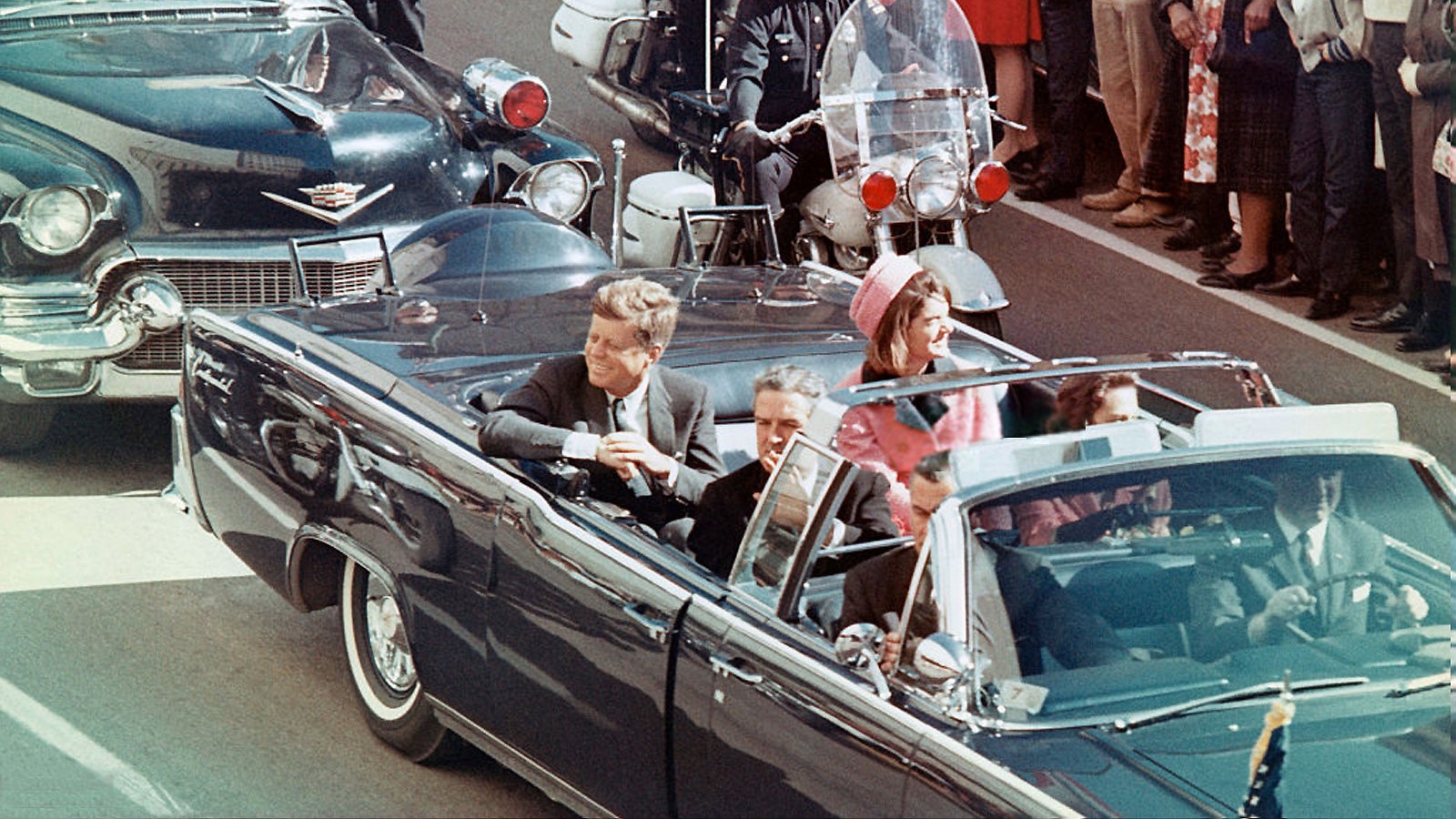
In mid-November, 1963, according to all major best-seller lists, the most popular nonfiction publication in America was a book that portrayed Jack Kennedy as “immature,” “arrogant,” “snobbish,” “glib,” “slick,” “calculating,” “hard as nails,” “mealymouthed,” “opportunistic,” “Machiavellian,” “intellectually shallow,” “spiritually rootless,” “morally pusillanimous,” “passionless,” “vain,” “shifty-eyed,” and, for every good reason, nicknamed “Jack the Knife.” The book, of course, was J.F.K.: The Man and the Myth, by Victor Lasky. By the end of the same month there burned above the grave of the very same man an eternal flame, more often reserved in the protocol of his religion for saints of the first order. Whatever their religious or political persuasion, few Americans were protesting this instant canonization. In the horror, grief, and guilt that overwhelmed the nation following the assassination, the minor Kennedy myth that Lasky had contended against—the fine-liberal-fellow image—had expanded uncountable times, been transformed and purified, burst all mortal bonds, and soared toward the realm of the supernatural. As after the death of Lincoln nearly a hundred years earlier, the common thought of Americans was “How are the fallen mighty!” and John F. Kennedy was on his way to becoming the legendary national hero of his century.
“It is difficult now to comprehend the wave of hero-worship which swept over the country after Lincoln’s assassination,” Roy P. Basler wrote a generation ago in The Lincoln Legend. “Lincoln was suddenly lifted into the sky as the folk-hero, the deliverer, and the martyr who had come to save his people and to die for them … the folk mind was enraptured with the stories of how Lincoln had suffered, prayed, dreamed, and loved mankind and conquered his enemies. How he had doubted, despaired, cunningly schemed, and contrived to effect his ends, no one wanted to hear.” Thousands of Americans were soon seriously arguing that Lincoln was of divine origin. (Alter all, in his own words he was the son of an “angel mother”; his father-of-record was a poor carpenter; and he was shot on Good Friday.) This conclusion would have astonished Lincoln only a little more than, in the view of Arthur Krock and some of John Kennedy’s other friends, the lighting of the eternal flame would have embarrassed Kennedy nearly a century later. But neither man was by this time making history. It was being made for him.
Until 1872 Lincoln biography was entirely in the hands of spiritual and stylistic descendants of Parson Weems, rather than of men who had known him as he was. Then a book appeared by Ward Hill Lamon, a jovial crony of Lincoln’s who had ridden the backwoods legal circuit with him in central Illinois. Lamon was “pre-eminently the Good Fellow,” writes Sandburg, and the President’s more punctilious associates regarded the long Lincoln-Lamon alliance as evidence of “a certain degree of … obtuseness” on Lincoln’s part. “Sing me a little song,” he often said to Lamon, who would then make him smile with some such nonsensical ballad as “Cousin Sally Downard.” “I want you with me, I must have you,” Lincoln told his old friend when he was about to leave for Washington, and he arranged to have Lamon appointed a city marshal at the capital. Lamon’s biography of Lincoln, pulled together by a ghostwriter, was based largely on material gathered by Lincoln’s onetime law partner, William H. Herndon. A bald account of the late President’s political opportunism and his often indecorous life during his western years, it was denounced as “shameless.” “Want of delicacy and even decency,” wrote a more worshipful biographer, made its appearance “something close to a national misfortune.” The book did not even reap the traditional reward of publications charged with indecency; it was a financial failure. In the first years after the assassination Herndon had delivered several lectures based on the material he had made available to Lamon, but it wasn’t until 1889 that he published his own biography, Herndon’s Lincoln, in which Lincoln emerged as an earthy, moody, irreligious frontier hero, unrecognizable as the saintly Christian martyr of prevailing legend. (“Why, Lamon,” wrote Herndon, “if you and I had not told the exact truth about Lincoln he would have been a myth in a hundred years after 1865.”) The Herndon book, which, of course, launched myths of its own, such as the Ann Rutledge love story so infuriating to Mary Todd Lincoln, brought Herndon less than five hundred dollars in royalties in the next eight years. Their tedious, circumspect Abraham Lincoln: A History proved to be a more profitable venture for Lincoln’s two private secretaries, John G. Nicolay and John Hay. Authorized by Robert Todd Lincoln, the President’s surviving son (Nicolay and Hay, gibed Herndon, were “afraid of Bob; he gives them materials and they in their turn play hush”), the widely admired biography appeared in serial form in the Century Magazine during the eighties but was not published as a book until 1890, a quarter of a century after Lincoln’s death.
The colleagues of our twentieth-century presidential martyr did not wait so long to be heard from. As we all know, among the nearly two hundred books on Kennedy issued in the thirty-six months after his death (including The Mind of JFK, The Faith of JFK, The Kennedy Wit, More Kennedy Wit, and other striking signs of publishers’ faith in the selling power of the newly sacred name) were reports by his special counsel (Theodore Sorensen’s Kennedy), by one of his special assistants (Arthur Schlesinger, Jr.’s A Thousand Days), by his chief of press relations (Pierre Salinger’s With Kennedy), by his private secretary (Evelyn Lincoln’s My Twelve Years with John F. Kennedy), and by his children’s nurse (Maud Shaw’s White House Nannie). Besides these, there was The Pleasure of His Company, by Paul B. “Red” Fay, Jr., Kennedy’s old friend from PT-boat days whom he called “Grand Old Lovable,” who could always make him laugh with his uninhibited rendition of “Hooray for Hollywood!” and whom Kennedy brought to Washington by arranging his appointment as Under Secretary of the Navy.
None of these posthumous best sellers was authorized by the surviving Kennedys, of course, in the same sense that they authorized the Manchester account of the assassination. Indeed, the family tried to prevent publication of White House Nannie. After the attempt failed, however, they censored only a few paragraphs since it turned out to be in the inane tradition of inside stories by refined nannies who wouldn’t dream of telling all (“[Mrs. Kennedy] never likes to put other people out, even the tiniest bit”). The Pleasure of His Company is on the family Index, although Fay submitted it for clearance and has said that he deleted 90,000 of about 180,000 words at Mrs. Kennedy’s request. His publisher thinks it was not so many. He balked, he said, at removing another 30,000, which would have reduced it to a third of its original length and might have rendered it unpublishable, an outcome the Kennedys may have had in mind. No passim cuts could remedy its pervading indiscretion—the evidence throughout the book that Kennedy, the symbol of intellect and culture come to the White House, had chosen to spend a large share of his leisure time dining the last twenty years of his life with a good-hearted end man whose mother tongue is Kiwanis Club slang and who cheerfully admits he had to be clued in on Renoir and Cézanne. (“If you have to ask a question like that, do it in a whisper,” Kennedy told him. “We’re trying to give this administration a semblance of class.”) Rejecting Fay’s three-thousand-dollar gift to the Kennedy Library, Mrs. Kennedy—for whom those long, recurrent weekends en famille with the Fays may have been somewhat of a trial—wrote that she regarded the contribution as “hypocritical.” Of all the diarists of the Kennedy era to date, Fay, best man at the Kennedy wedding, had been closest to the Hyannisport-Hickory Hill contingent. Since the appearance of his fond but inelegant view of life with their martyred brother, he and the Kennedys have been, as the columnists say, don’t-invite-’ems.
Schlesinger, Sorensen, and Salinger—the S-men- remain decidedly grata in the compound, however, nor have diplomatic relations apparently been severed with Mrs. Lincoln, in whose adoring book the Kennedys made no changes. She had relied almost entirely on her personal diary and her trusty notebook; but the long, intensively documented accounts of the Kennedy administration by Sorensen and Schlesinger—and, to an extent perhaps, Salinger’s specialized report of those years as seen from the White House press office—could not have been written without access to information and records in Kennedy control. Only lion believers would suggest that the authors played “hush” in any respect just because someone named Bob gave them materials. But even before their books were stamped with approval, these men were part of the privy council, sworn to serve the clan that the same nonbelievers have charged with assuming the prerogatives of an American royal family in temporary exile. Members of the council (William Manchester must now be inclined to refer to it as another “long,” the epithet that, in Death of a President, he applies to Johnson’s Texas followers) are pledged to rally around during all Kennedy campaigns, to run general interference in off-election years, to squire the widow about on occasion, and to help the family maintain its dominion over all insiders’ published recollections of the Kennedy era--or so it appears to gawkers on the sidelines. Of course, in the years since the White House was their second home, they have all made other lucrative professional commitments, but there doesn’t seem to be much doubt about where the priorities would lie if a footman should arrive with a summons from Jackie.
During Kennedy’s term of office his staff was accused of trying to manage the news. Now, of course, the charge on several fronts is that of managing history. Kennedy himself during his drive for the Presidency had no qualms about attempting to control what appeared in books written about him. In the late fifties he saw to it that some of his father’s anti-Semitic remarks were removed from a biography of the family, and at about the same time, according to Sorensen, he “waged an intensive effort with his contacts in the publishing world to prevent a projected biography by a writer inaccurately representing himself to potential publishers as a Kennedy intimate—a man whom Senator Kennedy in fact regarded as uninformed, unobjective and unsound.”
The authors of the certified chronicles do not pretend to be objective. Salinger notes that his inability to continue to work for Lyndon Johnson was no fault of Johnson’s, whom he liked. He simply came to realize that “the memory of J.F.K. was too overpowering.” “Our faith in him and in what he was trying to do was absolute,” he writes of Kennedy’s cadre of White House assistants, and, in retrospect, Sorenson is moved by their sense of common challenge and dedication to their leader’s cause to quote Henry V at Agincourt:
Kennedy once joked with his staff about Evelyn Lincoln’s blind devotion to him. “If I had said just now, ‘Mrs. Lincoln, I have cut off Jackie’s head, would you please send over a box?’ she still would have replied, “That’s wonderful, Mr. President, I’ll send it right away. … Did you get your nap?’ ” Often, in these approved histories, when a head has been cut off, Schlesinger and company, though they don’t run for a box, seem to suggest that somebody else did the dirty deed or anyhow talked Kennedy into it. or that, even if their leader did it himself, it was all, in the long run, for the best—especially if he got his nap. For example, they cite every pragmatic political excuse for Kennedy’s trepid record on McCarthyism, and Sorensen himself takes full blame for not pairing him against McCarthy in the Senate vote on censure. (Since Kennedy was incommunicado in the hospital and had not heard the final debate, says his loyal assistant, Sorensen felt it would be in violation of due process to record his vote.) Kennedy, having assailed Eisenhower for failing to issue an executive order forbidding racial discrimination in federally financed housing, then sat on the same order for nearly two years after he took office, but his delay is treated as an instance of his shrewd sense of values—even grace under pressure--since the controversial edict would have endangered the rest of his legislative program. The excuse is not extended retroactively to his predecessor.
The band of brothers combines to portray Mrs. Roosevelt as a villainess, as indeed she appeared to Kennedy in the pre-nomination days when she held him in deep distrust and maneuvered her forces in favor of Stevenson and Humphrey. And although Kennedy did once telephone the New York Times and suggest a vacation for David Halberstam, whose Vietnam dispatches were rankling, he made the call, argues Salinger, knowing full well that its effect would be to insure Halberstam’s continued presence in Southeast Asia. As for the Cuban invasion, some of the press at the time noted that while Kennedy at his own desk was manfully taking entire responsibility for the disaster, his staff in the outer office was plying newspapermen with evidence that the debacle was really the fault of the C.I.A., the Joint Chiefs of Staff, and the previous administration. In their books they are still at it. But then, as Sorensen writes: “This is not … a neutral account. An impassioned participant cannot be an objective observer.”
Still, if we should not be surprised to find Kennedy’s friends giving him the best of it, it’s all right, perhaps, to be taken aback when Schlesinger in the Life serialization of A Thousand Days has the President crying in his wife’s arms after the Cuban setback and then removes the scene from his published book, announcing that “it sounded sob-sisterish” and “didn’t come off.” Apparently where John Kennedy is concerned, the previous winner of the Bancroft, Parkman, and Pulitzer prizes for history thinks of historic material as something that may be tried this way, turned around and tried that way, and balled up and discarded if it doesn’t seem entirely becoming to the subject. And then there is the matter of the style sheet that probably didn’t need to be sent to these prospective authors since they knew the house rules. Among its apparent proscriptions:
Don’t call Bobby “Bobby,” as everybody else does. Salinger, Sorensen, Fay, and Mrs. Lincoln dutifully make it “Bob.” Schlesinger prefers “Robert Kennedy,” even in describing the celebrated occasion when, fully clothed, he jumped or fell into Robert’s swimming pool. There are a few exceptions, almost unavoidable since the books are full of remarks by their President in which he used the politically awkward diminutive. Schlesinger breaks ranks all the way on the few pages that cover the events at the 1960 convention after Kennedy offered Johnson the vice-presidential nomination and, apparently to his astonishment, was accepted, and his brother then appeared in the Johnson hotel suite on what Johnson interpreted as a campaign to talk him out of it. In the farrago that followed, right out of the second act of Three Men on a Horse, the cast of characters included another Bobby, last name Baker. Possibly Schlesinger won a special dispensation, arguing that to play fair and also call the latter “Robert” struck him as a bit much. However, in the account of the same melee by Sorensen, now quite a formal fellow for a born-and-bred Nebraskan, it is “Robert Baker.”
Pretend you always called the President’s wife “Mrs. Kennedy” or “Jacqueline,” not “Jackie,” as the whole world knows her. Although he complies, this stipulation must have been a particular drag to Paul Fay, a highly informal type whose own wife the President always referred to as “the Bride,” who knew Kennedy for many years as “Shafty Boy,” and who shared with him a fraternity of pals called, in middle age as in their youthful Navy days, by such nicknames as Bitter Bill, Dirty John, and Jim Jam Jumping Jim.
The President’s father is not to be called “Joe,” “Old Joe,” or “Big Joe.” Refer to him as Mr. Joseph P. Kennedy or “the Ambassador”—and always respectfully. (“I would like to see Red Fay write this story if my father was not ill—I think it is an outrage,” runs a notation on the Fay manuscript beside an anecdote about Kennedy, Sr., that did not appear in the book.)
Rules having to do with nomenclature need not signify much. Yet anyone reading a biography of Jack Kennedy that leaves out characters called “Jackie,” “Bobby,” and “Big Joe” may be entitled to wonder what else has been omitted to suit his survivors. The only matters suppressed in his book, says Sorensen, are those absent “for reasons of security or propriety.” One of the men delegated by Mrs. Kennedy to help blue-pencil the Fay as well as the Salinger efforts is J. Kenneth Galbraith (who once wrote an essay on the general topic of the political build-up, which he defined as “synthesizing a public reputation as a matter of deliberate design”). Most of the deletions that were eventually made in the books in question, he wrote recently, “involved the elimination of language or anecdotes which, out of context, cast reflection on the dignity of the office of President or which might, without purpose, have injured the feelings of personal friends of President Kennedy”—a patriotic and benevolent censorship policy with built-in conveniences. Mrs. Kennedy, he added, insisted on protecting more feelings—that is, removing more material—than he thought strictly necessary. One noticeable excision from all the books, just for openers: the name of any woman Kennedy ever had the slightest interest in other than his wife, unless you count Mrs. Lincoln’s passing reference to a few anonymous girls so unimportant to Kennedy in his premarital years that he usually took them to the movies once apiece and had his secretary set up the dates at that. One of Fay’s unforgiven transgressions, according to rumor, is his casual mention of the presence at the inaugural festivities, presumably with Kennedy’s approval, of a young actress the President is said to have admired. Other evidence in the Fay book makes it obvious that Grand Old Lovable saw a great deal of his old Navy friend in the decade between the PT-boat episode and Kennedy’s marriage at the rather advanced age of thirty-six, but virtually everything that went on in that unencumbered time is apparently among the thousands of words that Fay was persuaded to sacrifice in the vain hope of staying in the family favor. His book was published by Harper and Row, which had brought out Profiles in Courage and at the time was hoping to publish Manchester’s Death of a President without legal incident. Clearly, if the present keepers of the eternal flame can prevent it, there will be no Ann Rutledge chapter in the Kennedy legend.
Lincoln once found a life of Edmund Burke “so lavish in praise of his every act that one is almost driven to believe that Burke never made a mistake or a failure in his life.” Most biographies, he grumbled, “commemorate a lie, and cheat posterity out of the truth.” Kennedy had a similar complaint after reading the first volume of Eisenhower’s autobiography. “Apparently Ike never did anything wrong,” he said. “When we come to writing the memoirs of this administration, we’ll do it differently.” Whatever blocking tactics Kennedy tried to use on books about himself during his long campaign for the Presidency, once that was won and then irrevocably lost, it was his remark about biography and infallibility that his personal historians tried to keep in mind. Despite all their excuses for him vis-à-vis McCarthy, they felt free to conclude that in many respects he was “insensitive” and “wrong” on this issue. After all the many alibis for the Bay of Pigs, his performance there is labelled essentially “stupid”—and, as is often the case in these books, the harsh judgment is his own.
Soon after he took office, Kennedy directed the Voice of America to broadcast the nation’s story “with all our blemishes and warts, all those things about us that may not be so immediately attractive.” If certain of his own blemishes are still considered unmentionable, the authorized accounts are not without authorized warts. They don’t hesitate to mention his crankiness, his scorching sarcasm and quick temper, his lack of consideration for those working for him, and his impatience with anyone, no matter how worthy, who bored him. Although only an infrequent “son of a bitch” or “kicked in the can” is quoted, there is no pretense that his language in private was in keeping with his posthumous saintlike image. Even the White House nannie tells of an occasion when Caroline left behind in Kennedy’s office a large doll whose special accomplishment was that it would repeat whatever was said to it. The feat involved a tape recorder, and the next day when Caroline retrieved the doll and pressed the proper button, there emerged from its rosebud plastic lips Daddy’s angriest voice, using, said Miss Shaw, “a very naughty word.” Not knowing how to erase the tape, she hastily called a Secret Service agent to perform a disembowelment.
(Curiously, Miss Shaw’s account of the day of the assassination omits Caroline’s harrowing ride through the Washington streets with a Secret Service man just after the news from Dallas began to come in, the episode that Death of a President relates in such detail. Caroline and John, she says, had just had lunch at the White House with Teddy Kennedy’s children and were about to be put down for their naps when the word came. Thus, as in so many aspects of the Kennedy saga, historians are reminded of how variable is the human memory of events even so soon after the fact.)
The books by Kennedy’s three White House assistants are, of course, the memoirs that will be of serious interest to future historians. Of these the gracefully written A Thousand Days is much the best job. After all, Schlesinger has been arranging presidential crises into orderly chapters for two decades. Moreover, most of his White House years were spent not in Kennedy’s West Wing wheelhouse but in the East Wing writing voluminous memos, from which task he would be summoned now and then for advice or for a bit of political legwork. His engagement in Kennedy’s program was not the roll-call-by-roll-call affair that it was to Sorensen and Salinger, and he was able to view it with some perspective against a background of what had gone before and what was happening elsewhere and was thus able to write a book that is more the history of an exhilarating national interval than the biography of one man. Sorensen’s Kennedy is shorter than the Schlesinger book (758 pages vs. 1,031) but it gives the impression of being far longer, since it covers in dense detail the last eleven years of Kennedy’s life (Schlesinger was involved only in the last four) from a vantage point rarely more than a centimeter from Kennedy’s elbow. Salinger’s With Kennedy is a slighter book than either of these; yet it has a certain long-range interest, especially in its accounts of the vast preparations for total war in October, 1962, the problems confronting the American press during the two Cuban crises, and his own comparative intimacy with individual Russians, including Khrushchev.
Before joining Kennedy’s staff, reports Schlesinger, he was warned that he would be plunging into “a ruthless scramble for access and power.” He found instead that “the Kennedy White House remained to the end remarkably free of the rancor which has so often welled up in Presidential households.” Although the three members of the brotherhood whose memories of Kennedy are now in print often deal with the same event, in which each played some part, little jockeying for historical position clutters their books. Their putdowns and waspish digs are generally reserved for others, usually those not wearing a PT-boat tie clasp. Here also the influence of Kennedy as editor-in-absentia is apparent. “Nor would he tolerate from his staff the slightest disparagement of the Vice President,” notes Schlesinger, and although it may have taken some self-control, there are no swipes at the Vice President by these witnesses. All three, in fact, write with sympathy of Johnson’s understandable discomfort in his diminished role. Kennedy’s biographers feel freer to let their disparagement show, however, in reporting the 1960 convention when the two politicians were sworn enemies and, as Schlesinger puts it with historical detachment, Johnson was “laying about with heavy saber strokes, Kennedy mastering him with an urbane and deadly rapier.” As for Rusk, since Kennedy’s commitment to him was no longer total by 1963, Sorensen and Schlesinger permit themselves to write of him with less than total Saint Crispin’s Day loyalty. He was “almost too amiably cautious,” “bland,” “colorless,” “Buddha-like,” and so circumspect that during any given crisis “no one knew quite where he stood.”
There have been complaints, of course, that it was unseemly for Kennedy confidants to rush into print—and then off to the bank—with their versions of events that were so recent and that in some cases involved men still in office. But some historians will presumably be grateful that these reports were published while the memories of the impassioned participants were fresh and feisty rather than, like the biography by Lincoln’s secretaries, written decades later when the excitements of the age were measured from a stately distance. As for their lack of neutrality and occasional discreet excision, perhaps their degree of candor should be compared to that of accounts of the Eisenhower administration that Sherman Adams or George Humphrey might have written if their President had died in office—whether or not the testimonials had been cleared with his survivors.
History, like the news, has always been subject to some management, but the stage directions should be out of earshot. The question is how far the Kennedys and company propose to carry their by now conspicuous presumption. Only three of Kennedy’s ten White House assistants and none of his Cabinet have so far been heard from. But nearly all of them, it now appears, scurried directly home from the West Wing each night to write in their diaries, and the next wave of memoirs should start rolling from the typewriters soon. The planned collaboration by the Irish Mafia—Ken O’Donnell, Dave Powers, and Larry O’Brien—will apparently be a mere tandem affair. O’Brien, unlike the rest of the old gang, is still welcome in the redecorated West Wing where augmenting the J.F.K. mythology is not politically healthy. But doubtless O’Brien’s version will not be permanently withheld from us.
Will the heirs and tenders of the Kennedy mystique continue to assert editorial rights over each new volume, and will the authors acknowledge their eminent domain? No doubt it will depend on whether the authors firmly believe that a new Saint Crispin’s Day lies ahead and care to keep their place among the happy brotherhood around the new Henry V. If so, they will probably see the merit of not tampering with the legend. After all, the saintly-Lincoln myth that nourished after 1865 was of prodigious value to the then-new Republican party, whose dubious political caracoles in the next decades often took place behind a blown-up poster image of a much-loved President dead by an assassin’s hand.
Kennedy’s inaugural message was written after Sorensen, at the President-elect’s direction, made a searching study of the Gettysburg Address, trying to discover its magic formula for immortality. To White House gratification, Sam Rayburn announced after hearing the result of this effort that Kennedy was “better than Lincoln” (“I think—I really think—he’s a man of destiny”). But in Portrait of a President, his first book on Kennedy, published before he became a true, genuflecting believer, William Manchester wrote: “Certainly John Kennedy is not as lovable as Abe. He has a weaker grasp on the nation’s heartstrings, and the reason isn’t that he hasn’t been shot.” It was, of course, after he was shot that the two names began to be linked in an incessant litany. (The other two assassinated Presidents, Garfield and McKinley, were way out of it.) Reams were written about their common vein of humor, their similar fatalism about the danger of assassination, their century-apart (and equally gingerly) enlistment of the authority of the Presidency to help the Negro cause. Jim Bishop, who had written The Day Lincoln Was Shot and was soon making plans to give the same treatment to November 22, 1963, played a macabre game in the Hearst papers, listing numerous other similarities—from the fact that both men were succeeded by Vice Presidents named Johnson to the discovery that the names John Wilkes Booth and Lee Harvey Oswald had fifteen letters each. And right after the murder, Bill Mauldin’s cartoon in the Chicago Sun-Times showed the statue in the Lincoln Memorial covering its face with its hands.
“Find out how Lincoln was buried,” were Jacqueline Kennedy’s words to Chief of Protocol Angier Biddle Duke a few moments after Air Force One landed at the Washington airport on the tragic flight from Dallas. It was not a precedent that was desirable to follow in all details. After the Washington rites, Lincoln’s body was borne on a dead march through a dozen cities before finally being laid to rest in Springfield on May 4, nearly three harrowing weeks after the murder. The Lincoln funeral arrangements were in the hands of Secretary of War Stanton, the widow being bedfast and only half-lucid. Fortunately for the nation, Mrs. Kennedy was of a different mettle. Indeed it seems probable that the memory of her strength and heartbreaking dignity and the part she played in getting the American people through that terrible weekend will make it impossible for most of them to find serious fault with anything she does for the rest of her days (unless, as she herself shrewdly put it three years later, “I do something silly like run away with Eddie Fisher”). At her direction, Kennedy’s coffin, like Lincoln’s, stood in the candlelit East Room of the White House beneath chandeliers draped in black, and then in the great rotunda of the Capitol on the same catafalque, covered in black velvet, that had held Lincoln’s coffin. Following the ninety-eight-year-old scenario, six gray horses drew it down Pennsylvania Avenue to the same muffled roll of drums. Behind the wooden caisson walked, as in 1865, a riderless gelding with boots reversed in the stirrups, the military symbol of the fallen warrior. Two weeks later when Mrs. Kennedy and her children left the White House, the new tenants found that, in case anyone had missed the point, the names of the two murdered Presidents were now permanently linked in stone. The words “In this room lived John Fitzgerald Kennedy with his wife Jacqueline during the two years, ten months, and two days he was President of the United States, January 20, 1961—November 22, 1963” had been carved in the white marble fireplace of what had been Kennedy’s bedroom, directly below those that had long read: “In this room Abraham Lincoln slept during his occupancy of the White House as President of the United States, March 4, 1861—April 13, 1865.” It is doubtful if A. Philip Randolph, who a few days earlier had said that Kennedy’s “place in history will be next to Abraham Lincoln,” expected his words to be followed so literally, or so soon. But what seems most remarkable of all is that Abraham Lincoln found his place—in history, graven in stone, enshrined in legend—although at the time of his death his widow was the kind of woman no one paid any attention to, and he hadn’t a father, mother, sister, or brother to his name.