
Trusted Writing on History, Travel, and American Culture Since 1949
SEARCH 75 YEARS OF ESSAYS!
October 2004
Innovation
With American Heritage approaching its fiftieth birthday in December 2004, we asked five leading historians and cultural commentators to each pick 10 leading developments in American life in the last half-century. In this fifth installment, Phil Patton—whose books include Made in USA: The Secret History of the Things That Made America and Bug: The Strange Mutations of the World’s Most Famous Automobile—selects the 10 biggest changes in the realm of innovation and technology. In previous issues we presented our other authorities’ choices of the half-century’s biggest transformations in politics, business, home and the family, and entertainment and culture.
“I can’t imagine how we lived without it.” So we often say about an innovation that has changed our lives. But about the changes that have been most deeply absorbed into the pores of daily routine, we could also often say, “I can’t remember how we lived without it.”
125 Years Ago
At 9:00 a.m. on October 22, Charles Batchelor, a researcher in Thomas Edison’s “invention factory” in Menlo Park, New Jersey, sat down to record the results of the previous day’s work. “We made some very interesting experiments on straight carbons made from cotton thread … ,” he began. The results were interesting indeed. Earlier that month, after more than a year of frustrating efforts trying to make an incandescent light with platinum wire, Edison and his colleagues had struck out in a different direction, using filaments made of carbon instead. That had proved to be the key decision in the invention of Edison’s light bulb.
An early arrest proved no deterrent
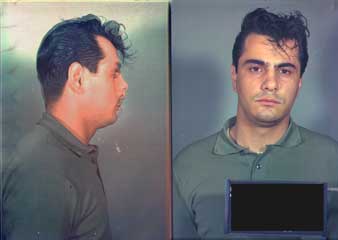
In 1965 I was a patrolman with the Suffolk County Police Department on Long Island, New York. One late night on patrol in the hamlet of Selden I came upon a young man trying to break into Mickey’s Bar, a local watering hole that had closed hours earlier. My first thought was that he was a juvenile trying to get a last bottle of booze for the night. I pulled my gun and cornered him behind the tavern. Pushing him up against my patrol car, I warned him not to move a muscle or I’d blow his head off. (In those days the rules that governed our dealings with potential lawbreakers were more relaxed than they are now.)
A landmark of comic art is saved from destruction
The newspaper comic is among the most ephemeral of art forms, but for almost 30 years a mural featuring cartoon characters has been lovingly preserved by the owners of a bar in New York City. The longtime showpiece of Costello’s, at 225 East Forty-fourth Street, was a wall decorated by America’s most famous cartoonists, but when the bar’s owner sold it earlier this year, the mural seemed in danger of going the way of yesterday’s crossword.
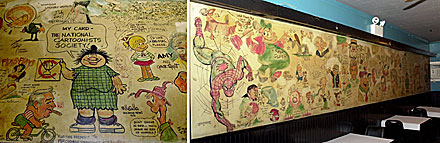
(LINDA ROSIER/NEW YORK DAILY NEWS)
Looking at the Big Picture
I have now been writing about the American economy and American business in this column for 15 years and enjoying every column inch of the job. One might think it would be a rather narrow subject, or even dismal, to use Thomas Carlyle’s famous descriptive. In fact it is just the opposite, for economics, properly considered, goes to the heart of what it means to be human. If our species only occasionally deserves its formal Latin name, Homo sapiens, we are always—rich and poor, smart and dumb—members of the species Homo economicus. Getting and spending are as necessary to life as breathing and sleeping.
Senator Tom Coburn (R., Okla.) on Thursday tried to get the Senate to rescind some of this year’s pork barrel spending. His purpose was to provide funds to help rebuild devastated Louisiana and Mississippi without going further into deficit.
The Senate decided to keep the pork. The vote wasn’t even close, 82-15 to be exact. (see linked article). Senator Ted Stevens, (R., Alas.), president pro tempore of the Senate (i.e., the senior member of the majority party and thus fourth in line for the presidency), was so outraged at the idea that he threatened to resign from the Senate if Sen. Coburn’s proposal passed. So a $220 million bridge to an island with a population of 50 will be built in Alaska, and the once-busy bridge over Lake Pontchartrain, now in ruins, will have to find the money elsewhere, which is to say in the bond market.
A few months ago, on a flight from Atlanta to New York, I found myself in a seat behind a man of about 19 or 20. He was wearing fatigues, the functional, not the fashionable, kind.
That I disagree with John Steele Gordon is not evidence that I can’t check “partisanship at the door and search for truth, not political advantage.” It’s merely evidence that I disagree with John Steele Gordon.
What I find more interesting in our exchange, for our purposes as a history Web site, is the controversy over Alger Hiss. I’m glad that Mr. Gordon brought up the topic of the Venona files, as this gives me entrée to recommend to our readers a fascinating article by David Lowenthal, a professor emeritus at University College London. Lowenthal blows some big holes in the theory that the Venona files implicate Hiss. http://hnn.us/articles/11579.html
Lowenthal’s argument is complex, but I’ll try to summarize it:
One sure sign that you’re getting old is when the decade you grew up in becomes the subject of campy nostalgia. It’s a 20-year cycle, so when I was growing up in the 1970s, we all watched Happy Days and Grease and put on what no doubt were grotesque parodies of 1950s sock hops in our high-school gyms. Did 1950s kids imitate the Depression, I wondered? Maybe not, but a few years ago, when I was reading a lot about the late 1940s, I was surprised to learn that Al Jolson and live vaudeville made comebacks after World War II.
In recent years my own decade has gone through the wringer, though it seems to be waning now. I knew the ’70s revival had passed its peak when I went to a basketball game and the team’s mascot appeared during a time-out disguised as what the announcer called “Mr. ’70s.” This basically amounted to a hippie on a skateboard, and I thought: Okay, if you take the average of ’60s and ’80s, I guess it comes out to ’70s.