
January 2011

war of 1812
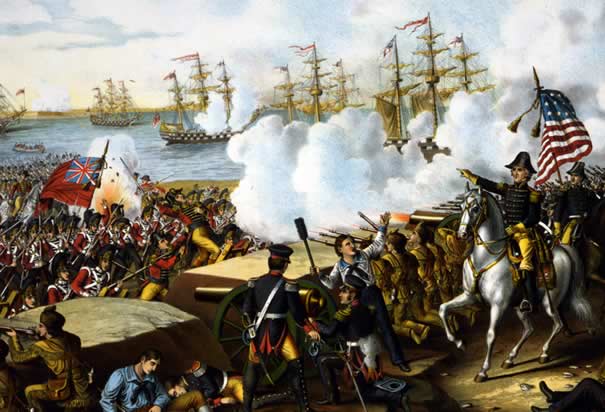
Major General Andrew Jackson and his soldiers claim a victory in the Battle of New Orleans during the War of 1812. Georgia National Guard

The War of 1812 has never quite lived up to, and never quite lived down, its title of The Second War of Independence. The suspicion that it was unnecessary, the fact that it was inconclusive, the fog of disunion, apathy, and muddle that hangs about it—these provide a dismal context for its heroic episodes and figures. Even so great a reputation as that of James Madison has been somewhat stained by it.

Late in the evening of August 21, 1793, Dr. Benjamin Rush, Philadelphia’s most prominent physician, sat down “much fatigued” to write to his wife to inform her that a “malignant lever” had broken out on the city’s water front. The disease, which had carried off twelve persons, was “violent and of short duration.”

“It had,” he wrote, “in one case killed in twelve hours,” and in no case had it lasted more than four days. What he did not write was that he had become convinced that it was the dreaded yellow fever.


The sea and the deep broad bays and rivers sweeping far into the continent ottered the early American colonists their easiest and cheapest highroad for commerce and communications. There were literally tens of thousands of miles of shore line which could be reached handily by boat, yet because of some perverse streak in man’s nature it wasn’t long before a number of restless people packed their scanty possessions and struck out for the heavily wooded, hilly interior.


For over two and a hall centuries now a persistent myth has haunted the minds of certain restless Americans. It is the dream of the big bonanza, or the jackpot—the jump from poverty to affluence overnight in one supernatural stroke of fortune.

Historians, of course, must be chary about naming the exact source of any legend. It is reasonable, however, to give a large share of the credit for this one to the exploit of William Phips, who, as a 36-year-old lumber-trading skipper from Boston, dredged up a fortune in gold and silver from a sunken Spanish vessel just oil the coast of what is now the Dominican Republic, in the year 1687. His entire career was one protracted laugh at the laws of probability; like all favorites of luck, he seemed to be specially excused from their operation.

“Our want of powder is inconceivable,” wrote Washington in the bitter early days of the Revolution. So too was our want of guns, supplies, and everything needed in a war against one of the major powers of the earth. Above all we needed an ally. And so the man who believed that there never was a good war or a bad peace, old Dr. Benjamin Franklin, a man laden with the world’s honors who might easily have pleaded age and weariness, set out for France in his seventy-first year to secure these necessities for his country.

This is an old tale, and not a pretty one; it is a true tale, a real “Western,” although it wouldn’t go on TV. It sounds to me like a ballad—the ballad of Cynthia Ann.


This is an old tale, and not a pretty one; it is a true tale, a real “Western,” although it wouldn’t go on TV. It sounds to me like a ballad—the ballad of Cynthia Ann.

Help us keep telling the story of America.

Now in its 75th year, American Heritage relies on contributions from readers like you to survive. You can support this magazine of trusted historical writing and the volunteers that sustain it by donating today.

Donate