
January 2011

Trained in the Düsseldorf school of dramatic, grandiose art, Albert Bierstadt devoted his life to painting the massive beauty of the Western landscape. He roamed the Rocky Mountain country in the 1850’s and 1860’s, painting the Indians, the buffalo, the wagon trains and, towering above all else, his beloved mountains. Bierstadt’s grandiloquent canvases left Eastern critics cold, but they brought him the acclaim of the people and the highest prices (up to $35,000) that had ever been paid to an American painter. When he painted his “Last of the Buffalo,” vast herds of bison still roamed the Plains, but within a few years they had been wiped out, not by the Indians’ spears but by the guns of white hunters.
No one ever caught the Old West, either in spirit or in fine detail, as faithfully as Frederic Remington. An Easterner, a Yale student and a youth of independent means, he went west in 1880 at the age of nineteen to make his own way as a cowboy and gold prospector. Fascinated by what he saw, he began filling notebooks with on-the-spot sketches of men and animals in action. Years later Remington asked to have his epitaph read: “He Knew the Horse.” He knew also the Indian, the cavalryman and the cowpuncher, the wagon train, the roundup and the campfire, the working and fighting of frontier life that was vanishing even as he caught it with his brush.

For twenty years Charles M. Russell was a working cowhand, riding the
Montana range, wrangling the horses and singing to the herds at night. One long winter he lived with the Blood Indians, across the border in Alberta. Russell liked the Indians and keenly felt the tragedy of a proud warrior people left helpless before the engine of industrial civilization.

By the time Henry F. Farny visited the Sioux country in the 1880’s, telegraph wires spanned the ancient buffalo range and the Indians had been pushed onto reservations. A sympathetic observer of the Red Man baffled by the White Man’s scientific world. Farny helped to win him a measure of belated justice.

In 1936 in New York City there occured the 100th anniversary of the Union Club, oldest and most socially sacrosanct of New York’s gentlemen’s clubs. From all parts of this country and even from abroad there arrived, from lesser clubs, congratulatory messages, impressive gifts and particularly large offerings of floral tributes.

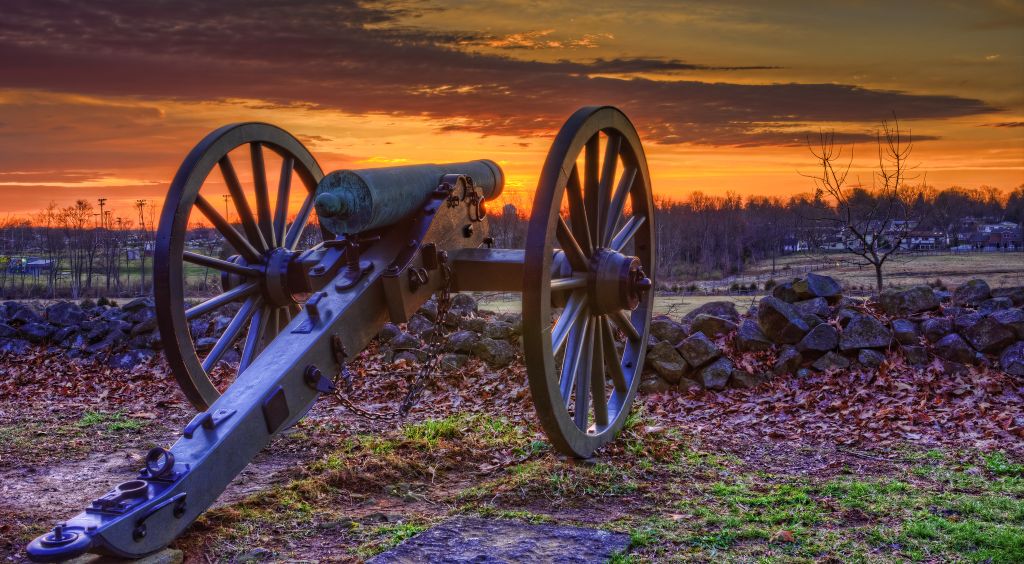
Cannon at Gettysburg, by Craig M. Fildes
An 1857 12-pound Napolean cannon still guards the battlefield at Gettysburg. Photo by Craig M. Fildes.

The sun goes down every evening over the muzzle of a gun that has been a museum piece for nearly a century, and where there was a battlefield there is now a park, with green fields rolling west under the sunset haze to the misty blue mountain wall. You can see it all just about as it used to be, and to look at it brings up deep moods and sacred memories that are part of our American heritage.

It is a big country, sprawling all the way from the Alleghenies to the Rockies, and it puts its mark on the people who live in it. Its climate tends to be uncompromising— baking heat in the summer, hostile cold in the winter—and it has never done anything by halves. Where it had forests, they rolled for hundreds of miles, great stands of hardwood, green twilight under their branches; its open prairies were like the sea itself, rolling west in an unbroken treeless groundswell.

A young Pennsylvanian, George Catlin, went west in the 1830’s with the purpose of preserving in art the culture and customs of the American Indian. For thirty years he traveled in Indian country, making a record of tribal life unmatched for thoroughness and accuracy.

A Swiss artist, Karl Bodmer, ascended the Missouri in 1833 with the German explorer-scientist Prince Maximilian of Wied-Neuwied. At Fort McKenzie, where the Blackfeet Indians came to trade furs, he painted their chiefs in full regalia. He was watching early one morning when a war party of Crees and Assiniboins, jealous of the Blackfeet’s trading privileges, attacked the camp outside the fort. The survivors of the slaughter were given refuge in the fort until the main force of Blackfeet came riding to their rescue.

This young Baltimore artist was hired by a Scottish adventurer. Captain William Drummond Stewart, to join him at St. Louis and paint pictures to adorn the Captain’s castle in Scotland. They followed the Oregon Trail through hostile Indian country to Fort Laramie, where Miller painted this famous frontier post with its surrounding Indian encampment.

Help us keep telling the story of America.

Now in its 75th year, American Heritage relies on contributions from readers like you to survive. You can support this magazine of trusted historical writing and the volunteers that sustain it by donating today.

Donate