I have virtually memorized key elements of “The Media and the Military” (July/August). This piece could not be more timely.

I have virtually memorized key elements of “The Media and the Military” (July/August). This piece could not be more timely.
Peter Andrews relates that Westbrook Pegler “tried” to get an interview with Gen. John J. Pershing and that Pershing was rudely brief with Pegler during the interview. Donald Smythe, Pershing’s biographer, relates the incident as follows:
“A very busy man, [Pershing] disliked wasting time in pointless talk or fruitless digressions. He also resented being interrupted. When the newspaperman Westbrook Pegler walked in unannounced one day and asked for a statement, he got one. ‘Pegler, get the hell out of my office!’”
Perhaps Pegler should have asked for an interview rather than a statement; he got no more and no less than he deserved.
I read with great interest Bernard Weisberger’s article “The Abominable No. 2 Man” (September), which drew on historical precedent to suggest the unlikelihood of Dan Quayle’s being removed from the ticket. But if Bush does want to engineer the removal of his Vice President next year while publicly appearing to support him, he need not look any further than the example set by Franklin D. Roosevelt in 1944.
Henry Wallace, like Quayle, did not command a great deal of respect or power in the Senate. But also like Quayle Wallace had been a loyal Vice President for four years and the President and his wife liked him. FDR was a politician first, however, and despite the fact that his chances for re-election to a fourth term were excellent, victory was a relative term for him. He made a career out of winning big and he wanted to win big again.
What was the nature of the spell Castro wove over his masses? Géorgie Anne Geyer, a foreign correspondent and syndicated columnist, asked herself as she began work on the biography Guerrilla Prince, the Untold Story of Fidel Castro . Now, after six years of research and five hundred interviews conducted in twenty-eight countries, she has a pretty good idea.
When the victorious young revolutionary Fidel Castro marched into Havana the first week of January 1959, the world cheered. “Fidel” had come down from the mountaintops—like Mao Tse-tung, like Moses, like Christ himself—to bring democracy and freedom to a long-suffering Cuban people.
Those battles in the Sierra Maestra were immediately transmogrified into legend, his tactics admired and mimed. Fidel himself came to be the prototype of Everyman’s fight against dictatorship and oppression in the second half of the twentieth century.
It is frustrating that photography didn’t arrive earlier. Louis Daguerre discovered how to fix an image on a sensitized plate in the 1830s, but everything he used to work that momentous trick, from the lens that focused the light to the mercury vapor that developed the picture, had been around for generations. So while it is not possible, say, to have had airplanes during the Civil War—their existence would have required industries that simply didn’t exist—a photographic record of the American Revolution would have been perfectly feasible had someone only lit on the proper recipe.
I think such a record would change the way a good many people feel about that struggle. The Civil War has lost none of its power to move us, whereas the Revolution —which, after all, took place just a lifetime earlier—can seem a sort of inevitable civic exercise. It arouses the feelings voiced with simple eloquence by the distributor in the thirties who begged MGM to make “no more pictures where they write with feathers.”
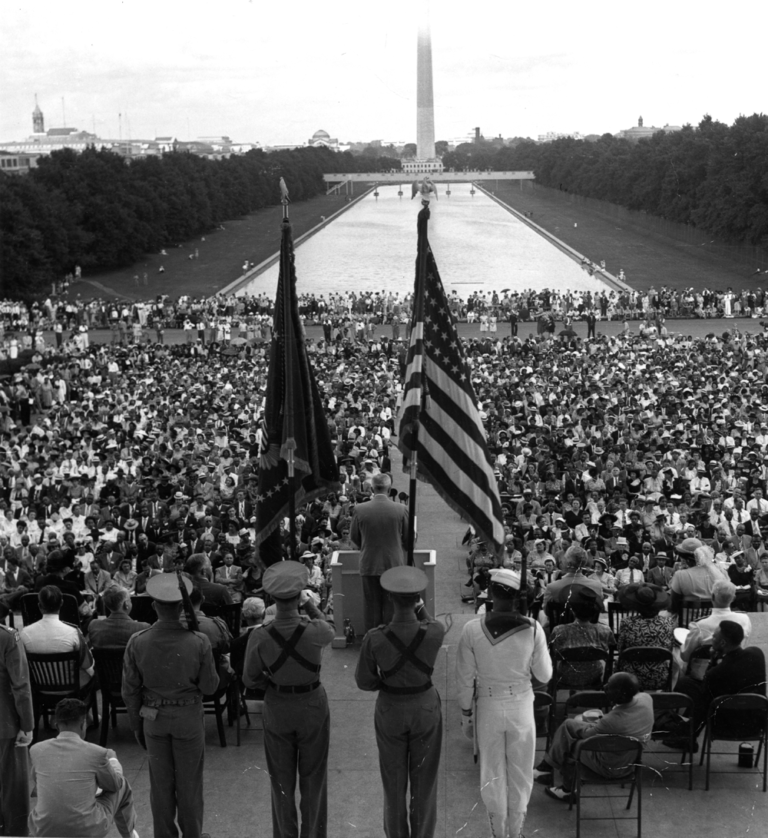
the NAACP’s 38th Annual Convention, the first
president ever to do so. National Park Service
Like a hurricane spawned in distant waters, the full force of the collapse of world communism has finally reached the island of Cuba and seems poised to sweep away the last vestiges of the Marxist-Leninist structure erected there over the last three decades. The demise of Cuban communism has been better foretold than its rise: in 1958, few Americans could have imagined the establishment, 90 miles off their shores, of a Soviet-allied state that, within four years, would bring the world to the brink of nuclear catastrophe. I certainly had no idea it could happen; America’s Cold War obsession with communism at home and abroad seemed to ensure that nothing like that would happen. But as it turned out, I unwittingly participated in the making of one of history's great surprises.,
Taking off in her modified Curtiss biplane from Chicago’s Grant Park on November 19 and landing in Hornell, New York, nearly six hours and 512 miles later, Ruth Law set a new longdistance flying record surpassing the previous one by 22 miles. Law’s plane had two secret advantages: overhangs on the wings for greater altitude and extra fuel tanks to accommodate 53 gallons instead of the normal 8. A sustaining tail wind also helped by keeping the plane’s speed at more than 100 miles per hour.
Law left Chicago at four in the morning, so bundled against the cold, she later recalled, that “I didn’t look any more like a woman than anything at all. A man, a workman with his lunch pail, came hurrying over, stretched out his hand, and said, ‘Well, good luck, young feller. I hope you make it.’”
Law flew without instruments, relying on strips of survey maps mounted on rollers inside a glass-topped box, which she tied to her left knee, “so that I could reach it and turn the map” to keep up with the changing scenery below.
As the returns came in through the long night of November 7, first The New York Times , then the New York World conceded the presidential election to Charles Evans Hughes, bearing out the odds makers’ 10-to-7 line against the incumbent, Woodrow Wilson. The Far West was yet to be heard from when news of the Times ’s concession interrupted the Wilsons’ game of Twenty Questions in Princeton. “Well,” said the judicious President, “I will not send Mr. Hughes a telegram of congratulations tonight, for things are not settled. …” He proposed to Mrs. Wilson that they have a glass of milk and go to bed. There was nothing to be done for now.
November was a month of readying for war—in Washington and on the seas. The Roosevelt administration’s two amendments to the Neutrality Act passed the Senate on November 7 and survived a close vote in the House six days later. The first amendment repealed a prohibition against arming merchant ships, while the second freed them to travel through war zones; together the amendments made commercial vessels less vulnerable but increased the chance of real American involvement in the war.