I find it difficult to understand how someone who chooses to read American Heritage has so little sense of history as to condemn that same magazine for running a story about Robert E. Lee. Whatever one’s feelings about North and South, Lee was a major actor during a crucial part of our country’s history. He was also product of a different time, as was Jefferson Davis, and both men were perceived as heroes by a large segment of the population of the country. To say that historians should ignore those from the past whose views differ from our own is tantamount to destroying much of what has made us what we are today.

Trusted Writing on History, Travel, and American Culture Since 1949
SEARCH 75 YEARS OF ESSAYS!
January 2011
Supreme Court vacancies have provoked fierce, colorful, and wholly partisan battles since the earliest years of the republic.
When Thurgood Marshall announced his retirement from the United States Supreme Court, politicians and pundits across the country bewailed the president’s succumbing to “politics” when selecting Marshall’s replacement. “Where are the giants?” demanded Newsweek, adding that “politics is packing the court with mediocrity.” In fact, this Court’s intimate relation to “politics” is as old as the Court itself, and it has managed to give us, along with the pygmies, some giants. Starting with George Washington, every president selecting a Supreme Court justice has kept clearly in mind the nominee’s compatibility with his own governmental—that is, “political”- philosophy.
Some people think that the history of boxing as a glamorous business, as promotion rather than as sport, begins with Muhammad Ali and Don King. Before Ali, they say, boxing was I just a bunch of palookas punching each other. Ali was boxing’s first showman, they say, the first glamour boy, the first bad guy whom the fans loved to hate; the first black athlete to be revered worldwide, the sport’s first true media creation. Don King, meanwhile, is sometimes thought of as the original larger-than-life promoter, the man who first showed us that a boxing match can be turned into one small part of a weeks-long media circus—one that can end by grossing, as did the Holyfield-Forman bout last spring, well over $70 million.
A century ago this month Chicagoans were at work with the builders’ zeal that had made them famous around the world, transforming 586 acres of wasteland into a sugar-white civic fantasy that one out of every four Americans would visit and that would make its influence felt in every town in the country—and all in the name of Columbus. There’s no great Columbian Exposition taking shape anywhere in America today. The commemorations tend to be diffuse and tentative. The state of Massachusetts, for instance, has just announced “Celebrate Discovery, Inc. (CDI)” to “implement programs” for the Columbus Quincentennial. GDI’s plans include “A Celebration of Peace and Justice,” an “Environmental Bell Ringing,” the issuing of a “500-page AIDS Strategy Book,” and a “Brochure describing GDI’s mission.”
I enjoyed “How the Seventies Changed America” (July/August), after I recovered from the shock to my babyboomer mentality of seeing that any decade of which I had a clear recollection could be classified as historical. However, there was one statistical point that I considered misleading. Mr. Lemann wrote: “As the country was becoming more fragmented, so was the essential social unit, the family. In 1965 only 14.9 percent of the population was single; by 1979 the figure had risen to 20 percent.” Throughout much of our country’s history, anywhere from 20 to 25 percent of the population remained single. But the 1950s and 1960s saw, among other postwar anomalies, a steady increase in the percentage of people who married. So while the current percentage of single adults may seem artificially high compared with the peak marrying decades, it is in line with figures for most of the years before that time.
In his fine article “Getting Right With Robert E. Lee” (May/June), I believe Stephen W. Sears missed the point on the character of this Confederate military genius. Like most revolutionary figures of this world, Lee lacked any sense of what future he was fighting for, but only saw what he was fighting against. This may be honorable and gallant in the short term, or in a very limited sense, but Lee fought against what George Washington’s greater vision told him he was fighting for—a stronger union. In short, I look upon Lee as a Shakespearean-type tragic figure, and therein lies his fascination.
In the “Correspondence” section of the July/August issue, Ms. Frances O. Bohman states that “R. E. Lee was a slave owner.” Robert E. Lee was only eleven years old at the time of his father’s death, and the family had become next to impoverished. After he was appointed to the United States Military Academy, he was involved in the military almost entirely. Lee married Mary Anna Randolph Custis, and in 1857 her father died. He had asked particularly that all of his slaves be “emancipated at his death,” and they were—by Lee, as executor. In essence, there is no evidence that Robert E. Lee ever owned a single slave. The writer says also that General Lee should have been executed for treason. A day or two after Appomattox, a cheering crowd approached the White House with a band playing patriotic songs. After a while President Lincoln raised his hand and said to the crowd, “Now let the band play ‘Dixie.’”Apparently Mr. Lincoln didn’t have the animosity in 1865 that Ms. Bohman does in 1991.
“The shooting has started,” announced President Franklin D. Roosevelt in a radio address to the nation on Navy Day, October 27. “America has been attacked.” Ten days earlier the U.S. destroyer Kearny had been torpedoed by a German submarine, and eleven of its crew had become the first Americans to die in the war. When it was hit, the Kearny had been escorting ships off Iceland as part of the joint British and American effort to protect merchant traffic in the Atlantic.
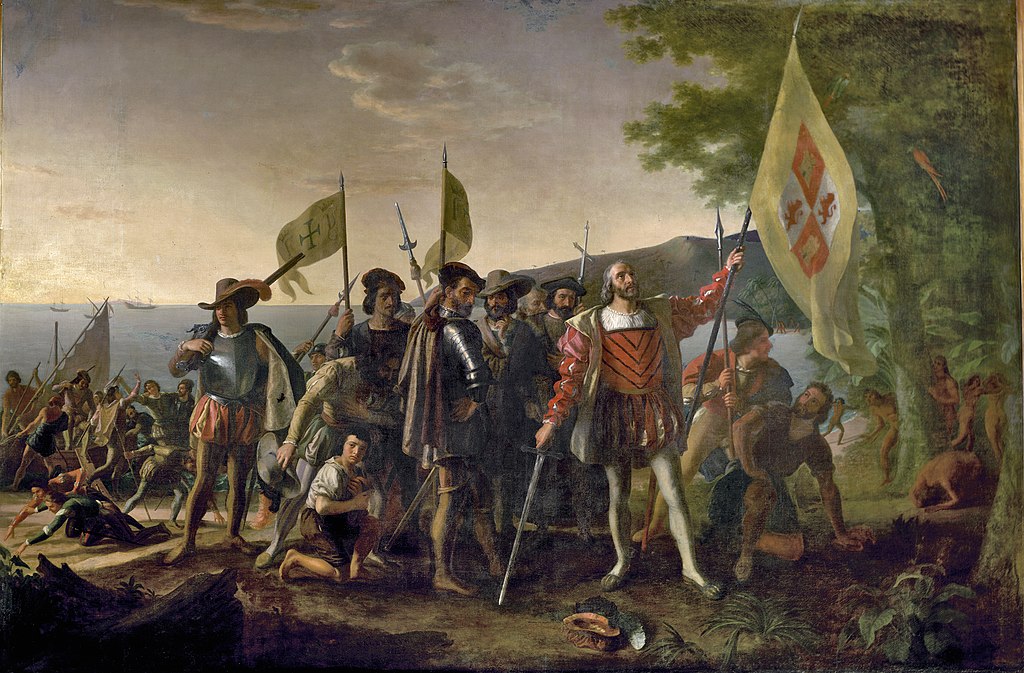
1. DID COLUMBUS DISCOVER THE NEW WORLD?
No. But how pleased he would have been to learn that he is often credited with discovering two vast, far-flung continents whose size and variety he could scarcely have begun to imagine. Those continents had been populated for millennia by a mix of peoples whose cultures were as diverse as their lands. They may have migrated from northeastern Asia more than fifteen thousand years ago. When they came is still a matter of warring scholarship, but those natives were the discoverers of the New World.