
January 2011

My favorite historical puzzle is the question of what Lincoln actually thought about Reconstruction and black rights in the period just before his assassination. Was he on the verge of accepting the radical commitment to federally enforced racial equality, or was he closer to the conservative position that would be defended by his successor, Andrew Johnson? Two key documents, supporting one side or the other, have been discredited or at least called in question. One is a letter to Gen. James S. Wadsworth advocating universal manhood suffrage for blacks, which was apparently concocted after Lincoln’s assassination to support the black-suffrage cause. The other is the uncorroborated testimony of Gen. Ben Butler that as late as 1865 Lincoln still considered the “colonization” or deportation of the freedmen the best policy that the federal government could pursue. The remaining evidence is inconclusive, and we still don’t know whether Lincoln embraced public equality at the time of his death or remained a moderate white supremacist. A plausible solution is that he had not yet made up his mind.
I think the two greatest mysteries in American history concern the Sacco-Vanzetti and Alger Hiss cases. With regard to the first, Felix Frankfurter once wrote his friend William L. Marbury, a Baltimore attorney, that when he reached heaven, he wanted the divine authorities to give him the true story of that case. Were the two Italians guilty of murder, or were they victims of unjust prejudice against Italians and against anarchism when the state of Massachusetts sent them to their death?

Equally intriguing is the role that Alger Hiss may or may not have played in the transmission of American diplomatic secrets to the Soviets on the eve of the Second World War. If I had a battery of graduate students, I would like them to rummage in the files of the Soviet intelligence agencies to locate whatever materials might shed light on the matter. Certainly there are mysteries surrounding the affair that Alien Weinstein’s study, Perjury , could not resolve beyond a shadow of doubt.

Anybody solving my favorite mystery in American history will ease my frustration at my own failure to do so. Twenty years ago for a book in process I set myself to find out who invented the hamburger—not its grandfather, the German-born “Hamburger steak,” a broiled mound of chopped beef eaten with knife and fork, but the browned patty tucked into a plump white roll that became the worldwide symbol of American gastronomy. I did draw some blood: Around 1900 Louis’ Lunch in New Haven was serving a broiled beef-patty sandwich, but that was on sliced bread, not the roll, as essential to the classic hamburger as potatoes are to clam chowder. I managed to trace a rapid infiltration of a “hamburger” item into lunch wagons and carnival lots well before World War I but turned up no definite point where the roll took over. People kept telling me roll-hamburgers first appeared at the St. Louis World’s Fair of 1904. But local archives had no trace of such a thing, nor did Thomas Hart Benton when I asked him about it: “No, sir, I had a growing boy’s appetite, and I was all over that fair every day—no hamburgers.”

More than anything I would like to know who really shot Huey Long or what actually happened in the marbled back corridor of the Louisiana State Capitol on September 8, 1935. And while we’re at it, I’d like to know who got the “de-duct” box, Huey’s presidential campaign chest filled with more than a million dollars in “contributions” from state workers “encouraged” to tithe to the Kingfish.

By the summer of 1935 Long had become even more ruthless and driven than ever, sure that he could beat FDR the next year and confident, even though he was a United States senator, that he could still control everything back home. After introducing forty-two power-enhancing bills in the Louisiana House on Sunday, September 8, including one that would eliminate an old enemy, Judge Benjamin Pavy, by redrawing his district, Huey confidently roamed the State Capitol. Waiting in a hall outside the House chamber was Dr. Carl A. Weiss, the son-in-law of Judge Pavy. According to some witnesses, Weiss was carrying a .38-caliber pistol. What happened next is wrapped in mystery and contradiction.

For almost a decade historians and journalists have known only a small, small part of post-World War II America’s most intriguing spy story: how from the early 1950s through the early 1980s the FBI’s two most prized secret informants were a pair of aging Communist party international travelers, Jack and Morris Childs. The Childs brothers’ story is both-fascinating and convoluted. Personally acquainted with a wide range of world figures, ranging from Fidel Castro to Mao Tse-Tung, the brothers—spoken of as Solo within the U.S. intelligence community—played significant roles in multiple arenas: questioning Castro about Lee Harvey Oswald and the Kennedy assassination; and telling the FBI that Stanley D. Levison, a New York attorney who later would become one of Martin Luther King, Jr.’s principal advisers, was a central figure in the subterranean financial structure of the Communist party (CP).

Did Franklin D. Roosevelt realize how ill he was by the end of the year 1944, when he was about to begin his fourth presidential term? Why in heaven’s name did he insist on holding onto the Presidency, considering that Gov. Thomas E. Dewey surely would not have changed American foreign policy, had Dewey been elected?

Clark Clifford once said that Roosevelt thought he was going to live forever. And yet in his heart of hearts he must have known better. In late 1944 he was no longer waited upon by his regular physician, Vice Adm. Ross T. Mclntire, an ear, nose, and throat man, but by Lt. Comdr. Howard Bruenn, a heart specialist, who was seeing him every day. How much imagination did it take to see what was going on?

The mystery I should like to see resolved is the clearing of Kurt Waldheim, in 1971, by the CIA, for election to his post as secretary-general of the United Nations.

When Andrew Jackson ran for the Presidency in 1828, the Nashville Central Committee issued a statement to explain the strange, indeed mysterious, circumstances of his marriage to Rachel Donelson Robards. According to the committee’s report, Jackson escorted Rachel to Natchez in January 1791 to help her escape her husband, Lewis Robards of Kentucky. Then he returned home. Several months later Jackson heard that Robards had obtained a divorce from his wife. Without waiting for confirmation, Jackson returned to Natchez and, according to the committee’s statement, “married Mrs. Robards” sometime in the summer of 1791. Two years later the couple learned that Robards did not have a divorce. All he had was an enabling act permitting him to sue for his freedom in a court of law. Not until September 27, 1793, did a jury find Rachel guilty of living “in adultery with another man” and desertion, whereupon the court dissolved the marriage. Four months later Jackson and Rachel were legally married by the justice of the peace of Davidson County, Tennessee, Robert Hays, Rachel’s brother-in-law.

For me, one of the nagging little mysteries in presidential history is why James Monroe spent his post-Presidency incessantly suing the federal government. Scarcely out of the White House, Monroe wheedied thirty-six thousand dollars out of Congress in 1826 in satisfaction of a claim for extra salary and expenses that he insisted were owed him for the two diplomatic missions he had carried out many years earlier, funds he had never previously sought to recover. Almost immediately after the settlement, he was at it again, dredging up additional items he solicited reimbursement for. Once more Congress obliged, granting him thirty thousand dollars in 1831, for which Monroe regarded himself not so much grateful as shortchanged! What was Monroe up to in his time of retirement?

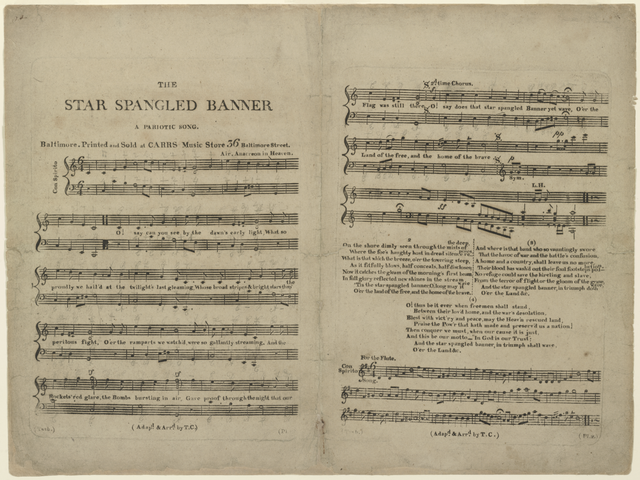
star spangled banner
First written as a poem titled "Defence of Fort M'Henry," the Star-Spangled Banner was soon turned into song. 

Our national anthem, “The Star-Spangled Banner,” has always been wrapped in mystery. Except for the first stanza, nobody knows the words. For historians, an even greater mystery surrounds the circumstances under which the anthem was written.

We do know that Francis Scott Key wrote it immediately after the repulse of the British fleet attacking Baltimore in the War of 1812. He had been detained while on a truce mission to the fleet and had to observe the battle with two American companions from the British anchorage eight miles down the Patapsco River.

Help us keep telling the story of America.

Now in its 75th year, American Heritage relies on contributions from readers like you to survive. You can support this magazine of trusted historical writing and the volunteers that sustain it by donating today.

Donate