
January 2011

Two large questions interest me: First, who really owned the slaves in the antebellum South—the planters or the bankers, especially Brown and Baring Brothers? If the banks owned the slaves as mortgaged property, then it was the bankers, rather than the planters, who were able to control manumission.

Second, what percentage of the U.S. national budget was expended on the arts and sciences, including the Smithsonian project, in the period between 1840 and 1860? Research in all printed records provides a tantalizing clue: Between 25 and 33 percent of the national budget was spent on such projects. If this figure proves to be correct after research through the ledgers by a team of researchers, it changes the complexion of American culture as seen from Tocqueville and a number of those, including the artists and scientists themselves, who have declared the United States government consistently ignorant and parsimonious about the arts and sciences.
How did the federal government come to cede back to Virginia the portion of the District of Columbia that lay south of the Potomac? That was in 1847. So far as I know nothing similar has been done or contemplated in other countries (Mexico, Australia, Brazil) with federal districts. Why was it never taken back, in 1865 or some other manageable moment? On the map the District continues to look like a sandwich with a large corner bitten off. And why in recent years, with D.C. statehood so much in the news, do we hear so little about the old—whatever it was, folly, deal, concession to states’ rights?

It is a murder mystery—or an essential part of one: the nagging questions about Edwin M. Stanton, Lincoln’s Secretary of War. Why did he refuse the escort the President asked for when he called at the War Department the day of his assassination? The reason Stanton gave for not letting Maj. Thomas Eckert go with Lincoln was urgent business at the telegraph office, which the major supervised. When the President went into that office and repeated his request, Eckert, in virtual insubordination, gave the same excuse. The record proves that no dispatches were sent from the office that night; indeed, neither Stanton nor Eckert showed up there. In the event, the substitute bodyguard proved criminally neglectful.

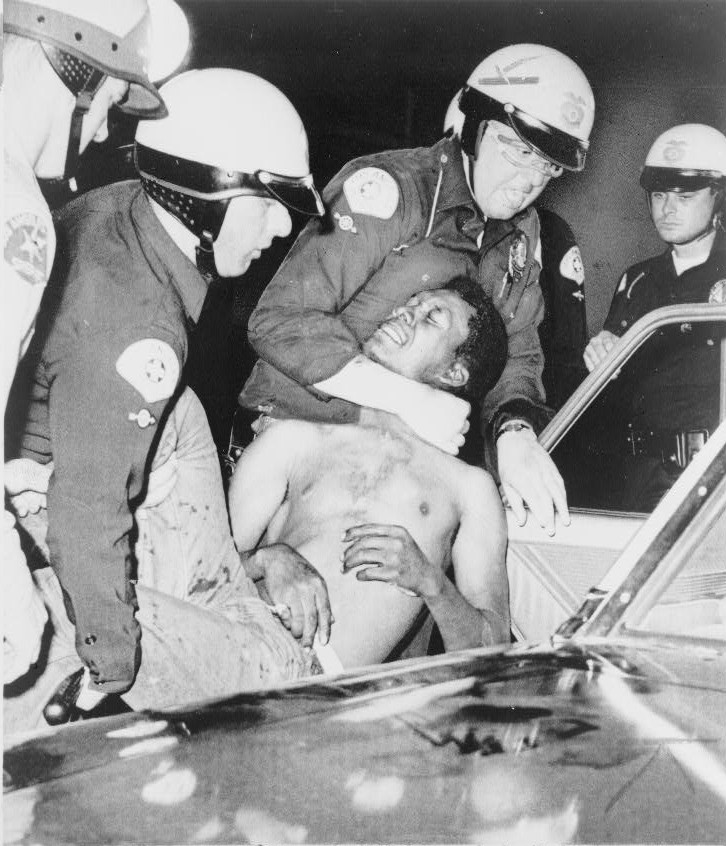
watts riots
 Police arrest a man during the Watts riots on August 12. Library of Congress

Under the chairmanship of the former CIA director John McCone, the Watts Commission delivered its report on schedule in early December. The eight-member commission had been appointed by California’s governor Edmund G. Brown to investigate the causes of violence following six days and nights of arson, gunfire, and looting that had torn through the largely black Los Angeles suburb the August before. The rioting had dominated an area of 46.5 miles overall, killing thirtyfive people and injuring more than a thousand.

The question we asked this year of the members of the Society of American Historians, and several other scholars, was simple: What is the one mystery in United States history you would like to see resolved? And what do you imagine is a plausible solution?

To encourage their responses, we added that the missing minutes of the Nixon tapes was an obvious example of what we had in mind. And what Aaron Burr was up to was another. But we were sure there were many other mysteries from all eras of our past—ones that involved people, events, and social and economic patterns. Finally, to forestall any objections that considerations of this kind might be seen as trivial, we quoted the words of that wonderful seventeenth-century philosopher Thomas Browne: “What song the sirens sang, or what name Achilles assumed when he hid himself among women, though puzzling questions, are not beyond all conjecture.…”

The results follow. If nothing else, they prove that history is never fully disclosed; the case is always open.

—The Editors

I have often wondered what Aaron Bunwas really up to when he wandered south and west, raising money, enlisting coconspirators, intriguing with the British, the Spanish, and the Mexicans, dropping hints of separatism and empire. The answer, I suppose, was targets of opportunity, with maximum and minimum objectives. In some moods he must have seen himself as the emperor of America; in other moods he perhaps hoped that if he threatened enough trouble, the Jefferson administration would buy him off by a diplomatic appointment. But a mystery remains: How could a man, so coolly realistic so much of the time, live so rich a fantasy life the rest of the time?

On September 1, 1802, the Richmond, Virginia, Recorder; or Lady’s and Gentleman’s Miscellany , asserted that President Thomas Jefferson “keeps, and for many years past has kept, as his concubine, one of his own slaves. Her name is SALLY . The name of her eldest son is TOM . His features are said to bear a striking although sable resemblance to those of the president himself.”

For me one of the minor mysteries in United States history, but one that had great importance historically, was why James Madison, who had been categorically resistant to adding a bill of rights to the Constitution in 1787, by 1789 not only favored adding rights to the Constitution but performed one of the greatest feats of legislative leadership in American history in shepherding through Congress what became the Bill of Rights. Why the shift? Some suggest that it was the influence of Thomas Jefferson, others simply that Madison “saw the light,” especially during the period of the state ratification conventions. My own theory is much more political: Madison discovered a great deal of support for the Bill of Rights when he vied with James Monroe for a seat in Congress and made commitments in the election contest that as a person of integrity he honored in the first session of Congress. I should add that the question of Madison’s motivation is still a matter of dispute among historians, as lately as the last convention of the Organization of American Historians.

Did Meriwether Lewis, who with William Clark first blazed a trail to the Pacific in 1804–06, die by his own hand at Grinder’s Stand on the Natchez Trace in 1809, or was he murdered? If he was murdered, who was the murderer and what was the motive?

Through the years the names of several suspects have been advanced, but little is known about most of them. On the list are Robert and Priscilla Grinder, or Griner, who operated the inn where Lewis died violently. Others are James Neelly, an Indian agent traveling with Lewis; John Pernier, Lewis’s servant; and Tom Runions, believed to be an occasional land pirate. In the documentation that exists are numerous discrepancies.

Questions are also unanswered in the evidence that has been presented to give credence to the suicide of Lewis. Some of it came from the suspects themselves. Recent scholarship leans toward the suicide theory, but in the area of Tennessee where Lewis died, local folklore still strongly supports the belief that he was murdered, even among descendants of some of the suspects.

William Henry Harrison defeated President Martin Van Buren on December 2 with a popular vote of 1,275,390 to 1,128,854. A lasting effect of the election was the popularization of the new Americanism, “O.K.,” which had first appeared in print the year before. Supporters of Van Buren gave him a nickname, “Old Kinderhook,” for his native Hudson River town in old Dutch New York, and formed O.K. clubs during the campaign. Though the true origin of O.K. remains clouded, Martin Van Buren’s failed reelection effort helped give it a national currency that remains strong to this day.

Help us keep telling the story of America.

Now in its 75th year, American Heritage relies on contributions from readers like you to survive. You can support this magazine of trusted historical writing and the volunteers that sustain it by donating today.

Donate