
Trusted Writing on History, Travel, and American Culture Since 1949
SEARCH 75 YEARS OF ESSAYS!
January 2011
On April 10 President George Washington signed the nation’s first patent law, enacted under Congress’s constitutional power to “promote the Progress of science and useful Arts.” The law stipulated that any two members of a patent board, made up of the Secretary of War, the Attorney General, and the Secretary of State, could grant a fourteen-year patent to “any useful art, manufacture, engine, machine, or device, or any improvement thereon not before known or used.” The Secretary of State, Thomas Jefferson, opposed the granting of monopolies, but he assumed the board’s main responsibilities because he hoped the patent law would stimulate American science. Though Jefferson’s high standards of originality and utility permitted the board to grant only three patents in 1790, he welcomed the new nation’s “spring to invention.”
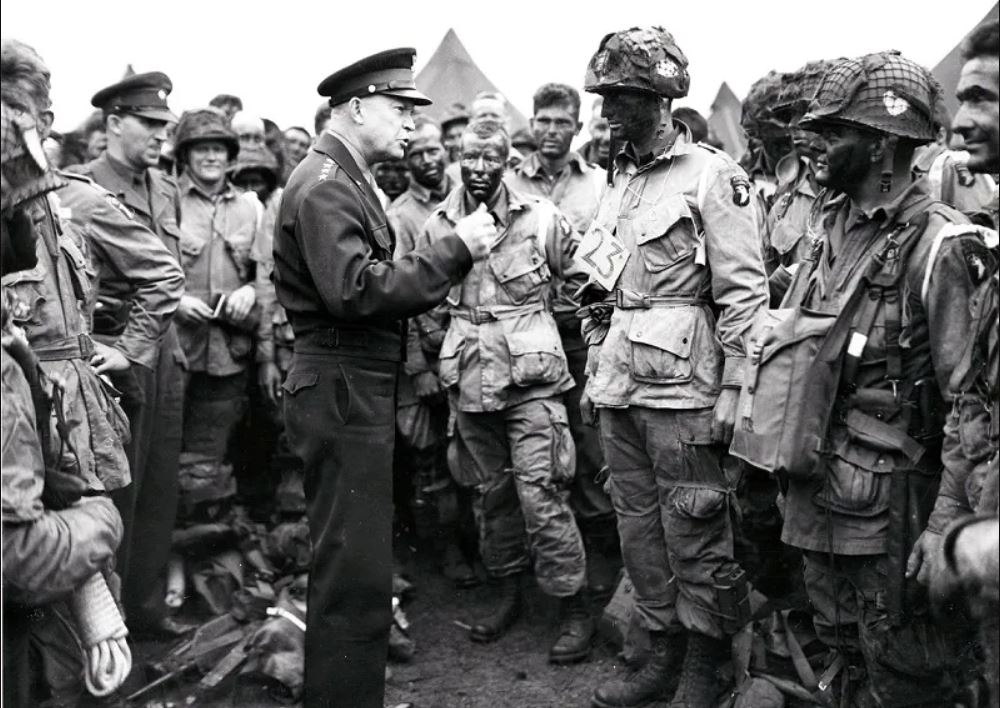
The photograph has been printed and reprinted far and wide. It is found in school books, history books, and encyclopedias. It is on display at the Pentagon.
It is, of course, the photograph of General Dwight D. Eisenhower taken the evening before D-day, June 6, 1944, speaking to the men of the 101st Airborne Division. The caption always reads that he is urging his paratroopers “on to total victory.” But, to this day, what really occurred and what was really said is still known only to the men with whom he was talking.
In the late 1960s, I was a reporter on the staff of a big-city daily newspaper in the border South. My beat was local politics, which at the time had edged into civil rights and sometimes racial confrontations. The issues were clear. The nation had ended slavery and declared segregated schools to be illegal. Now, we were about to proceed into more personal matters.
During the debates over equal accommodations and such, time after time, I was told by black and white, rich and poor, young and old that the speaker himself/herself had no problem with sharing a lunch counter or water fountain or study hall or locker room with people of other races, but that the rest of the population wouldn’t stand for it. Sure, I muttered to myself, the problem is always other people.
The armchair across the page provides elegant proof that there was more to the turn-of-the-century Arts and Crafts movement than Gustave Stickley. Stickley’s linear style is the one most people associate with American Arts and Crafts furniture. Yet even the most passionate Stickley collector might be happy to trade a dozen of his chairs for a single example like this. In the work of the brothers who made it we see the best possible proof that the movement was not a monolith but a collection of regional styles. Charles Sumner Greene and Henry Mather Greene of Pasadena designed houses, landscapes, and interiors in a uniquely Western idiom that took the best of the Crafts aesthetic and shaped it to the particular demands of California life.
In our household, where my mother and father kept a drugstore open from 7:00 A.M. to 10:00 P.M. seven days a week, the women handled transportation.
Aunt Gallic bought a Ford touring car about 1916. On cold mornings she would get up early to see if the car would start. If it did not start, she would send me back in the house to get a hot-water bottle, which she tenderly placed under the hood. Whatever had broken since yesterday could be fixed, usually with a wire hairpin, adhesive tape, or a clothespin.
Many a morning I’d handle the correct maneuver of spark and gas to start the car while Aunt Gallic cranked. My other aunts and my grandmother learned to drive the car, but only Aunt Gallic could change a tire. After she married and moved to New York, 1 was elected to be the tire changer.
The photograph of two “Union soldiers … somewhere in a sundered America” (“Coming Up in American Heritage,” February) is of New York City’s 22d Regiment of the National Guard, and the photograph was taken while the regiment was stationed at Harpers Ferry, West Virginia, in 1862. While at Harpers Ferry the 22d was extensively photographed. But like most National Guard units during the Civil War, the 22d was on active duty for only short periods of time. In 1862 they served from May to September, and in 1863 from June to July. The 22d later served in the Spanish-American War and in both world wars.
For me, the worst horror of entering a new school in the fourth grade was show-and-tell. Each morning, just after attendance, we were expected to hone our “communication skills” by giving a little talk on something that interested us. I had no communication skills to hone—terror made me sway alarmingly and caused my voice simply to disappear when I was called upon (no loss, since it also prevented me from summoning up the simplest words)—and I was convinced that nothing that interested me could possibly interest my new classmates.
Wherever opportunities for great wealth are concentrated, there will also be a concentration of men who make up in ambition, genius, and reckless courage what they sometimes lack in scruples. This is as true of Wall Street and Hollywood as it was of the fallen empire of the Incas and the slave coast of Africa. It was true of Butte, Montana at the turn of the century.
Montana has never been embarrassed about the source of its greatness. Its official nickname is the Treasure State, and its motto is the briskly straightforward Oro y Plata (“Gold and Silver”). But it was the copper in the “richest hill on Earth” that really put the state on the map.