
January 2011

I was wondering if Mr. Gordon in his research ever found out why J. P. Morgan did not join the Union Army during the Civil War. Morgan was in his mid-twenties, an ideal time to volunteer or be drafted. I would guess he paid some German or Irish immigrant to go in his place. Edmund Morris, in his biography of Theodore Roosevelt, tells how Roosevelt’s father, “an ardent Union man,” hired a substitute during the Civil War. Shelby Foote, in his three-volume book The Civil War: A Narrative , describes how the classes at Harvard and Yale over the four-year period were little disturbed by the need for manpower. I guess the cliché used at the time that it was “a rich man’s war but a poor man’s fight” was quite true.
John Steele Gordon replies: I believe you are right that Morgan hired a substitute rather than serve in the Army during the Civil War. This was perfectly legal and, from Morgan’s short-term viewpoint, the eminently sensible thing to do. There was just too much money to be made on Wall Street for him to seriously consider doing anything else.

I would agree with you that the Civil War, like most others, was a poor man’s fight. But I do not think it was a rich man’s war. The Union—“the last, best hope of earth”—was preserved and the abomination of slavery was expunged from the land. All of us, rich and poor, who have lived in this country since are the beneficiaries of those two singular achievements of the men who fought in the Union Army.

As for those rich who paid to stay home and make money, I wonder if they did not, like the “gentlemen in England now abed” on the day Agincourt was fought, afterward hold their man-hoods a little cheap. Along with the money, I suspect Morgan and thousands of others paid a quiet, inward, lifelong price.

In “Powder River Country: The Movies, the Wars, and the Teapot Dome” (April), Oakley Hall noted that the winter of 1886-87 devastated the great ranching concerns of Wyoming’s Scottish and English cattle barons. He further noted that “they were succeeded by moneyed Easterners, like Teddy Roosevelt in the North Dakota badlands.”

Actually, Roosevelt shared their fate. Teddy started his ranching career in 1883. The incredibly harsh winter that ravaged the Powder River country did not spare Dakota Territory. In the spring of 1887, his herd decimated, Roosevelt began to extricate himself from his brief affair with cattle and cowboys.

Regarding “Post Haste” by Robert L. O’Connell in your September/October issue: In the 1920s and 1930s my grandmother lived in a suburb of Chicago and we lived in a suburb of New York City. Letters to and from her were delivered overnight. Now my son lives in Midland, Texas, and I am on the eastern end of Long Island, New York, and letters to and from Midland take about four days! I fully believe one of the reasons for faster service between New York and Chicago back then was that the mail was sorted en route. Now mail is sorted on the ground in various central post offices.

Just before George Bush announced his running mate in 1988, a one-liner going the rounds was that he should choose Jeane Kirkpatrick to add some machismo to the ticket. Until midway through the campaign, the embarrassing “fact” about Bush, as revealed in a spate of jokes, cartoons, and anecdotes gleefully reported or generated by the press, was the candidate’s “wimpiness.” A wimp, of course, is effete, ineffectual, somehow unmanly. Real men, the diametrical opposite of wimps, are war heroes and government leaders, especially combat pilots and spy masters. But wait! Didn’t George Bush become a combat pilot at 18, fly on 58 missions, and win the Distinguished Flying Cross? And doesn’t everyone know that he directed the Central Intelligence Agency?

Historians struggle to find a pattern in the facts they gather about how men have lived. Individuals struggle too, not so much for an understanding of the broad scheme of things but simply to come to terms with the impersonal forces and events they can’t get out of the way of. History as personal experience is the theme of next month’s issue, when, on the occasion of the magazine’s thirty-fifth anniversary, we’ll be publishing an array of recollections by eminent writers of their brushes with—or wallopings by—history.

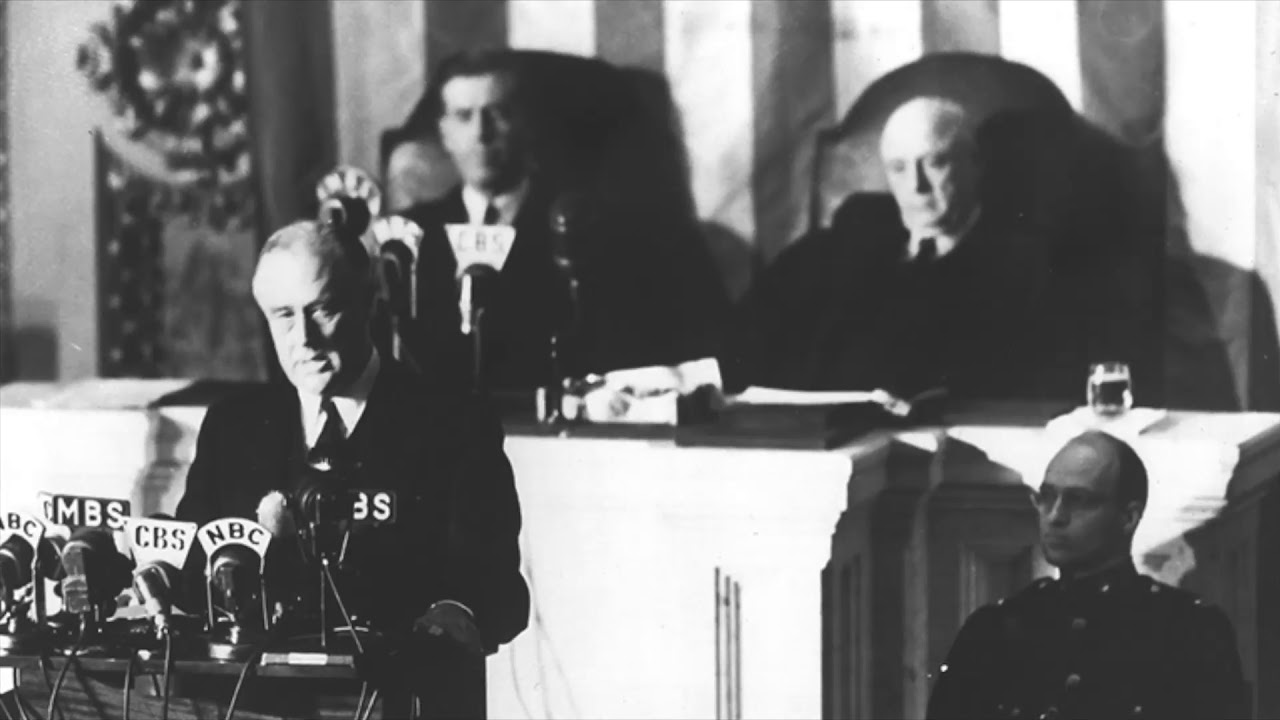
fdr infamy
Roosevelt gave his famous speech in front of Congress the day after Pearl Harbor. 

For most Americans, Sunday began quietly, with nothing to suggest that this was the last morning for almost four years when the nation would be at peace. It was cold and crisp, a glorious day across the eastern half of the country. The Roosevelts had company for the weekend—all old friends. The president’s cousin Ellen Delano Adams and her husband, with their son and daughter-in-law, were there, as was Mrs. Charles Hamlin, known as Bertie, whom Franklin had met years before in Albany, New York, at his uncle Ted’s inauguration as governor. The White House was silent when Bertie Hamlin awoke, and she dressed quietly, walked down the long hallway past the closed doors leading to the President’s bedroom and study, went downstairs, and crossed Pennsylvania Avenue to St.

Sci-Fi History Morgan’s Magnitude Morgan’s Magnitude Morgan’s Magnitude Even TR Failed Slow Post Meet Me in Frisco Whose Beef? Wrong Ship, Wrong Side Detour Detour Edison Did Hear A House Seen Anew A Taller Tower No Anomaly In Old Colorado City Life beyond TV Family History

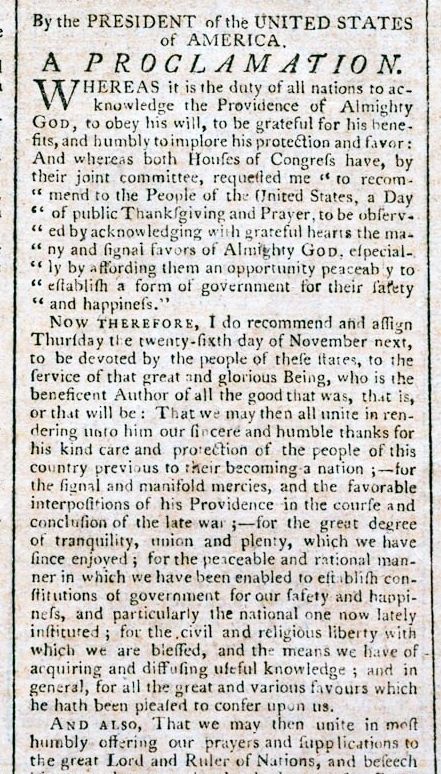
George Washington proclaimed the first Thanksgiving in 1789.

In celebration of the formation of a viable government under the new Constitution, President George Washington proclaimed November 26 to be the first national Thanksgiving Day. The President spent the day worshiping at an Episcopal church in Manhattan and sent a small donation to provide “provisions and beer” to debtors locked up in the city jail.


Abolitionism entered national politics on November 13, when a convention at Warsaw, New York, unanimously nominated James G. Birney for President. The convention was an open rebellion by the politically activated wing of the movement against the ideological leadership of William Lloyd Garrison and marked the first appearance of what would later emerge as the Liberty party.

Help us keep telling the story of America.

Now in its 75th year, American Heritage relies on contributions from readers like you to survive. You can support this magazine of trusted historical writing and the volunteers that sustain it by donating today.

Donate