Examination of a Legend Dangerous—But Skeptical The Faithful British Tar

Trusted Writing on History, Travel, and American Culture Since 1949
SEARCH 75 YEARS OF ESSAYS!
January 2011
In December of 1907, President Theodore Roosevelt sent sixteen battleships out of Hampton Roads on the first leg of what turned out to be a cruise around the world. This irritated both the United States Navy and the chancelleries of Europe, gave an unexpected turn to American foreign policy, and indicated that the country had reached physical maturity without entirely shedding its innocence. Baffled but proud, the American people at last concluded that it was a Good Deed, and the fantastic cruise of the new battle fleet passed into a legend that endures to this day.
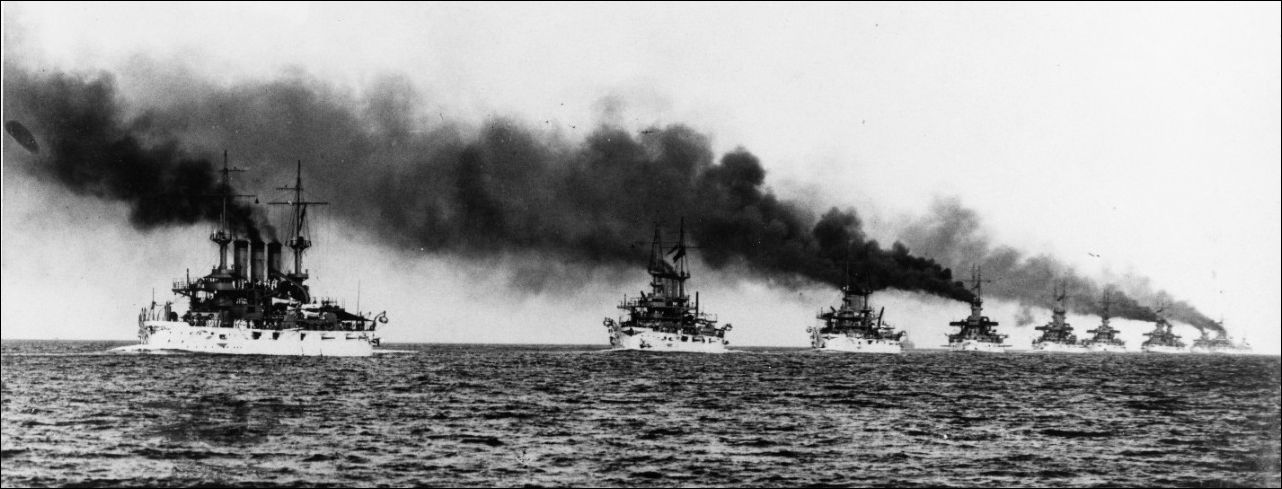
One Japanese naval officer who did not witness the American fleet’s visit because he was on duty elsewhere was a young man who had been born Isoroku Takano. He changed his family name before long to Yamamoto, and he was to have most intimate dealings with the United States Navy a generation later. It was Yamamoto who, as commander of the Japanese fleet, devised and caused to be executed the famous blow at Pearl Harbor, and ever since then Americans have remembered him as one of the most dangerous enemies America ever had.
As a capable naval strategist, Yamamoto undeniably was dangerous. But he is remembered in America largely as an unbalanced braggart who gravely under-estimated American power: the author of the boast that he would force his way into Washington and dictate a peace in the White House.
Among the fifty states, no other had a beginning like Oklahoma’s. Its settlers did not arrive singly, or in small groups, but in masses of thousands, all at once. Many of them, moreover, rushed to areas where cities were likely to develop, hoping that the claims they staked out would fall on a choice corner of a still-unplatted town; in order to run their lines for lots and streets, surveyors had to elbow their way through mobs of squatters. As various segments of the Oklahoma Territory were made available for white settlement by “runs”—of which, between 1889 and 1895, there were five—the lands were fully occupied in a matter of hours, with every trade and profession represented, and more people than could be used effectively.
John James Audubon’s incomparable Birds of America is famous throughout the world. Motivated by the scientist’s passion for a complete and exact record of nature, Audubon produced for his renowned work a set of 435 illustrations that are still treasured by ornithologists. Yet his passion and skill were so great that his paintings were soon recognized for other qualities; they are exceptional works of art. Actually, it is not Audubon’s originals that the world in general knows, but the reproductions made by the British engraver Robert Havell between 1827 and 1838 (and copies of those engravings). Virtually the entire collection of original paintings for this monumental work is now preserved in the New-York Historical Society and has never been photographically reproduced in color.
October 28, 1886, was a day unique in the history of New York City: a day of lolly speeches and colorful heroes on parade, of boisterous crowds—the biggest since Grant’s funeral the year before—and miserable weather and the noisiest, most chaotic: water pageant ever put on in New York Harbor. It was, in the words of the New York Times, the day “a hundred Fourths of July broke loose.” It was the day they unveiled Liberty Enlightening the World, a gigantic statue, a gift from the people of France to the people of the United Slates in honor of the hundredth anniversary of the signing of the Declaration of Independence.
Because the first daguerreotype in this country was made in 1839, it is nearly impossible to bridge, through photography, the gulf that separates us from the eighteenth and early nineteenth centuries. For that reason, the cruelly scarred picture on the facing page is an extraordinary document; it is the photographic likeness of a woman born seven years before the Revolution began, who was an eyewitness to the beginnings of the United States of America, and who was friend to most of the chief participants in those great events. This daguerreotype, made in the late 1840’s, is of Dolley Madison, wife of the fourth President of the United States.
In 1847 that Boston gentleman and man of letters William Hickling Prescott concluded twenty years of labor on the history of Spain under Ferdinand and Isabella and on the conquests of Mexico and Peru. It was a noble edifice that he had raised, the most impressive literary monument yet reared in the New World. So said Daniel Webster: a comet had blazed out on the world in full splendor. So said Lord Holland, over in London: it was the most important historical work since Gibbon. So said the great Alexander von Humboldt, who had embraced the entire cosmos.
“We have,” Savannah says, “and we can prove it.”
A crowd of 250 persons gathered in Savannah’s Colonial Cemetery one day in the autumn of 1964. To be exact, it was October 19—Victory Day, as il is called in Savannah, the anniversary of the surrender of Cornwallis at Yorktown. But those gathered in Colonial Cemetery had also come to commemorate another momentous occasion. They had met to unveil a fifteen-foot-high marble monument to the most controversial set of bones ever to beguile American historians. The bones were those of Button Gwinnett, a signer of the Declaration of Independence and the second “president,” or governor, of Georgia. At least, that’s what the sponsors of the unveiling believed. Others were not so sure.