
Trusted Writing on History, Travel, and American Culture Since 1949
SEARCH 75 YEARS OF ESSAYS!
October 2005
John Steele Gordon makes a number of interesting statements about the origins of and possible solutions to our Federal deficits. He asserts that the eighteenth-century Founders, like other eighteenth-century Englishmen, thought that the King was expected to live off his own revenues. This was indeed true of an earlier phase of British history, but it is stretching a point very far indeed to claim that this was true after the end of the seventeenth century, when a revolution in British public finance compounded of new debt instruments (the sinking fund) and a radical increase in public revenues (much of it the excise, in an age of radically expanding trade) meant that Britain could run and finance vast deficits, deficits that gave it the means to first stalemate and then shatter the French monarchy in what has been called the second Hundred Years War, picking up control of a quarter of the globe in the process.
A few days ago my mother had a brief conversation with a woman at the Post Exchange at Fort Dix, in New Jersey. It was one of those bits of passing small talk you have with strangers while standing in line to check out. The woman had the misconception that Rosa Parks was no longer living. My mother, who is as informed about American history as about that of her own native Germany, quickly told her that Rosa Parks was indeed alive, and was downright huffy that any American citizen wouldn’t know that.
Mom told me this story yesterday evening, her voice filled with the same bewildered dismay that must have been present when she schooled the stranger in the PX. She does not watch very much television, so she could not have known that Rosa Parks had just died, or was dying perhaps even as we spoke. For my own part, I always try to avoid the news after 5 p.m. I figure that if there’s anything more intense and catastrophic than what’s already happening, somebody will make it their business to tell me. So I didn’t find out until this morning. It was like a soft punch to the heart, hearing the news.
Hank Williams was the last echo of the barbaric yawp from Walt Whitman’s America. In just five short years, from 1948 to his death in the backseat of a car on the way to a concert on January 1, 1953, he recorded 66 songs, most of them his own compositions, many of which can still be heard on radio stations almost anywhere in the world. A Nashville songwriter named Harlan Howard summed them up in a nutshell: “Three chords and the truth.”
Every American and just about everyone who knows something about America recognizes at least a refrain from “Cold, Cold Heart,” “I Can’t Help It if I’m Still in Love With You,” “Your Cheatin’ Heart,” “Why Don’t You Love Me (Like You Used to Do)?,” “Jambalaya,” “I’m So Lonesome I Could Cry,” and perhaps a score of other songs, whether in versions by Williams himself or Elvis Presley, Nat King Cole, the Grateful Dead, Bob Dylan, Keith Richards, Tony Bennett, James Brown, Linda Ronstadt, the Bee Gees, and even Lawrence Welk. What other songwriter been covered by Nat King Cole, the Grateful Dead, and Lawrence Welk?
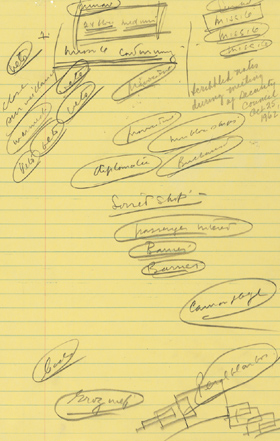
I did not mean to imply that Alger Hiss passed atomic secrets to the Russians. I used the atomic secrets image only as an example of a serious disclosure of classified information, as opposed to the trivial “outing” of someone who has had a desk job at Langley for the last several years and is such a hush-hush, super-secret spy that she sat for a photo spread in Vanity Fair.
And I am perfectly aware of what crime Alger Hiss went to jail for. I merely said that the pumpkin-papers scandal ended up putting him in the slammer. By the way, Mr. Zeitz says that reasonable people can disagree as to whether Alger Hiss was guilty or not. If I understand things correctly, the Venona Project’s recently opened archives show that the Russians certainly thought that Alger Hiss was one of their assets. If that is the case, it would seem that only unreasonable people could think him innocent.
As for whitewashing the perpetrators of Plamegate, I did no such thing. I said only that unless there is some major unknown component to this “scandal,” there is not much of a scandal here.
American Heritage celebrates the baby-boom generation with the cover story of its October issue, “Boomer Century,” which will appear as the main feature on AmericanHeritage.com next Tuesday, October 25. The article’s subtitle asks, “What’s going to happen when the most prosperous, best-educated generation in history finally grows up?” The magazine answers one way; the following list, suggesting new lyrics for old baby-boom hit songs (which I received from a friend), answers another:
This is not a hands-in-the-cookie-jar scandal like Teapot Dome, which sent an attorney general to jail. It is not a serious breach-of-national-security scandal like the Pumpkin Papers, which sent Alger Hiss to jail. It is not an old fashioned corruption scandal like the vicuna coat affair that cost Eisenhower’s chief of staff his job. It is not a hanky-panky-in-high-places scandal like Monicagate, which got a President impeached.
Instead, it has been basically a scandal about politics as usual. Unless there is some blockbuster revelation to come from the special prosecutor, no one has endangered the Republic. No one has sought pecuniary profit from his position in the government. No one has disgraced himself and the country by his personal behavior. Instead it would appear from what we know now that some person or persons may have leaked for political purposes classified information that half of Washington already knew and/or may have been less than totally forthcoming or completely consistent when questioned about it afterwards.
John Steele Gordon asserts that there is some profound difference between the Valerie Plame affair and all previous Washington scandals, that there is no scandal because “no one has endangered the Republic,” and that if Fitzgerald indicts anyone, this will be a case of the criminalization of normal politics. This seems premature at best, since unlike some special prosecutors’ investigations Fitzgerald’s does not seem to leak like a sieve, so we do not know what charges, if any, he will make, or what indictments he will seek. But the odds seem pretty good that he is thinking about obstruction of justice, making false and possibly perjurious statements, illegal disclosure of classified information, and conspiracy. In other words, some of the possible charges sound a lot like the ones that fueled the Watergate and Monica Lewinsky scandals, and the ones that differ seem more serious than any crime President Clinton(or Sherman Adams) can be plausibly accused of having committed.
I’ve always thought of George W. Bush as the Lou Reed of Presidents. Well, maybe that isn’t quite true, though it would be if you substituted “never” for “always.” But it is true that when I heard about President Bush’s latest Supreme Court nominee, Lou Reed is who I thought of.