
The Cuban Missile Crisis: A Lesson for Today?
On October 22, 1962, President John F. Kennedy announced to the nation that the Soviet Union was building military bases in Cuba. He added, “The purpose of these bases can be none other than to provide a nuclear strike capability against the Western Hemisphere.” Such a capability was impermissible, and so two atomic powers suddenly found themselves on the brink of war. Then, with a series of deft diplomatic maneuvers, a deadly confrontation was avoided. Though 45 years have passed since the Cuban Missile Crisis, it still has a lot to tell us both about compromise and about human fallibility.
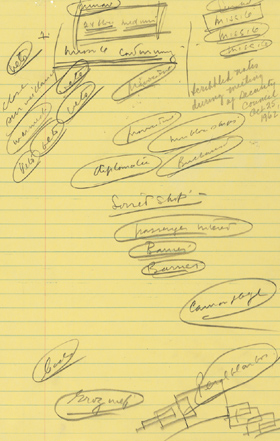
On October 14, 1962, a U-2 spy plane photographed a Soviet missile at a launching site in Cuba, 90 miles off the coast of the United States. If launched, the missile could have struck the Eastern seaboard within minutes. No one knew if the missile was armed with a nuclear weapon, but it presented a serious threat no matter what. Kennedy convened an executive committee that included Secretary of Defense Robert McNamara, former ambassador to Moscow Tommy Thompson, and Special Council to the President Theodore Sorensen. ExComm, as the group was called, was divided between some who favored an immediate air strike against Cuba and others who wanted to first pursue a diplomatic strategy. These two camps would later be dubbed hawks and doves.
Sorensen remembers Vice President Lyndon Johnson arguing, “When I was a boy in Texas, walking along the road, and a snake raised its head, there was only one thing to do, and that was to take a club and cut off its head.” But McNamara pushed for diplomacy, fearing an all-out nuclear exchange. He asked Kennedy “to consider the consequences [of a strike]. I don’t know quite what kind of world we’ll live in after we’ve struck Cuba. How do we stop at that point?”
Kennedy decided to set up a naval blockade of Cuba, halting the build-up of weapons on the island by preventing any more from arriving. This sent a strong message without air strikes. On October 24, Russian and American ships ranged themselves along the quarantine line, eyeing each other testily.
America waited for four days, seemingly on the brink of nuclear war, until Soviet Premier Nikita Khrushchev capitulated. He announced that work on the missile sites would stop, if Kennedy promised never to invade Cuba. Kennedy not only made that promise but also secretly agreed to withdraw American nuclear-armed missiles from Turkey, at the edge of the iron curtain.
As the ships pulled away from the quarantine line, tension between the Soviet Union and the United States began to wane. Within a year, the Limited Test Ban Treaty went into effect, the two countries vowed to explore space together, and nuclear war between the superpowers seemed increasingly unlikely.
The Cuban Missile Crisis showed that peaceful, diplomatic solutions could be possible even between sworn enemies armed with the deadliest weapons in history. People “no longer thought that the only solution to the very real conflicts of interest between Washington and Moscow was to look down the nuclear gun barrel at each other,” Sorensen said.
For McNamara, the lesson was more about the limits of rational people. In Erroll Morris’s 2003 documentary, The Fog of War, McNamara reflects, “The major lesson of the Cuban missile crisis is this: The indefinite combination of human fallibility and nuclear weapons will destroy nations. Is it right and proper that today there are 7,500 strategic offensive nuclear warheads, of which 2,500 are on 15-minute alert, to be launched by the decision of one human being? … I think the human race needs to think more about killing, about conflict. Is that what we want in this twenty-first century?”
We have already been at a kind of a brink again in this new century, as we approached war based on evidence that another hostile nation, Iraq, was stockpiling internationally threatening weapons, as well as thwarting United Nations weapons inspections. Again there was a fear that untold destruction could be unleashed in a matter of minutes. President George W. Bush suggested that Iraq would need as little as 45 minutes to spread chemical and biological weapons. The administration retreated from this after the invasion revealed only empty bunkers and unused trailers, but even though the danger ultimately proved false, there was a real concern for American lives. Once again, in a different situation in a different era, the relative merits and dangers of military and diplomatic solutions had to be very carefully weighed.
For McNamara the reason why war was avoided 40 years ago was sheer accident. He says, “At the end we lucked out. It was luck that prevented nuclear war… . Rational individuals came that close to total destruction of their societies. And that danger exists today.” Luck certainly played a part. So did restraint and patience, and courage in believing that the leader on the other side would ultimately behave rationally. That time, at least, he did.