
Trusted Writing on History, Travel, and American Culture Since 1949
SEARCH 75 YEARS OF ESSAYS!
August 2007
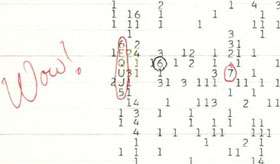
It would have been the biggest news story of all time had it been confirmed. On August 15, 1977—30 years ago today—a radiotelescope at Ohio State known as “the Big Ear” heard something very unusual as it scanned the skies. It was searching for evidence of intelligent life elsewhere in the universe, as part of the program known as the Search for Extra-Terrestrial Intelligence, or SETI. Four days later, Professor Jerry Ehman of Franklin University, in Columbus, Ohio, was flabbergasted as he looked over a printout of that night’s readings.
Recalling his small-town upbringing in Ohio before the Civil War, the novelist William Dean Howells remarked that he had led something of a dual existence, sometimes devoted to a “world of foolish dreams” that the adults in his life tried to impose on him, but just as often spent with other children who did the serious work—“swam, and fished, and hunted, and ran races, and played tops and marbles, and squabbled and scuffed in the Boy’s Town.” As Howard P. Chudacoff’s engaging new volume, Children At Play: An American History (NYU Press, 288 pages, $27.95), shows, however much children’s play has changed over the centuries, there remains an eternal tension between the ideas that adults try to impose and the freedoms that kids insist on.
In the summer of 1975, Bruce Springsteen was backed against the ropes. His first two albums, Greetings From Asbury Park, N.J., and The Wild, The Innocent, and the E Street Shuffle, had been critically but not commercially successful. Jon Landau of Rolling Stone, who famously wrote in 1974 that Springsteen was “rock and roll future,” had taken leave from his job to help him finish his third record. The album, to be named Born to Run, had kept Springsteen in the studio for over a year, and he knew it was his last shot at a breakthrough. But if it was to be his defining statement, he needed an audience to validate it. He got that audience with an electrifying ten-show stand at a 400-seat club in Greenwich Village called the Bottom Line. It would propel him onto the October 27 covers of Time and Newsweeksimultaneously and mark a turning point both for his career and for rock music.
On Sunday, August 7, 1921, 39-year-old Franklin Delano Roosevelt arrived at Campobello, a small Canadian island across the Bay of Fundy from Maine that was close to his heart, if not as deep in his blood as the Hudson River valley. He thought he was starting a vacation there pretty much like any other.
His parents had first taken the infant FDR to a resort hotel at Campobello in 1883, and they soon purchased a house overlooking the water where the boy could roam free in the wilds and sail the sometimes treacherous waters. After his marriage, in 1905, his widowed mother, Sara, bought a 15-room cottage next door as a gift for her son and his wife, Eleanor. This visit, however, would be FDR’s first extended holiday on the island since he had become Assistant Secretary of the Navy, in 1913. Work had kept him too busy for more than the occasional long weekend, though he always saw to it that Eleanor and the “chicks,” as he called his four sons and one daughter, enjoyed a more leisurely visit.
In “Civil Disobedience” (1849), Henry David Thoreau wrote: “This government never of itself furthered any enterprise, but by the alacrity with which it got out of its way. It does not keep the country free. It does not settle the West . . .” Admirable as Thoreau’s small-government principles may be, this is nonsense.
For the West to be settled, as opposed to simply being inhabited by nomadic resource exploiters, a territory needed soldiers to protect the settlers, surveyors to define their land holdings, officials to register them, and governments to make and enforce laws. Before all these, though, settling Western lands required diplomats to define their borders, and the work of these men is the main focus of Seizing Destiny: How America Grew From Sea to Shining Sea, by Richard Kluger (672 pages, $35), just published by Knopf.
The Purple Heart is known among servicemen as the “medal no one tries to earn,” yet hundreds of thousands have been awarded. It is the oldest military decoration still in use in the world, having been established by Gen. George Washington at a moment when he feared losing his army to mutiny or revolt, yet for a century and a half it was all but forgotten, only to be reborn in the 1930s. It was born for the first time 225 years ago today.
Forty-five years ago yesterday, on August 5, 1962, Marilyn Monroe was found dead in the bedroom of her Los Angeles home. Her housekeeper and her psychiatrist broke into the locked bedroom at about 3:30 a.m. and discovered her face-down on her bed, nude, with a hand on a telephone receiver. An empty container of Nembutal sleeping pills was on her nightstand. The authorities labeled the cause of death as “probable suicide,” but controversy and conspiracy theories quickly followed, and they’ve never gone away.
Wild Bill Hickok, that legendary hero of the West, was shot dead in Deadwood, South Dakota, 131 years ago today, on August 2, 1876. Jeff Morey is one of the leading experts on him. In fact, Morey is one of the leading researchers on the American frontier in general. He was historical adviser for the 1993 movie Tombstone and appeared as a commentator in the History Channel’s Tales of The Gunseries and its biography of Doc Holliday. He has also been a consultant for the Gene Autry Museum, and he’ll soon be seen on a new series produced by BBC, The Wild West. From his home in San Diego, he talked with us about the life and legend of Wild Bill Hickok.
As a legendary figure, Wild Bill Hickok follows such heroic earlier frontiersmen such as Daniel Boone, Davy Crockett, and Kit Carson. But those men had real historical import, whereas it’s hard to find purely historical reasons for Wild Bill’s legend. How did he become a household name, and why?