
Life in Space Discovered?
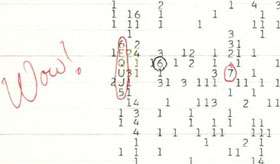
It would have been the biggest news story of all time had it been confirmed. On August 15, 1977—30 years ago today—a radiotelescope at Ohio State known as “the Big Ear” heard something very unusual as it scanned the skies. It was searching for evidence of intelligent life elsewhere in the universe, as part of the program known as the Search for Extra-Terrestrial Intelligence, or SETI. Four days later, Professor Jerry Ehman of Franklin University, in Columbus, Ohio, was flabbergasted as he looked over a printout of that night’s readings.
The telescope was tuned to listen to a frequency of 1420 megahertz. That is the natural emission frequency of hydrogen, the most common element in the universe, and for various technical reasons it is thought to be the logical frequency to use if one were hoping to contact an alien civilization. The signals received were recorded according to their strength above the background noise of space, along a scale that began with 1, ran up to 9, and then went through the alphabet, A to Z.
Amid the usual 1s, 2s, 3s, and occasional 4s, Ehman noticed this series: 6EQUJ5. It was a piercing scream among a million whispers. He circled it and wrote “Wow!” in the margin. But not only was the signal an extraordinarily strong one; it had lasted much longer than such signals usually did. That meant it was almost certainly from outer space, not earthly radio interference. Also, it seemed to be intermittent. When the Big Ear scanned the same point in the sky a few minutes later, it was silent.
A strong, focused, intermittent, and apparently artificial signal from space was exactly what the people who had established SETI had been hoping for. But the signal has never been repeated. The best guess, and it is only that, is that it came from an earthly space probe of which the researchers were unaware.
It was not the first time radio signals were received from space that scientifically trained people thought might be from a civilization. In the fall of 1967, Jocelyn Bell, a Ph.D. candidate in radioastronomy at Cambridge University, detected a signal from outer space that repeated precisely every one and a third seconds. At first laughingly ascribed to “LGMs” (Little Green Men), several similarly regular signals were soon detected in other parts of the sky. Astrophysicists ultimately figured out that they were being generated by rapidly spinning neutron stars, the immensely dense remnants left over from supernova explosions. They dubbed them pulsars, a now-familiar term for the phenomenon.
People have wondered, probably since caveman days, about the possibility that we are not alone in the universe. It’s hard to look up at the night sky and not wonder. Certainly the idea was entertained by various Greek thinkers. However, Aristotle’s model of a geocentric universe, later elaborated and systematized by the astronomer Ptolemy, caused the idea to wither in Western thought until the Renaissance. In the Renaissance it became increasingly clear that the Earth held no special place in the universe and that the sun was simply another star (the philosopher Henry More, a contemporary of Milton’s, wrote, “our world's sunne/Becomes a starre elsewhere”), and the idea of extraterrestrial life began to spread. Aliens inhabiting the moon, the sun, and the planets became a commonplace notion—until astronomical knowledge increased and it became obvious that intelligent life was highly unlikely anywhere else in our own solar system. If it exists, it is located on planets orbiting other stars.
In 1959 two physicists at Cornell University, Giuseppe Cocconi and Philip Morrison, published a short paper in Nature called “Searching for Interstellar Communications.” In it they suggested how one might go about such a search and what such a signal might be like. They admitted that many thought such a venture belonged in science fiction, not science, but they pointed out that there was nothing to indicate that intelligent life was, in fact, confined to earth. “The probability of success is difficult to estimate; but if we never search, the chance of success is zero,” they wrote.
Scientists have been looking ever since, without result except for that one enigmatic signal in 1977. That is, perhaps, not surprising. Space is almost inconceivably empty. If the sun were the size of a walnut, planet Earth would be a grain of sand, orbiting a little less than eight feet away. Jupiter would be a peppercorn, about 38 feet out. Pluto would be a speck of dust a block and a half away. Beyond that, there would be only the occasional dust mote until you got to the nearest star. How far away is that star? If the walnut sun were in New York City, then Alpha Centauri, as our nearest neighbor is called, would be a pair of walnuts (it’s a binary star) in Cleveland.
And yet the universe is so unfathomably vast that there are an estimated 200 billion stars just in our galaxy, the Milky Way. And there are about 100 billion galaxies in the known universe. In 1959 we did not know how many, if any, of this uncountable number of stars had planets. Since the early 1990s we have been discovering extrasolar planets by the dozens, and it is clear that planets are very common, quite probably a normal artifact of star formation. It’s now highly likely that the universe contains many billions of earth-like planets circling sun-like stars at a distance where water would be liquid and thus earth-like life could evolve.
How often it does so and how often it reaches a human level of intelligence and technology are, of course, still anyone’s guess. Nor do we know if radio is the means most technological civilizations, assuming they exist, would use to communicate over long distances. Just as radio was unimagined in the eighteenth century, so civilizations a technological iteration or two ahead of us might well use something unimagined by humans and regard radio the way we regard smoke signals.
Still, it seems worth the relatively minute resources that are devoted to SETI to continue searching. After all, were a radio telescope one day to receive a signal from deep space as simple as beep-beep-beep beep beep-beep-beep-beep beep beep-beep-beep-beep-beep-beep, alternating with beep beep-beep-beep-beep beep beep-beep-beep-beep beep-beep, it would be headlines—in war type—in every news outlet in the world. Why? That’s pi alternating with the square root of two. The random whispers of space don’t make signals like that, and for the first time in four billion years of life on earth, we would know we were not alone.
Wow! indeed.