What Is Sea Power? Mistakes of Strategy Reconstruction

Trusted Writing on History, Travel, and American Culture Since 1949
SEARCH 75 YEARS OF ESSAYS!
January 2011
The task of the military historian is beginning to look a trifle odd because the world is moving out from under him. Statesmen who have at their disposal intercontinental missiles with atomic warheads are not apt to find much nourishment in studies of conventional strategy. The lessons of even the most recent war—painstakingly studied and evaluated with profound thought—seem as out of date as an instruction in the tactical necessities of the Carthaginian war galleys. Only an optimist can believe that men will never again make war, but the one certainty seems to be that they will not again make war as they made it in the past. What is there, outside of the field of purely antiquarian interest, for the military historian to say?
Samuel Eliot Morison takes a broader view in his compact, thought-provoking little book, Strategy and Compromise . That is, although he too concerns himself primarily with sea power, it is the strategy of the entire war which engrosses him, and he discusses not so much what happened at sea as the basis on which strategic decisions were reached and the results that rame from them.
It might, indeed, have been worth remembering in that crucial war of the American people, the Civil War that was waged between 1861 and 1865. That war was fought, apparently, on the pious belief that once secession had been crushed and slavery had been ended, both sides could pick up the old threads and go on to rebuild a once-broken but now-restored Union. In the end the picking-up process turned out to be rather intricate.
This process brought with it the unpleasant period known as Reconstruction, in which a good many bad things happened; and a highly informative and eloquent sidelight on some of these bad things is contained in Jonathan Daniels’ new book, Prince of Carpetbaggers .
At the end of October, 1797, the year V of the French Revolution, a 41-year-old American artist named John Trumbull was stranded in Paris. The government was in peril and the capital was near chaos. With business at a standstill, poverty was general; restless, quick-tempered crowds roamed the streets. For a foreigner, the atmosphere was dangerous.
In the spring of 1863 the Union government tried hard to break into the strongly defended harbor of Charleston, South Carolina. In April navy ironclads attached the Confederate defenses and were repulsed; joint army-navy operations were then planned, and in July the army seized the lower end of Morris Island, a long, low stretch of tlie coast on the southern side of the entrance to the harbor. It was believed that if all of the island could be taken, siege guns could be mounted so as to destroy Fort Sumter and other harbor defenses and clear the way for Union warships.
On the morning of [August] twentieth [1793], with about three thousand men, including the mounted Kentuckians under [General Charles] Scott, [Wayne] marched down the north branch of the Maumee to attack the Indian position. A drizzling rain was falling and the clouds were dark.
The Indians had long been preparing for the conflict… A few miles south of the British fort, they had taken up a position at Presque Isle, a hill or ridge along which ran a mighty swath of fallen timber, felled years before by a tornado. Among the fallen trunks, many of which were twisted but not severed from their stumps, a second growth of trees had sprung up. The Indians cut off these smaller trees breasthigh and turned their sharpened ends toward the enemy. In the fortress thus formed by wild winds and men were gathered Little Turtle, Blue Jacket, and Tecumseh with from fifteen hundred to two thousand warriors, and about seventy French, English, and Tory Rangers under Captain Caldwell. Their line was about two miles long and lay at right angles to the river; a red foe crouched behind every stump …
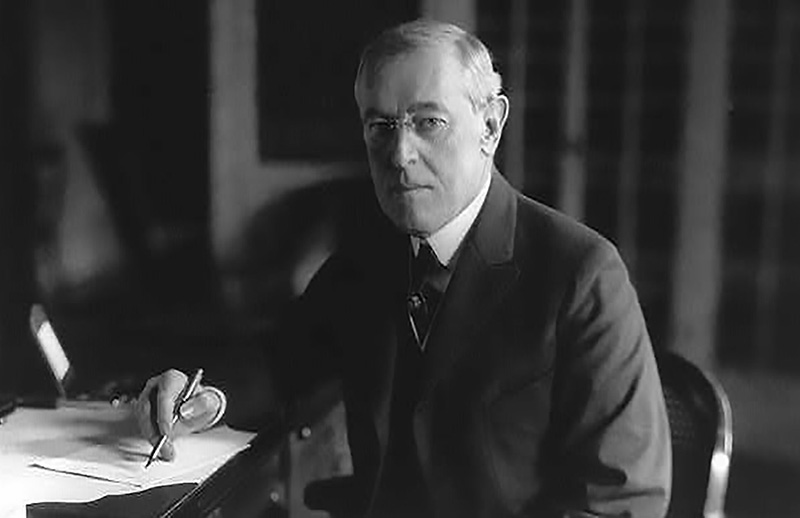
A third of a century since his defeat and death, most of the passion that surrounded Woodrow Wilson in life is spent. Nearly all his friends and contemporaries have left the scene, and a world resounding to fresh agonies catches only echoes of the crusade that failed and of the opportunity cast aside at the close of the “war to end wars.” But the figure of the crusader himself, the unlikely St. George in silk hat and pince-nez, the Presbyterian moralist wrestling with a backsliding world, remains ever interesting, a hero suited to Shakespearean tragedy, the center of an ever-mounting literature.