
January 2011

american union bank
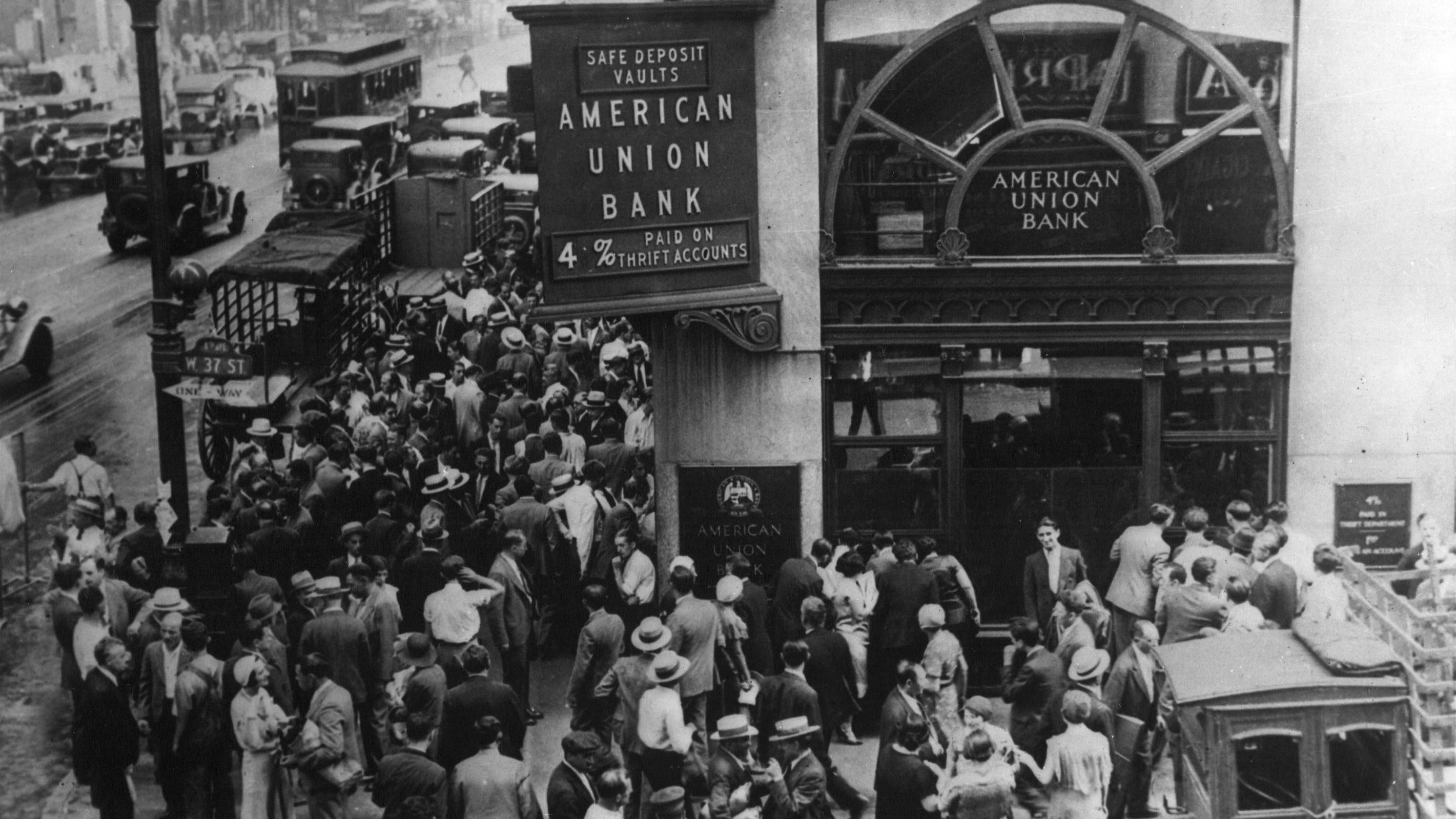
In the early days of the Great Depression, market insecurity led to bank runs like this one at American Union Bank in New York City. National Archives

The decade of the twenties, or more precisely the eight years between the postwar depression of 1920–21 and the stock market crash in October of 1929, were prosperous ones in the United States. The total output of the economy increased by more than 50 per cent. The preceding decades had brought the automobile; now came many more and also roads on which they could be driven with reasonable reliability and comfort, There was much building. The downtown section o[ the mid-continent city—Des Moines, Omaha, Minneapolis—dates from these years.

On Thursday, June 30, 1859, the atmosphere at Niagara Falls was charged with excitement. A slightly built Frenchman, dressed in tights and carrying a long balancing pole, was planning to attempt the impossible—he was going to walk across the terrible gorge of the Niagara River about a mile below the Falls on a slender rope cable, 190 feet above the swift and boiling flood. As they watched in fascination, shading their eyes with their parasols, ladies in crinolines nearly swooned. Strong men in top hats and stocks were tense, for many had wagered large sums on the outcome. Little girls clung to the skirts of their nurses and small boys skylarked. Three hundred thousand people —or was it ten thousand?—held their breath as Jean François Gravelet, better known as Blondin, edged out onto the sloping cable.

In the autumn of 1885, around harvest time, when a granger was likely to have sold his wheat, a man in a slouch hat, wearing the Grand Army badge, appeared on the piazza of almost every American home. There was nothing in his hands to suggest his errand. Touching his hat respectfully, he would say: “I called to give you an opportunity to see General Grant’s book, of which so much has been said in the papers.”

Most people at Niagara remembered Blondin fondly, but to Mark Twain, who in 1869 bought a one-third interest in the Buffalo Express , the great Frenchman was merely “that adventurous ass.” A certain Professor Jenkins was then in the news for crossing the gorge on a velocipede, and on August 26 Twain wrote and published the following satirical letter, signing it “Michael J. Murphy, Reporter”:

To the Editor of the Express:

The Tragic Motive With the Gunners The Technician

The tragic pattern seldom finds a place in the American story. Our history is keyed to the mood of success: the victorious struggle, the rise from depths to heights, the triumph that grows out of daring and endurance. Fidelity, bravery, and nobility of soul always pay off, and the reward is always immediate and tangible. Our most enduring legends seem to be built around the winner.

But human life does not always work that way—not even in America; and it may be that our deep, unfailing interest in the Civil War simply reflects the fact that here the tragic pattern holds across four dreadful years. For the Civil War was (to use the burnished cliché) the war between brothers, the war which Americans waged against themselves and which, as a result, brought tragedy as well as triumph. It was the great struggle against the dark star, the contest with fate itself, one of whose lessons was that victory and defeat are opposite sides of the same coin.

It was, to repeat, defeat and victory together, one and inseparable; and although some profound emotion compels us to look at the beaten, we do see at the same time that various people on the other side had something to do with the outcome. Gettysburg Was not just lost; it was also won, and something can be learned by asking “Why?” on that side as well.

Gettysburg has been under the microscope for many years, and on the tactical side not much ground has been left unplowed; but Fairfax Downey has found a relatively untouched area in the handling of the artillery at this fight. He explores it with diligence in The Guns at Gettysburg , and the result is a book that makes a good companion piece to Mr. Dowdey’s book. (It is possible to foresee a certain confusion in the bookstores, here; between Mr. Dowdey and Mr. Downey, either the clerks or the customers are likely to get a little mixed.)

The technician, as a matter of fact, can be extremely important in American history, and when the story is his alone we do get the traditional success story. Increasingly, we are a people who work with gadgets, whether the gadgets be rapid-fire guns or earth-moving machines, and the man who knows how to use gadgets properly becomes increasingly worth attention. Not all of our profound efforts take place in wartime. Some of them are directed against the physical environment itself—the environment and the physical weariness, or indecision, or doubt and confusion that seem to go with an attack on it. One of the most notable of these was the immense effort which, beginning more than half a century ago, resulted in the digging of the Panama Canal.

In 1835, after a bitter stump-speaking campaign, Congressman Davy Crockett of Tennessee was defeated in his bid for a fourth term. Fed up with politics, he headed for Texas, but on his way to death and glory at the Alamo he is alleged to have made a speech, here described in his own words, in Little Rock, Arkansas. Like much other material attributed to him in The Life of David Crockett, the Original Humorist and Irrepressible Backwoodsman , it may be apocryphal, but in essence it accurately describes the kind of political campaigning for which Crockett—and many another politician before and after him—became famous.

Help us keep telling the story of America.

Now in its 75th year, American Heritage relies on contributions from readers like you to survive. You can support this magazine of trusted historical writing and the volunteers that sustain it by donating today.

Donate