
January 2011

E very Christmas should begin with the sound of bells, and when I was a child mine always did. But they were sleigh bells, not church bells, for we lived in a part of Cedar Rapids, Iowa, where there were no churches. My bells were on my father’s team of horses as he drove up to our horse-headed hitching post with the bobsled that would take us to celebrate Christmas on the family farm ten miles out in the country. My father would bring the team down Fifth Avenue at a smart trot, (licking his whip over the horses’ rumps and making the bells double their light, thin jangling over the snow, whose radiance threw back a brilliance like the sound of bells.
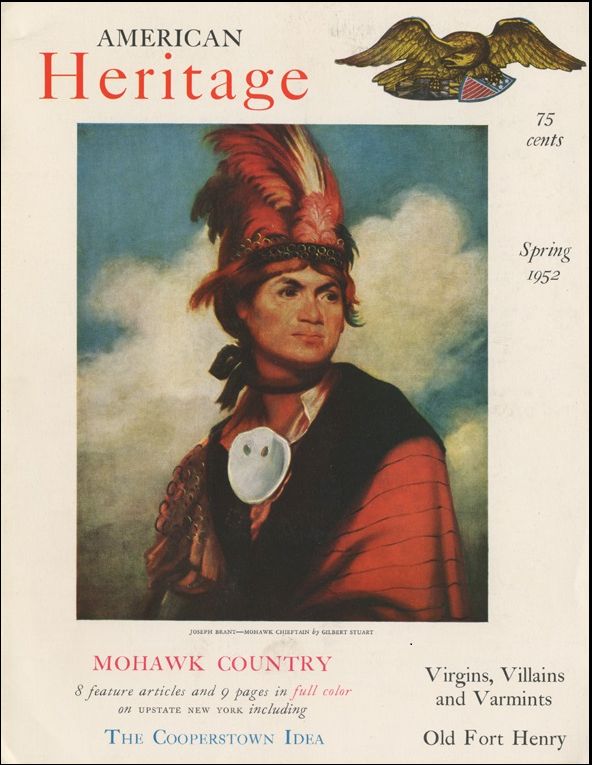
The Spring 1952 issue focused on upstate New York.

American Heritage is the oldest, most widely known and respected popular U.S. history magazine. Central to its mission is making top-tier scholarship accessible to a wide range of audiences, proving that history can be lively, interesting, even spell-binding. It is published by the non-profit National Historical Society based in Washington, DC.

For 75 years, the magazine has told the American story with verve, humor, accuracy and authority. American Heritage has always been apolitical and non-partisan, but tells the story of our nation and the people who built it with respect and appreciation.

The Working Group is assisting the National Portal team with advice on technical issues that occur and on the development of national standards.  It is composed of leading experts from museums, archives, and libraries with knowledge in collection documentation, metadata issues, and the development of national standards.

The Working Group has a dual role: 1) internally to assist in and advise on the development of the National Portal as the primary source of expertise that can be drawn upon and to provide timely technical reviews of proposals, and 2) externally role to act as liaison with the stakeholder community and other metadata initiatives including METS. Members will serve as a voice of their constituents to raise issues in development of the portal, and to assist in communicating the results of National Portal activities back to the community.

“The National Portal is a historic opportunity for the museum and archive fields. As Chairman of the Advisory Committee, I will do everything in my power to help it succeed.”

—Allen Weinstein, former Archivist of the United States

“The need for a national clearinghouse for information about the rich heritage available at historic sites and history museums is much needed and long overdue to connect these collections to the public.”

—Barbara Franco, Executive Director, Pennsylvania Historical and Museum Commission

“We put as much of our collection online as we could and it paid off in increased loan fees, greater visibility (even internationally), and increased image licensing and purchasing. Your strategy of collections aggregation is brilliant. It not only promotes individual museums, but becomes greater than the sum of its parts with cross-museum searches.

—Anna Holloway, VP, Collections, Mariners' Museum, Newport News, VA

The Advisory Board for the National Portal, chaired by Allen Weinstein, former Archivist of the United States, is a committee of leading museum executives that meets a couple of times a year to review progress on the National Portal. It held its first meeting June 10, 2010, hosted at the Library of Congress by Deanna Marcum, Associate Librarian for Library Services. The Advisory Board will provide oversight and strategic advice on important issues such as:


Early in the York town year of 1781 the Continental Congress heard the report of a committee which had been at work estimating the debts of the United States. The committee failed to find enough income even to meet interest charges. The Continental paper had reached a point where it cost more to print a bill than it was worth in the market place. Next day the members of Congress voted unanimously to dump the whole mess in the lap of Robert Morris.

The Financier, as he came to be called, was the center of a web of commercial enterprises which included most of the banking and land speculation and shipping of the middle states. He was openhanded, approachable, a bold trader who exuded that prime commercial quality described as confidence. He was thought to be the richest man in America.

Not long ago a distinguished New Yorker, manager for many years of the great National Horse Show, was asked for his opinion of the famous, vanished carriage-building firm of Rrewster it Company. Wouldn’t he describe them as “the Tiffany of the carriage business”? Not at all, he replied. “Rather, I would say that Tiffany is the Rrewster of the jewelry trade.”

Help us keep telling the story of America.

Now in its 75th year, American Heritage relies on contributions from readers like you to survive. You can support this magazine of trusted historical writing and the volunteers that sustain it by donating today.

Donate