January 2011

As I now move, graciously, I hope, toward the door marked “Exit,” it occurs to me that the only thing I ever really liked to do was go to the movies. Naturally Sex and Art always took precedence over the cinema. Unfortunately neither ever proved to be as dependable as the filtering of present light through that moving strip of celluloid that projects past images and voices onto a screen. Thus, in a seemingly simple process, screening history.

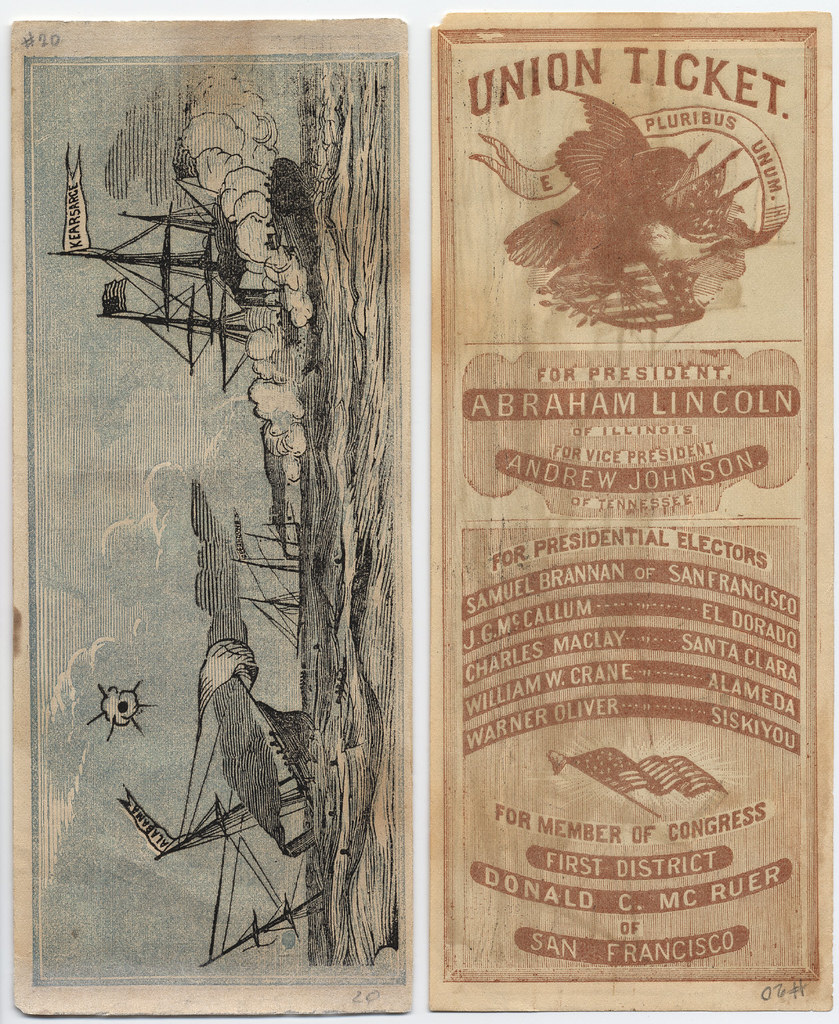
union ticket ballot
A Union party ticket from the election of 1864, featuring candidates Abraham Lincoln and Andrew Johnson. Cornell University Library

“I’ve got a ballot, a magic little ballot,” sang supporters of Henry Wallace’s presidential campaign in 1948. ”… There is magic in that ballot when you vo-o-o-ote !”

dem vs republican
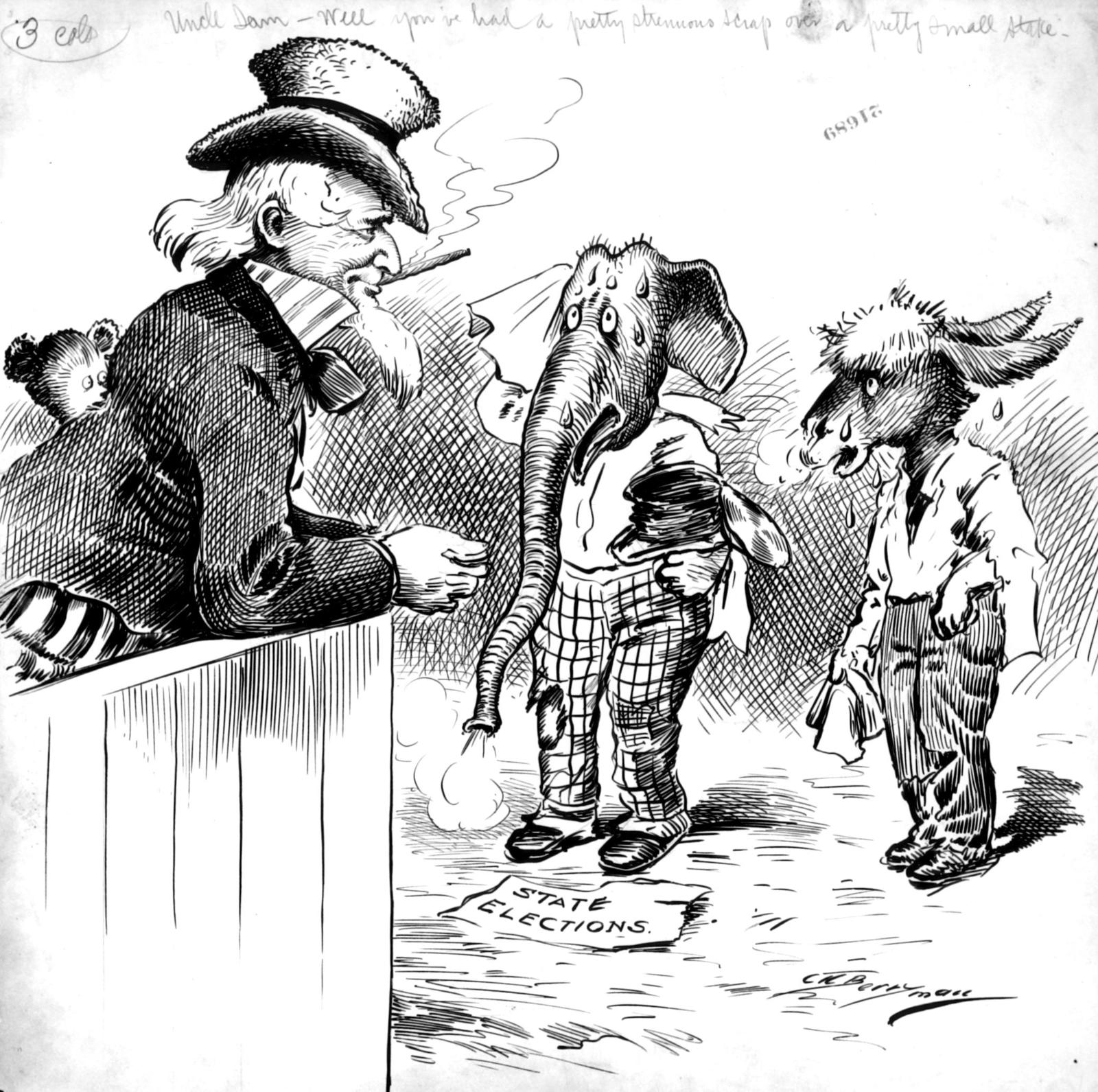
Though they have almost always been at the core of American political life, America's political parties were neither welcomed nor provided for by the framers.

Recently, I got a letter from a friend of mine, Max Lale, the current president of the Texas State Historical Society, that gave me a quick glimpse of a vanished world. Lale recalled that on election day of 1928, when he was twelve, he accompanied his father on a mile-and-a-quarter walk to their local polling place in Oklahoma. There he waited while his Southern-born father, faced with a choice between Al Smith and Herbert Hoover, agonized over which would be worse: to support a Catholic or a Republican. In the end he cast no vote for president. It was impossible to betray either the Protestant religion or the Democratic party.

On September 10 Putnam released Norman Mailer’s savage hunting parable, Why Are We in Vietnam? The book follows the story of a man and his son from Dallas—"Tex” and “DJ."—who go after Alaskan grizzlies, bragging and killing and swearing their way across the wilderness. This twisted tale was Mailer’s answer to the question posed by his title, and his implied psychological portrait of Lyndon Johnson’s White House as an imperial hunting party provoked many of the same harsh feelings as the war his book was lampooning: some reviewers panned it for the grotesque the author had made of the American attitude; others agreed with Mailer’s sentiment but found the analogy between the hunters’ mission and the U.S. engagement in Southeast Asia strained and overlong. For his puzzled colleagues who claimed to see no relation between the book’s essayistic title and the swearing bear-shoot inside, Newsday ’s Mike McGrady explained, “It’s about violence and brutality, fear and power, thwarted and misdirected sexuality, the Texas way of thinking.”

When the last wartime Miss America was crowned in September, Miss Chicago took the loss particularly hard and wept without restraint on the Atlantic City stage. No one knew, of course, how long the war might last, and the winner, Miss Texas, or JoCarroll Dennison, began an indefinite reign. Her clinching song in the musical portion of the competition, “Deep in the Heart of Texas,” brought mighty cheers from servicemen in the audience. In addition to noting Dennison’s anatomical statistics, Life magazine reported that she could rope, ride, take dictation, and had vowed not to marry until the fighting was over.

Japan released the first pictures of American prisoners of war in several government-propaganda magazines. One publication, Freedom , showed captured Americans enjoying camp meals of “juicy meat” and others gathered in a drab circle around a radio. “Music and merriment reigns in Shanghai concentration camps,” the magazine explained.

The women’s magazines, customarily a mixture of romance stories and homemaking advice, had been almost entirely devoted to the war effort since spring, and the September issue of The Ladies’ Home Journal was a grim case in point. In a section called “Questions That Women Ask Mr. Hoover” (then head of Food Administration), readers were advised to eat more potatoes and to put a temporary end to their four-o’clock teas for the sake of the boys they were sending abroad. H. G. Wells’s thoughts on “The God of This New Age” replaced the past discussion of French hats, and cooking tips now took on a greater urgency in morality tales such as “How Mrs. Black Sent Lard Up.” She did it (sent the price up, that is) by throwing away the fat from her roast rather than using it for her biscuits later.

The thriving railway traffic of Chicago had grown so thick and constant that many in the city were worried for the safety of visitors to the coming year’s Columbian Exposition. A Harper’s Weekly reporter visiting the town in September observed that “the slaughter and mangling and maiming of the citizens by the railroads go on, and is unparalleled elsewhere in the world. The people of Chicago may be said to know that each rising of the sun ushers in a day in which a human life will be taken by some train of cars, so nearly do the murders in each year approach the sum of one a day. And that is saying nothing of the daily mangling.” The hopes of the city lay in moving the depots back from the center and connecting them with a circular railroad—”an elevated road, most persons predict.”

With twenty-five thousand dollars and the heavyweight championship at stake, John L. Sullivan and James J. Corbett met for twenty-one rounds at the Olympic Club in New Orleans on September 7. The New Orleans police had agreed to sanction the bout only if the contestants observed the Marquis of Queensberry Rules and wore big, civilizing gloves, making it the first title fight of boxing’s gloved era. Each round was to last three minutes under the adopted system, instead of ending whenever a fighter was thrown down, and grappling, made more difficult by the gloves, was outlawed. Boxing had always been notorious and popular; now it could be legal too.

On September 5 the first of many thousands of Texas longhorns were packed into twenty waiting cattle cars of the Kansas Pacific Railway and left Abilene, Kansas, for Eastern slaughterhouses. The event marked the birth of the era of great cattle drives along the Chisholm Trail and the culmination of Joseph McCoy’s work. He had first bought the 480-acre town for twenty-four hundred dollars, then made a deal with the railway company and persuaded ranchers to drive their herds to his Northern shipping point. He built holding pens near the depot and a hotel where the cowboys could flop at the end of their long drives.

The earlier railheads had been in Missouri and New Orleans, impractically far from much of rural Texas with dangerous territory in between. Moreover, a growing number of Missouri counties were prohibiting longhorns for fear of Texas cattle fever. McCoy’s depot site lay safely to the west of these settlements when it opened. After Abilene, cattle towns would continue to move west with the railheads, out of the way of encroaching settlements.

East to the Slaughter Fighting’s Kinder, Gentler Era The Deadly Center Politics of Lard Miss America Goes to War Why Were We in Vietnam?

Help us keep telling the story of America.

Now in its 75th year, American Heritage relies on contributions from readers like you to survive. You can support this magazine of trusted historical writing and the volunteers that sustain it by donating today.

Donate