
January 2011

In writing “Vermont vs. New Hampshire” in the April issue, Judson D. Hale, Sr., omitted a significant difference: the language. Vermonters speak English. New Hampshirites speak the Down East dialect in which a barn is a “ba’n” and an umbrella is an “umbreller.” When these variants are combined in one word, the result can be confusing. I once listened to an elderly New Hampshire lady who kept referring to a person apparently named Masher. It was some time before I realized that she was talking about her niece, whose name was Marcia. You wouldn’t have that trouble in Vermont.
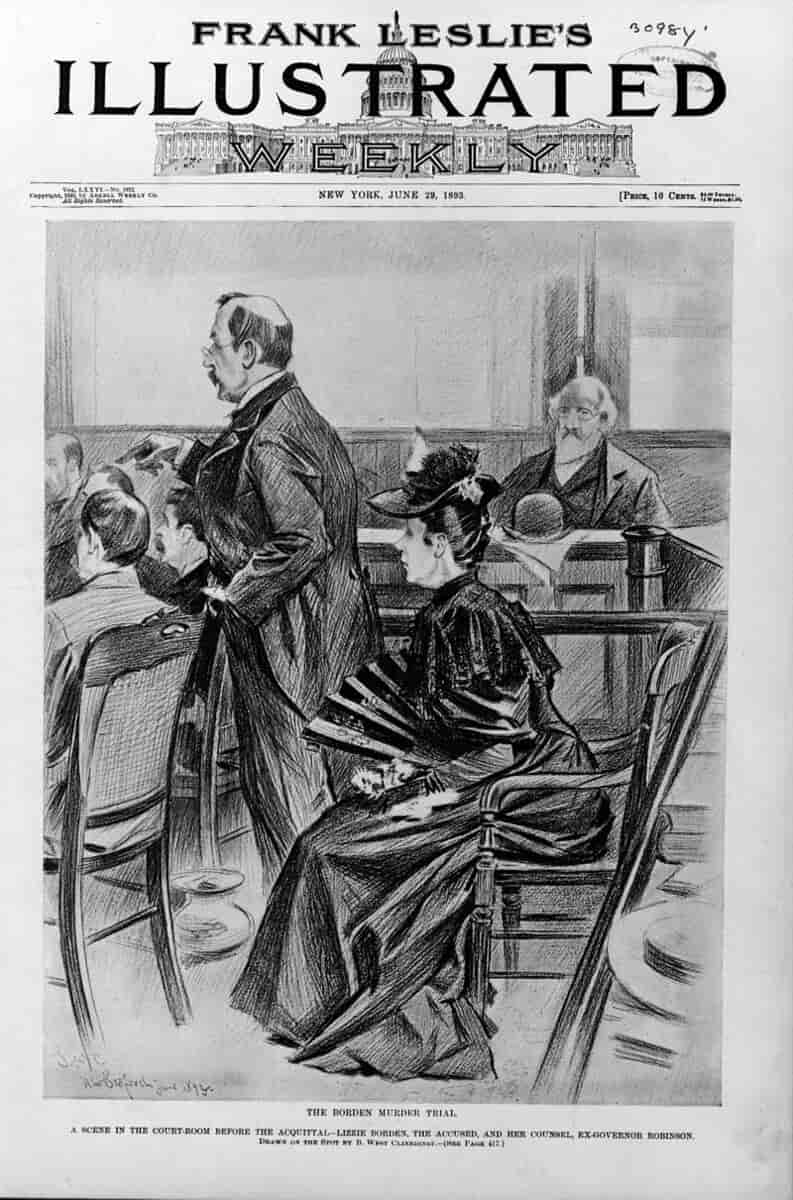
borden
Borden's story and trial captivated the American public in 1893. Frank Leslie's Illustrated

A century ago in Fall River, Massachusetts, a jury of twelve men deliberated about one hour before acquitting Lizzie Borden of killing her father and stepmother. Lizzie’s innocence has not been so easily accepted by other people—either in 1892, when the murders were committed, or today. Since the trial people have continued to question evidence, police procedures, alibis, and strange behavior by members of the Borden household. Amateur prosecutors have put forward other suspects. Still, the evidence against Lizzie is strong enough to keep alive the speculation that she was the killer.

All this happened thirty and more years ago, in the late 1950s. I was a reporter on a New York paper working on what was called the lobster shift. That meant we came in at one in the morning and left at eight. Somewhere there is somebody who knows why the lobster shift was called the lobster shift, but I have never met that somebody.

One morning, around five, the night managing editor told me Harry Truman was spending the night at the Hotel Carlyle on Madison Avenue. “He always takes a morning walk around six. Go up. Maybe he’ll say something.”

“Okay.” Truman had been out of office for years. His historical ranking was very low—China lost, inconclusive Korean War, inflation, corruption, Reds in the State Department. I did not agree with the general view. I had always admired him.

Vt. vs. N.H. Vt. vs. N.H. One of Our Own Cold War Battles At Least We Didn’t Say Kit Carson Lee Reconsidered Lee Reconsidered Liederkranz Lament Liederkranz Lament

I can still see Harry and Bess Truman coming toward us across the crowded terminal of the Kansas City airport on that night in 1970, their 86-year-old faces pinched and almost grim with concern. Then they saw their daughter, Margaret, walking safely beside me, and their worries vanished. Their smiles transformed them.

Introductions were swiftly accomplished. The Trumans already knew who I was and why I was there—to help Margaret on the research for her father’s biography.

Within the hour we were ensconced in a small library in the broad-porched three-story white Victorian house on North Delaware Street in Independence where Mrs. Truman had spent much of her girlhood.

A few weeks ago I had lunch with Gene Smith, the writer whose memoir of Harry Truman accompanies David McCullough’s close-in look at the 1944 Democratic Convention that opens this issue. We talked shop for a while, and I asked him if he had ever seen our sister publication, American Heritage of Invention & Technology . He shook his head. “I’ll send you a copy,” I said. He recoiled in horror; I might have been offering to send him a water moccasin. “No, no! Keep it away from me. I hate technology.”

On August 30, at the end of that extraordinary summer, the United States Senate voted 69 to 11 to confirm Thurgood Marshall as the first black associate justice of the U.S. Supreme Court.

Amid all the love-ins, acid tests, and dreamy good feeling, the summer of 1967 also saw some of the greatest internal violence since the Civil War as riots broke out in at least seventy American cities from Grand Rapids to Boston, Buffalo to Tampa. The riots shared a bleak uniformity—each with an inciting police incident, brutality either real or alleged, looting, and fire bombing.

The Monterey Pop Festival, in California, was over by July, but the hippie assault on Haight-Ashbury continued long into the summer. Tourist buses were rerouted to pass through the ragged crowds of drug dealers, guitar poets, and flower children. Scott McKenzie’s anthem to this new San Francisco, one of July’s top songs, urged visitors to “wear flowers in your hair.” Among the ringing successes at Monterey had been a Los Angeles band called the Doors, named for a line from William Blake and a hallucinatory memoir by Aldous Huxley. Singer Jim Morrison’s voice achieved a pop gravity when combined with a mockbaroque organ, splashy jazz drums, and the invocations of sex and death in the lyrics. In the last week of July, “Light My Fire” (written by guitarist Robby Krieger) became the Doors’ first top-selling single. It was peppy and affirming compared with the later, darker efforts of Morrison, who became a kind of Nietzschean crooner.

Help us keep telling the story of America.

Now in its 75th year, American Heritage relies on contributions from readers like you to survive. You can support this magazine of trusted historical writing and the volunteers that sustain it by donating today.

Donate