
Trusted Writing on History, Travel, and American Culture Since 1949
SEARCH 75 YEARS OF ESSAYS!
January 2011
There is no overview of this problem, so far as I know, but the following touch on various aspects: John Keegan, The Face of Battle (Penguin, 1983); Gerald Linderman, Embattled Courage (Free Press, 1987); Denis Winter, Death’s Men: Soldiers in the Great War (Penguin, 1985); Cols. William S. Mullins and Albert J. Glass, Neuropsychiatry in World War II (Government Printing Office, 1973); Peter Bourne, Men, Stress and Vietnam (Little, Brown, and Co.,1970). The last two are medical works, and the Bourne is mercifully short.
As the evangelist of the Spanish Colonial Revival in southern Florida, Addison Mizner was an architect of fantasy as well as of houses. “I based my design largely on the old architecture of Spain—with important modifications to meet Florida conditions and modern ways of living,” he wrote. The mixture worked: by the mid-1920s Mizner had become America’s most prominent society architect, responsible for the transformation of Palm Beach from a collection of simple frame cottages into a fashionable tropical resort.
Although it can be easily recognized by its bell towers, tiled roofs, arches, window surrounds, and stone or brick walls that are either left exposed or coated in stucco or plaster, it is hard to give this style a name that everyone will agree upon. Mediterranean, Spanish Colonial Revival, Venetian, and Moorish are some of the descriptive titles for what the architect James Marston Fitch has referred to as “the then-fashionable historicizing modes.” Mizner’s imagination could easily leap the barriers of centuries and of logic to create his historical fantasies. One building site made him envision a “nunnery, with a chapel built into the lake . . . a mixture built by a nun from Venice, added onto by one from Gerona, with a bit of new Spain of the tropics.” As the pictures at the right show, Mizner’s influence was far-reaching, even though the translation from his brand of fantasy to the realities of street-corner sites and mercantile demands can sometimes miss the mark.
To achieve the appearance of age and wear that he needed for the furnishings in his houses, Mizner created his own antiques. He worked up a material called Woodbite, a composite of wood shavings and plaster of Paris, which when molded turned out uncannily authentic-looking ceilings and doors. His studios made ceramic roof and floor tiles, wrought-iron grilles and hardware, and furniture, which his workmen antiqued by scraping with broken glass or beating with chains. Some surviving examples are shown here.
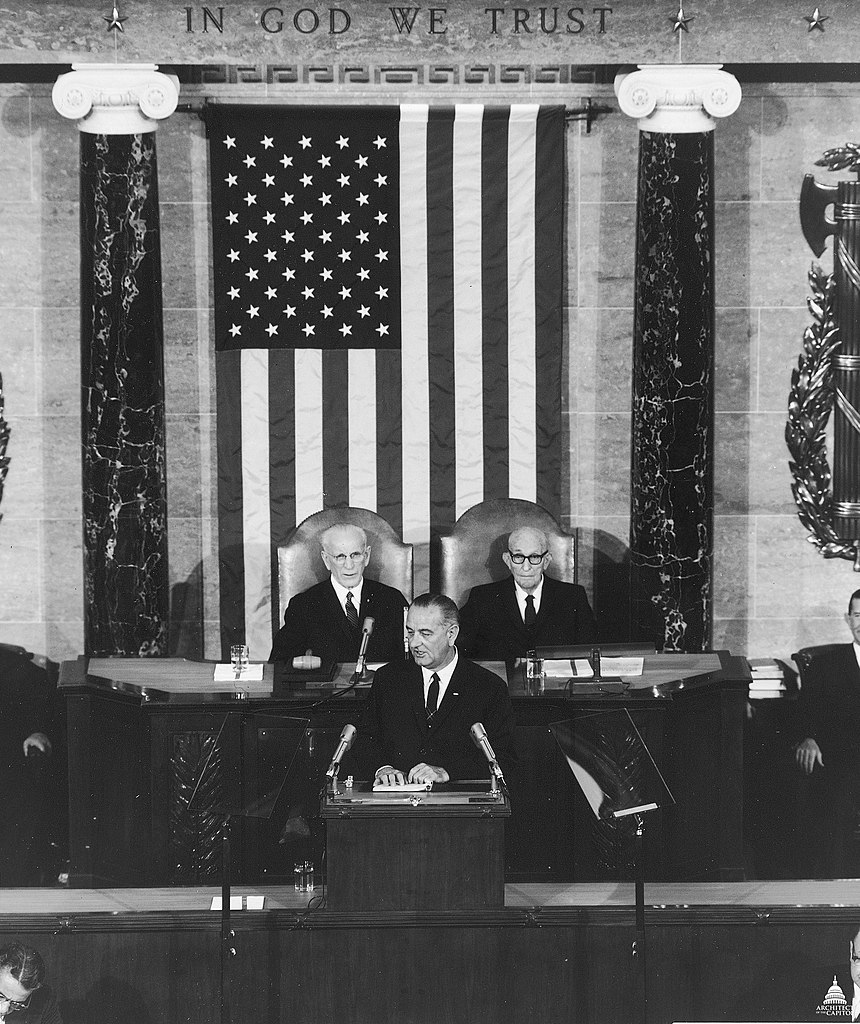
When The Path to Power (New York: Knopf, 1982), the first volume of Robert Caro’s multivolume study The Years of Lyndon Johnson , appeared, critics deplored the author’s relentless hostility to his subject but applauded the vivid style. The second volume, Means of Ascent , appeared in March. For lively one-volume accounts, see Paul Conkin, Big Daddy from the Pedernales (Boston: Twayne, 1986), and Ronnie Dugger, The Politician (New York: Norton, 1982). Doris Kearns, in Lyndon Johnson and the American Dream (New York: Harper, 1976), offers a psychological analysis of a series of interviews with LBJ, whose memory is sometimes untrustworthy but never dull. For a more even-handed account than Caro’s, watch for the publication next year of the first installment of another multi-volume work on Johnson, by Robert Dallek (Oxford University Press).
For much of their history Americans have demanded that art be both ennobling and democratic—morally uplifting and at the same time accessible to a wide audience. Many of the murals and monuments created with thest ideals in view seem sentimental or clichéd today, with the marked exception of animal sculpture. The best examples of this seemingly minor genre have an energy and originality often missing from more conventional statuary.
Sculptors who chose animals as their subject were building on a long tradition. In prehistoric carvings and cave paintings, the images that take pride of place are those of animals, and throughout recorded history there have been animals both wild and domestic in art. They may be symbols of divinity, as in ancient Egypt and the Near East, or figures of humor, as in some Chinese and Japanese art. But once Greece and Rome placed man at the center of things, animals tended to be downplayed or made into monsters. And so it went in European art as long as it centered on religious imagery.
The series we’ve been running on American house styles reminds us of how often the latest, most up-to-the-minute styles and movements in history and culture are revivals of earlier modes. A few issues back Alexander O. Boulton looked at the Gothic—a style that swept Europe in the eighteenth century and made its mark on thousands of American houses in the next century. The Gothic—in the arts, literature, and philosophy—was an exercise in nostalgia for a medieval world of deep spiritual values and faith from which arose some of the greatest artistic monuments of the West. But the houses of the Gothic Revival, when they first went up, were the newest, most fashionable toys in town. In our own era architects still resurrect Gothic forms to touch up their skyscrapers or beach houses.
Let’s call him Frank. “He was in the war” is how adults explained Frank’s odd behavior a generation ago. As he walked through the small town then, his gait was clumsy, his clothes disheveled, and he seemed to go nowhere in particular. One could drive through any part of town and chance to see Frank on the corner, his face at once drawn and blank, as he was waiting to cross a street where the traffic never ceased. Sometimes he carried a paper bag, clutched as though it were filled with precious things. Frank was ghostly, but in an odd way, never threatening. After all, he wasn’t quite there.
One day, in direct contravention of parental orders, a child approached Frank and asked him questions. Was he really in the war? Frank said yes. What did he do? He fought , he said, in the Pacific. Already a devotee of war movies, the child knew what that meant: jungle combat against the most fearsome of enemies, the Japanese. The child’s eyes widened, and the questions came tumbling out.