
December 2025

It will not be one man going to the moon . . . it will be an entire nation. For all of us must work to put him there.
-PRESIDENT JOHN F. KENNEDY, MAY 25, 1961

Even the White House ushers were abuzz on the morning of October 10, 1963, because President John F. Kennedy was honoring the Mercury Seven astronauts in a Rose Garden affair.
Kennedy wanted to personally congratulate the “Magnificent Seven” astronauts, all household names, for their intrepid service to the country. And his remarks marked the end of the Mercury projects after six successful space missions.
At the formal ceremony, Kennedy, in a fun-loving, jaunty mood, full of gregariousness and humor, presented the flyboy legends with the prize. It was the first occasion for all seven spacemen and their wives to be together at the White House since the maiden astronaut, Alan Shepard, accepted a Distinguished Service Award for his Mercury suborbital flight of fifteen minutes to an altitude of 116.5 miles on May 5, 1961.

George Washington faced a crisis when he took command in Boston -- there were few cannon and only enough gunpowder for seven rounds per soldier.

Two hundred and fifty years ago this month, a 26-year-old bookseller from Boston led a team of patriots that hauled 56 cannon, barrels of gunpowder, and critical supplies 300 miles through the wilderness from Fort Ticonderoga in northern New York to the American forces beseiging Boston. Henry Knox and his men accomplished the feat in the middle of winter, hauling 60 tons of supplies on sleds up and down the Berkshire mountains in the bitter cold. 

“Henry Knox’s expedition to secure cannon from Ticonderoga remains one of the most compelling experiences from the Revolutionary War,” says Matthew Keagle, curator of Ticonderoga. “It's a classic American story of someone from a humble upbringing who finds his way to greatness through his skills, his merit, and his experience.”

Editor’s Note: Michael Auslin is a Fellow at Stanford University’s Hoover Institution and author of National Treasure: How the Declaration of Independence Made America, which will be published next year by Simon & Schuster.

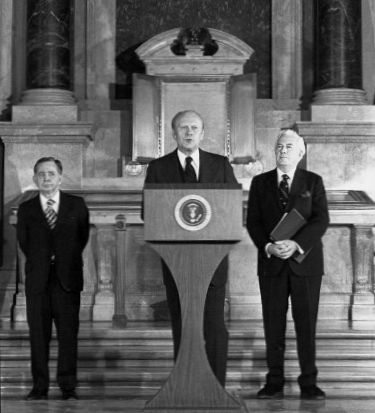
Pres Ford at National Archives, NARA
President Gerald Ford called the Declaration “the fixed star of freedom” at the National Archives in 1976. NARA

Standing in front of the old, commanding shrine in the Rotunda of the National Archives on July 2, 1976, President Gerald R. Ford summed up the unparalleled importance of the Declaration of Independence. The Watergate scandal, race riots, and the debacle in Vietnam had torn the country apart over the previous decade, but on that day, the president urged his listeners to put those divisions behind them.

Help us keep telling the story of America.

Now in its 75th year, American Heritage relies on contributions from readers like you to survive. You can support this magazine of trusted historical writing and the volunteers that sustain it by donating today.

Donate