
As we celebrate the 250th anniversary of American independence, our founding charter remains central to our national life, unifying us and paving the way for what we have long called “the American Dream.”
-
Winter 2026
9 months ago By Richard Bell Volume71Issue1
Editor’s Note: Michael Auslin is a Distinguished Research Fellow at Stanford University’s Hoover Institution and author of National Treasure: How the Declaration of Independence Made America, which will be published this May by Simon & Schuster.
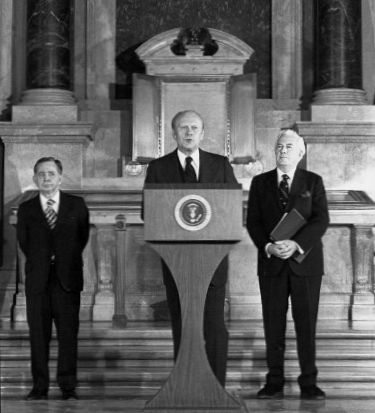
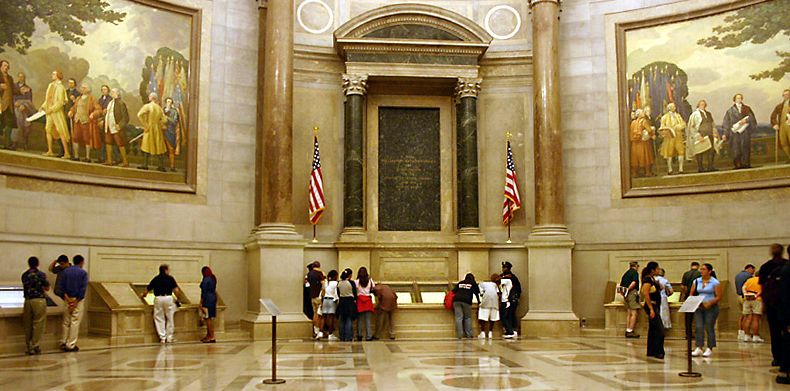
Standing in front of the old, commanding shrine in the Rotunda of the National Archives on July 2, 1976, President Gerald R. Ford summed up the unparalleled importance of the Declaration of Independence. The Watergate scandal, race riots, and the debacle in Vietnam had torn the country apart over the previous decade, but on that day, the president urged his listeners to put those divisions behind them.
The steady, reliable Ford was not known for his eloquence. Yet on the 200th anniversary of the day the Continental Congress had voted for Independence, he gave perhaps the clearest, most succinct appreciation of our founding document. Noting its physical location in the Rotunda “properly central and above all,” Ford called the Declaration “the Polaris of our political order — the fixed star of freedom.” That document, adopted two days after the vote to separate from Great Britain, “is impervious to change because it states moral truths that are eternal,” Ford explained to the world.
As we celebrate the 250th anniversary of American Independence, our founding charter remains central to our national life. The Declaration ties us together, linking us to our past and pushing us forward at the same time.
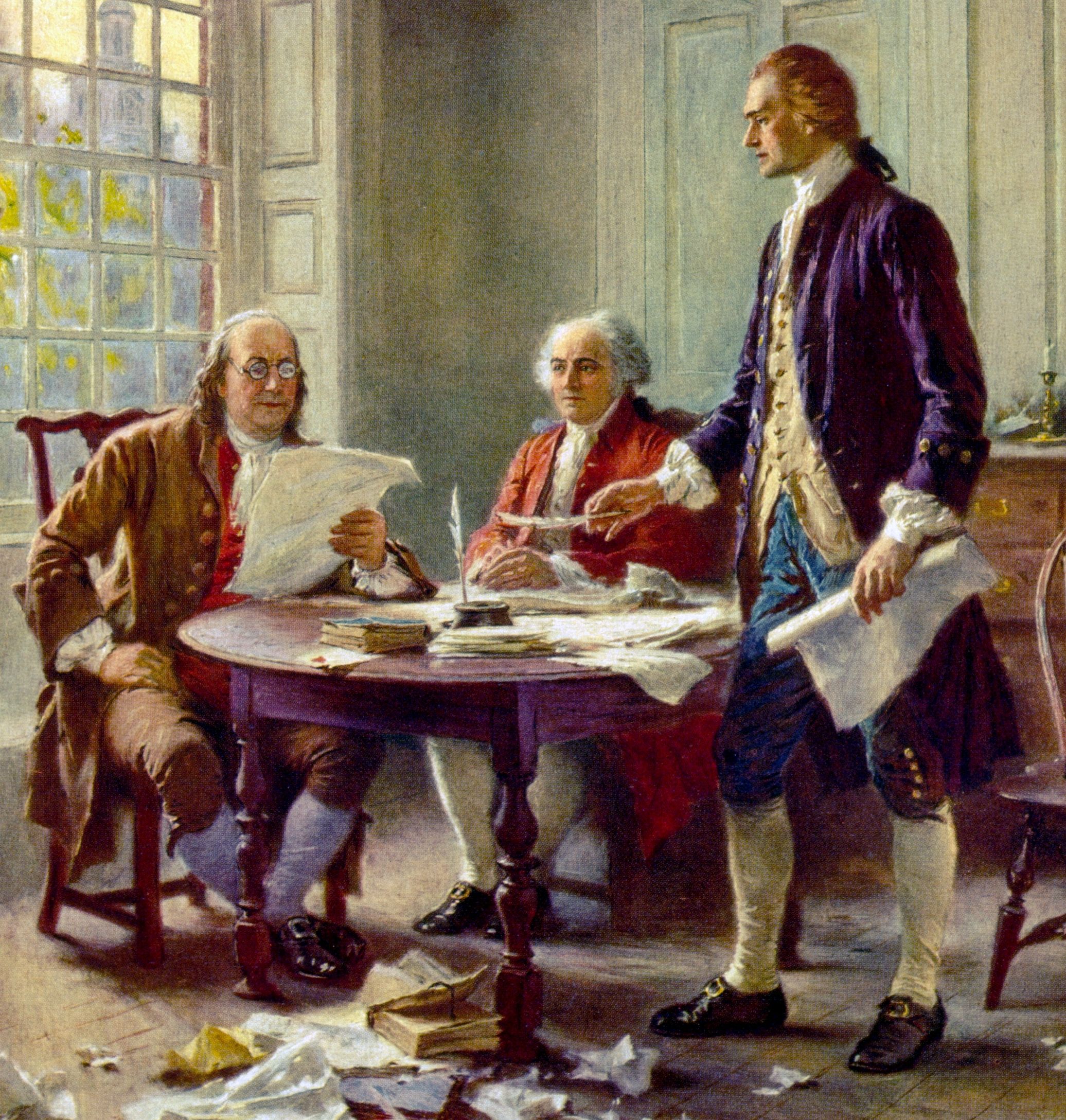
Few would have imagined, on July 4, 1776, that this would be the fate of a statement hastily drafted and haggled over. Once Congress had edited Thomas Jefferson’s draft, cutting out a quarter of his words, including his passionate condemnation of the slave trade, the thirteen colonies adopted the Declaration as sovereign States. No central government held them together.
So important to the States was their individual sovereignty that an “errant a”, which had accidentally been added before “government” in the proof copy of the broadside hurriedly printed up by John Dunlap that night, was quickly removed. The dangerous a in the eighth line, made the sentence read “…whenever any Form of Government becomes destructive of these Ends [of securing life, liberty, and the pursuit of happiness], it is the Right of the People to alter or to abolish it, and to institute a new government…” To suggest that the people could institute “a new government” implied the possible creation of a unitary, centralized entity, which in July 1776 was anathema to the representatives of the thirteen colonies assembled “in Congress” in Philadelphia.
And yet, as hastily as the errant “a” was removed, unity was implied in the document all the same. After an edit most likely made by Benjamin Franklin, the first line of the Declaration asserted that one people was dissolving their political bands with England. The Signers pledged to each other their lives, fortunes, and sacred honor, and adopted the document as “Representatives of the united States of America.”
The next thirteen years would see Congress and the States struggle to balance national unity and state sovereignty. On the same day in June 1776 that Congress named Jefferson, Franklin, John Adams, and two others to a committee to draft a declaration of independence, it also formed a committee to draft a plan of confederation, tasked with establishing a loose governing structure over the former colonies. The Articles of Confederation, when they finally came into effect in 1781, were purposely weak. They did their job only too well: the young nation was unable to raise taxes, pay off debt, raise forces to respond to Shays’s Rebellion in Massachusetts in 1786, and do most of the work of central governments. The result, of course, was the Constitutional Convention in 1787 and the creation of the federal government.
The Constitution may have answered the question of political unity, at least until the issue of slavery tore apart the Union. But it did not fully address the question of just how united the people of the United States would be. Over time, the Declaration created the idea of “Americans” even as it evolved with the country.
In 1776, one might not have thought it could play that role. Bowing to both Northern and Southern interests, the Declaration did not even mention slavery, let alone hint at equality for Black people. Nor, despite Abigail Adams’s entreaty to her husband John to “remember the Ladies,” did it create more equality for women. American Indians, described as “merciless savages,” were treated as a separate people. For all its idealism, the Declaration was rooted in the realities of 18th century norms and politics.
Over time, the Declaration created the idea of “Americans” even as it evolved with the country.
Yet it was not a document that had played its one, vital role on July 4, 1776, and then lapsed into irrelevance. Contained within the Declaration, in Jefferson’s stirring prose, were eternal concepts — moral truths — that gave a greatness to the document, and to the country it helped forge.
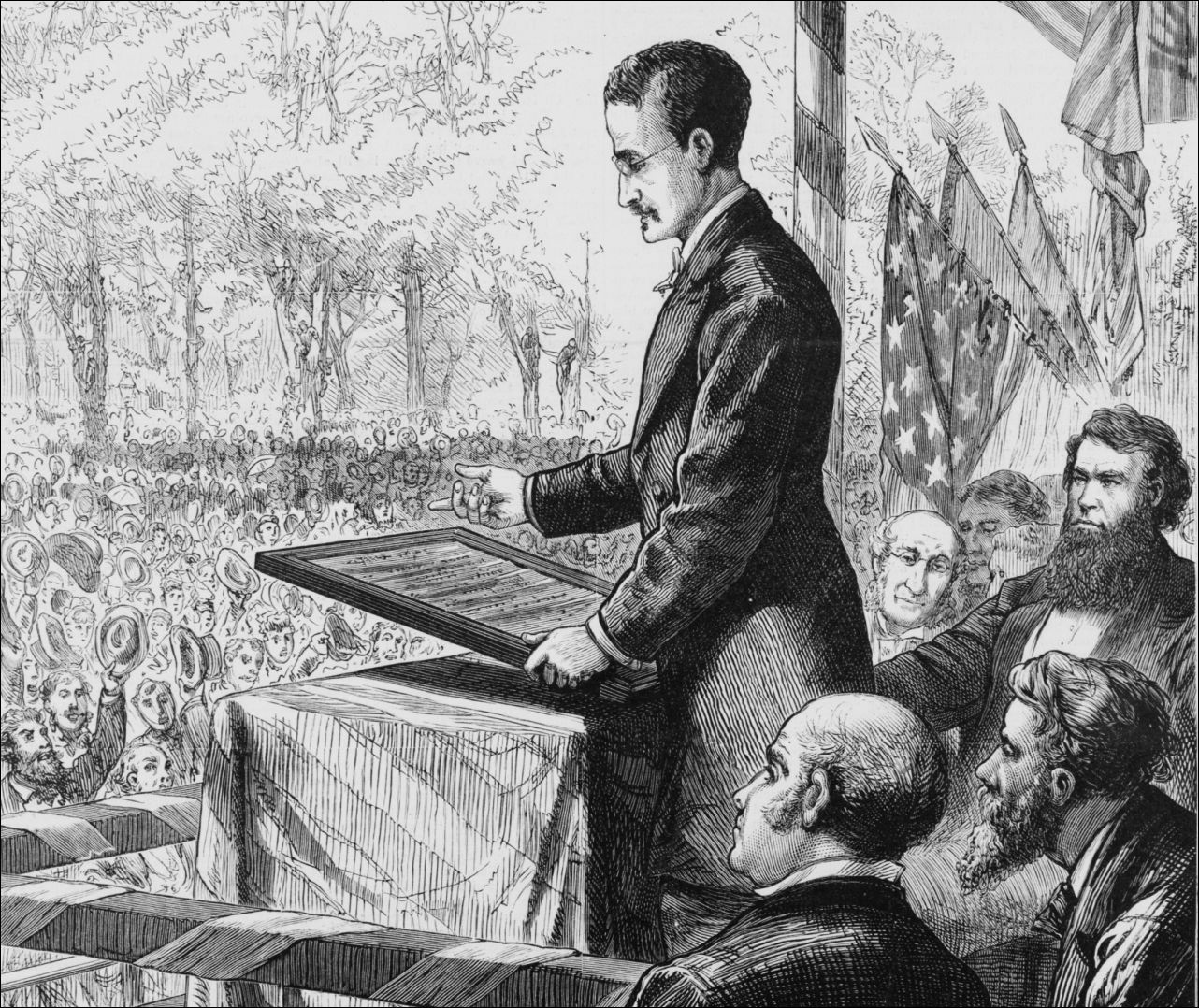
Within a few years of its signing, Black and White abolitionists quoted the Declaration to insist on the end of slavery, perhaps most famously by Frederick Douglass in his famous “What to the Slave is the Fourth of July” speech of 1852. By 1848, Elizabeth Cady Stanton had penned a “Declaration of Sentiments” for her American Women’s Rights Convention in Seneca Falls, New York. Change came slowly, and in the case of the Civil War, catastrophically, but it did come. Invoked by temperance movement reformers, socialists, and Texans seeking to break free from Mexico, the Declaration shifted from a list of grievances justifying a rebellion to a lodestar for those seeking to create a more perfect Union.
In the lead-up to the Civil War and during that terrible conflict, and throughout the 20th century Civil Rights movement, no American document was more often quoted. Reframed by Abraham Lincoln as an “eternal emblem of humanity,” he made the Declaration’s equality claim central to Americans’ understanding of their “great chart of liberty.” Unity, it is true, was imposed by force during the Civil War, for the issue of slavery was an irreconcilable one, but the Declaration’s appeal has more often worked through persuasion and inspiration, as it did in the 1960s, when Martin Luther King, Jr., called upon the Nation to honor the “promissory note” of equality pledged in 1776 and 1863.
Yet the Declaration’s story is not just one of reform and renewal. American society, while flawed, also offered greater freedoms and opportunities than any other on earth. More than any other document, the Declaration expressed the great aspirations of the American people to control their own destiny, to build a better life than their parents or than they had known in the old country. It beckoned Americans to remake themselves, to benefit from the extraordinary resources of the country, and to profit from its rough-and-tumble social, economic, and political arenas. It paved the way for what we have long called “the American Dream.”
The promise of the Declaration and of a land where one could live unfettered by class and prior circumstances drew tens of millions to these shores. It also inspired and heartened those traversing the continent, the settlers who created new territories and communities. Here, too, there was violence and bloodshed, but the new towns and farms also produced new opportunities for self-government and economic improvement for tens of millions who had been oppressed in their old countries or suffocated in the cities of the East Coast.
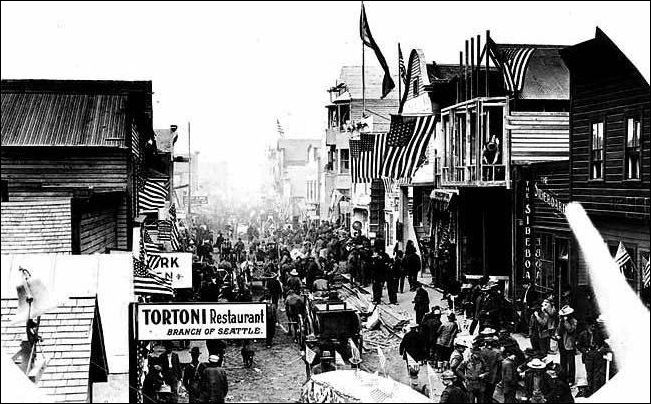
As soon as new territory was settled, whether on the Mississippi River in the early-1800s or Californians in 1850, the Declaration was recited and celebrated on July Fourth. The words “life, liberty, and the pursuit of happiness” motivated Swedes in the Upper Midwest in the late-1800s as much as they had Virginia Cavaliers the previous century. Reprinted in newspapers throughout the country, pasted up on bedroom walls, hung in classrooms and courthouses, the Declaration became the supreme symbol of the American promise.
Jefferson, Franklin, and members of the Continental Congress hoped that the document’s philosophy, its principles on the nature and ends of a just government would be understood, cherished, and promoted by all Americans. Tribalism, whether ethnic, racial, or religious, was not the goal envisioned by the Signers. They hoped to bring together a united people, diverse in faith, culture (what David Hackett Fischer called “folkways”), interests, abilities, and the like, but all vowing allegiance to ideals of liberty and equality that were inspired by Judeo-Christian and English enlightenment values. Neither the majority nor the minority were to be oppressed because of their beliefs or identities.
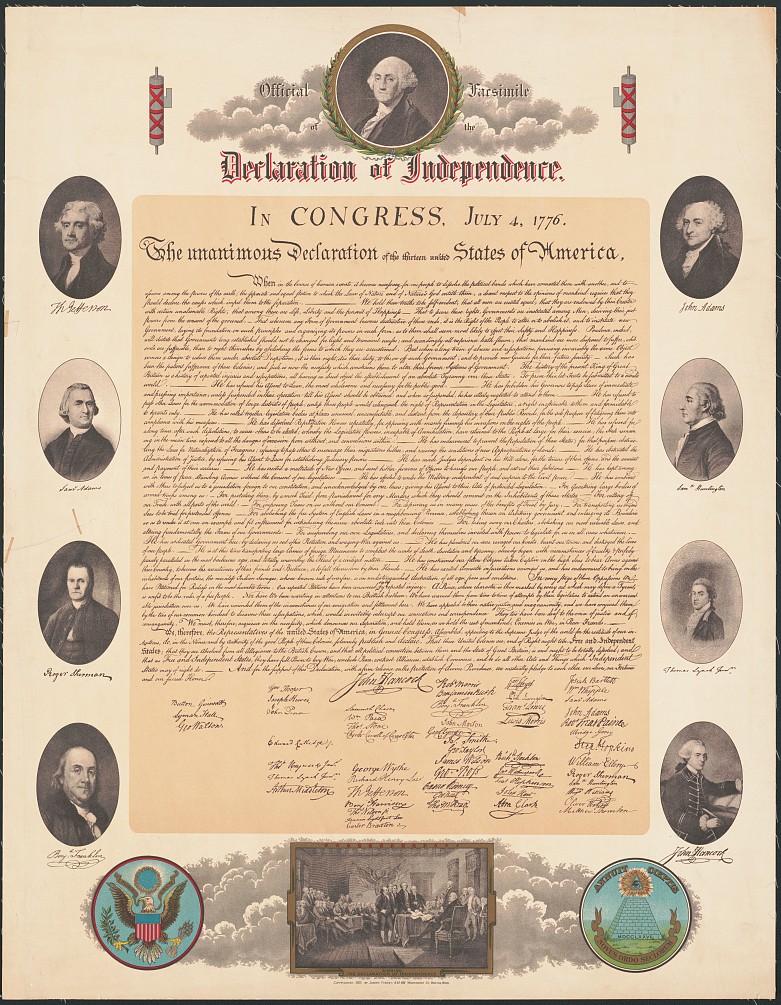
It was these values that were thought to make an American, no matter where he or she had come from. When millions arrived at the end of the nineteenth and beginning of the twentieth centuries in just a few decades, the Declaration was translated into their languages to help prepare them for citizenship. Swedish, Greek, Italian, Russian, and Yiddish translations joined older German and French ones. Handbooks explaining self-government, civil liberties, the rule of law, all based on the principles in the Declaration, were published to help immigrants understand the values and ways of their new homeland and assimilate into American society.
Not only citizenship, but shared ownership of the American experiment motivated the populace, those newly arrived as much as those able to trace their roots back to the Mayflower. To unite this melting pot, the farseeing Librarian of Congress Herbert Putnam put the Declaration on permanent display in an impressive “shrine” in 1924 as the shared inheritance of all Americans. The Declaration stayed in the Library of Congress until 1952, when it was transferred to an even more inspiring shrine in the National Archives, where it rests today.
Unity in America did not — and does not — mean thought or action imposed from above or a stifling conformity. It means a shared civic commitment to maintaining the values that allow a pluralistic society to thrive, that protect the rights of the individual, and yet also expect accommodation and sacrifices that limit unrestrained individualism to maintain civil society. It is the unity of ordered liberty, without which there can be no communal existence.
It is that sense of unity, as much as our commitment to equality, that allows our communities to be the locus of democratic practice. It the unity of purpose called forth by the Declaration that encourages citizens to participate in the political and civic process and to support each other through voluntary and civic organizations, rather than becoming dependent on the federal government. This also is the reason that Americans are the most charitable people on earth, as revealed in the Charities Aid Foundation's World Giving Index. Nearly two centuries ago, in 1835, Alexis De Tocqueville discussed our vibrant spirit of volunteerism and local community political participation, in his classic Democracy in America.
The genius of the Declaration was to place an umbrella of unity over its claims of both liberty and equality. At the same time, our system of federalism ensures that the States retain a critical role in democratic practice, and that within them, local communities take on as much responsibility as they can for their own governance.
To claim that the Declaration of Independence is America’s great statement of unity is not to downplay our history of division or our future of arguing with each other. A large part of what makes America great is our diversity of thought and dreams. The Declaration encourages us to follow our own paths, but we do so based on the revolutionary claim that all human beings have certain inalienable natural rights that cannot be traded away or surrendered. We are all equally free to manage our own life as we see fit (as long as that does not impinge on anyone else’s right to do the same). By articulating this belief — once radical, now commonplace in the world — Americans created the modern era, one still evolving, still challenged by different beliefs that seek to subordinate people to the power of the state or a class or a clerisy.
It was the Declaration of Independence that gave immortal voice to such beliefs, moving them from the pulpit and town meeting to the national and then global stage. For generations, it has expanded our conception of liberty and equality while binding us to its core beliefs and to each other. Without the Declaration, we would not be Americans. With it, we continue to remain the last best hope of earth, as Lincoln so eloquently put it, our task never complete. By recommitting to those principles in our semiquincentennial year, we may emerge more united than before.