
Trusted Writing on History, Travel, and American Culture Since 1949
SEARCH 75 YEARS OF ESSAYS!
December 2006
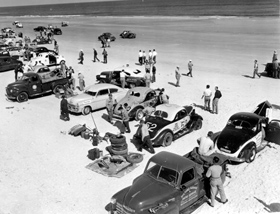
Sixty years ago today, on December 14, 1947, a group of mechanics, promoters, and race car drivers met in Daytona Beach, Florida, to bring some order to the chaotic world of stock car racing. One of them, Big Bill France, Sr., insisted that “stock car racing has got distinct possibilities.”
He was right. The National Association of Stock Car Auto Racing, which they formed at that December 14 meeting in the Streamline Hotel, became one of the biggest success stories in the history of American sports. Today stock car racing is the fastest growing sport in America, and NASCAR is a fixture of our national culture.
Six weeks ago, passersby discovered the body of the former heavyweight champion Trevor Berbick, bludgeoned, in a churchyard in Jamaica. Someone had murdered the former boxer with a steel pipe. His moment of glory, such as it was, was a long way behind him. Twenty-five years ago today, on December 11, 1981, Berbick had defeated Muhammad Ali in the great champion’s final bout. The aging Ali, nearly 40 and showing it, had succumbed to a frankly unimpressive assault, ending an era in sports and in history.
Ali’s final fight brought tears to the eyes of many of his fans. For nearly two decades he had embodied confidence, youth, masculinity, and black pride. He was, some said, the most recognized human being alive.
Forty-eight years ago today a group of 11 men converged on a stately Tudor home in a leafy suburban neighborhood in Indianapolis. There, in Marguerite Dice’s living room, they sipped cups of coffee as Robert Welch, Jr., an eccentric candy manufacturer from Massachusetts, spoke for seven hours straight about the perils of international Communism, interrupted only by a short lunch break. The following day, Welch enlisted 10 of the 11 men present to be charter members of the John Birch Society, a right-wing political advocacy group that would reinvigorate grassroots conservatism while walking a thin line between respectability and conspiratorial fantasy.
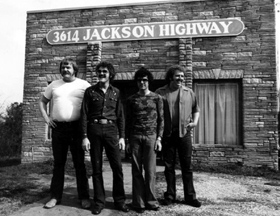
The Swampers in the mid-1970s: from left, Barry Beckett, Roger Hawkins, David Hood, and Jimmy Johnson. (Courtesy of the Muscle Shoals Sound Studio.)
On December 6, 1969, the Rolling Stones were going to perform a free concert at the Altamont Speedway racetrack near San Francisco. The Woodstock rock festival had taken place less than four months earlier, and the Stones’ show would feature the Woodstock alumni the Jefferson Airplane and Santana as opening acts. The show even shared a promoter with Woodstock, Michael Lang, and when asked by a reporter if it would be “Woodstock West,” he answered, “Well, it’s going to be San Francisco.” In fact, it would be a deadly disaster.
By the end of the evening, one man would be stabbed to death by a member of the Hells Angels motorcycle gang, two more people would be killed in an accidental hit-and-run, another would drown while in a drugged stupor, and some 850 concertgoers would be injured. What happened?
“This is the most unheard of thing I ever heard of” was all Sen. Joseph McCarthy could stammer to reporters 52 years ago today, on December 2, 1954. Usually verbose and combative, he was struck dumb. The United States Senate had voted to censure him.
This condemnation would have seemed impossible only a few years earlier, but the redbaiting Wisconsin Senator had made many recent enemies in Washington. Now the Senate had officially rebuked the most feared man in America, for turning his anti-Communist crusade into a national inquisition.
McCarthy’s place in American history is often half-taught. Many know about the tobacco-smoke-hazed hearings, the vicious attacks on politicians, and the damage he did to many entertainers’ reputations. Few, however, remember that he was disowned by his party and President and rebuked in public opinion after four short years in the national spotlight. While his censure did not end “McCarthyism,” his personal downfall did announce a limit to what the American people would allow.
Did you know that one of Maine's three top tourist attractions, along with the Atlantic Ocean and Acadia National Park, is a retail store? Three and a half million visitors traveled to L. L. Bean’s Freeport showrooms last year. Some couples have even chosen to be married there over the years.
Thanks to catalogs packed with practical, unconditionally guaranteed products, Bean is known to an untold number of Americans. But few realize that the firm, founded in 1912 by an enterprising 40-year-old outdoorsman, was in the late 1950s and early ’60s still operated more like a local lobster pound than like the venerable mail-order establishment Life, Reader’s Digest, The Saturday Evening Post, and other publications portrayed. Its aging proprietor was focusing more on how much he paid for merchandise than on the guarantee that backed it. He seemed to agree with his son Carl, who ran the company with him, on one topic only, growth—which both men spurned. Had a grandson, Leon Gorman, not been there to take over, the rickety concern would surely have collapsed after L. L. and Carl died, just months apart in 1967.