
Travel: A Rock Music Mecca in Alabama
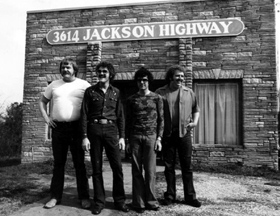
The Swampers in the mid-1970s: from left, Barry Beckett, Roger Hawkins, David Hood, and Jimmy Johnson. (Courtesy of the Muscle Shoals Sound Studio.)
In the 1970 documentary Gimme Shelter, a young Mick Jagger, Keith Richards, and the rest of the Rolling Stones get into their cars at the Holiday Inn in Florence, Alabama, and head across the Tennessee River. Their destination is the Muscle Shoals Sound Studio. It’s in a nondescript stone building in tiny Sheffield, Alabama, but during the late 1960s and 1970s it served as the hit recording capital of the world. Along with the Stones, stars such as Aretha Franklin, Bob Seger, Bob Dylan, Rod Stewart, Cher, Paul Simon, Willie Nelson, and others cut records there; in fact, more than 400 records were made there at the place during the 1970s, and more than 50 of them went gold and platinum. Now it has reopened, as both a working studio again and a museum.
The studio’s secret hit-making weapon was its famous house band, the Muscle Shoals Rhythm Section, also known as the Swampers. They were immortalized in Lynyrd Skynyrd’s song “Sweet Home Alabama”: “Now Muscle Shoals has got the Swampers/ And they’ve been known to pick a song or two/ Lord they get me off so much/ They pick me up when I’m feeling blue/ Now how about you?” The Swampers owned the studio, and they were prized for what became known as the Muscle Shoals sound.
“We had great enthusiasm,” says Roger Hawkins, who was the drummer and one of the studio’s owners. “What we did was become [the artists’] band; we just formed ourselves around their notions and their ideas and together we’d come up with a recording.”
Along with the bassist David Hood, guitarist Jimmy Johnson, and keyboardist Barry Beckett, Hawkins created legendary music in the studio at 3614 Jackson Highway. But as highly regarded as their operation was in the music world, it was virtually unknown to the general public, even to the locals who lived nearby. In fact, one attraction for recording stars was how they could go virtually unnoticed in a small town unaccustomed to watching for famous faces. “When we were working there, a lot of people didn’t know what we were doing,” Hawkins says. “We didn’t advertise; we just went there to go to work.”
The Swampers made a name for themselves at this original Muscle Shoals Sound Studio starting in 1969. In 1978 they moved to another location nearby. The original building, where most of the hits were made, was later home to an appliance dealership and a record store before it was finally abandoned and condemned by the city of Sheffield. In 1999, just before it was slated to be torn down, Noel Webster, a Chicago-born musician, happened upon it and bought it.
“I was working in the area and began looking for a studio to record my own music,” he says. “Some friends showed me this place one night by flashlight, and I didn’t know what it was; I just knew it was a studio, and I needed a place to record, so I bought it.”
As soon as he began making repairs, visitors started dropping by to tell him what he had acquired. Pete Carr, a local musician who had served as a session guitarist during the studio’s heyday, was one of Webster’s first visitors, and as Carr filled him in, Webster quickly decided against modernizing. “When I realized all that happened here, I knew it had to be preserved,” he says.
Instead of creating a modern studio, he began restoring the space to its former condition. He purchased exact duplicates of Swampers’ recording equipment and acquired the original vinyl sofa and chairs, which the Swampers had stored in an attic nearby. During his six-year restoration, which involved repairing water damage and hauling out more than nine tons of trash, he discovered many relics. There were a bathroom door and portions of the bathroom wall signed by artists including Wilson Pickett, Wayne Perkins, and Cat Stevens; there were still-intact vocal booths where Luther Ingram and the members of Blackfoot had left signatures or notes to the Swampers. Webster consulted archival photographs and Swampers themselves to make the studio look exactly as it had in 1969, the year Mick Jagger penned “Wild Horses” in the bathroom.
The result is a historic gallery of American pop culture that has attracted more than 2,000 visitors since it reopened earlier this year as both a museum and a working recording studio. Recently listed on the National Register of Historic Places, it contains rooms full of archival photos and memorabilia from historic recording sessions as well as vintage recording equipment—and the natural acoustics that helped make possible the legendary Muscle Shoals Sound.
“The sounds that came out of this room cannot be duplicated,” Webster says. “I’ve recorded in lots of studios, and the sound in this room just works. The building shakes when you play in it.” Local musicians and ones from nearby Nashville have done most of the recording in the studio since it reopened, but Webster has received calls from producers across the country and around the world who have heard that the place is back in business. Jimmy Johnson, one of the original Swampers, recently returned to record tracks for the debut album of the rock group King Karma.
An authentic living history museum, the studio allows visitors to see and feel the place where hits like Aretha Franklin’s “Respect” and the Stones’ “Brown Sugar” were created. And because the studio is actively recording again, guests can also witness its present-day contributions to music.
“It’s the music that brings them here,” Webster says. “The songs made here have been the themes to people’s lives. They all know the music, but they don’t know the place where it all happened, so I want to share it with the world.”
The Muscle Shoals Sound Studio is open for tours Tuesday through Saturday noon to 6 p.m. Admission is $10. For more information, visit www.muscleshoalssound.org.