
How NASCAR Conquered America
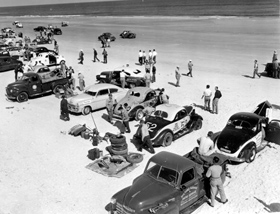
Sixty years ago today, on December 14, 1947, a group of mechanics, promoters, and race car drivers met in Daytona Beach, Florida, to bring some order to the chaotic world of stock car racing. One of them, Big Bill France, Sr., insisted that “stock car racing has got distinct possibilities.”
He was right. The National Association of Stock Car Auto Racing, which they formed at that December 14 meeting in the Streamline Hotel, became one of the biggest success stories in the history of American sports. Today stock car racing is the fastest growing sport in America, and NASCAR is a fixture of our national culture.
The star driver Richard Petty once said that auto racing began “the day they built the second automobile.” He wasn’t far off. In the 1890s, steam-powered “quadricyles” raced one another at speeds that hit 5 miles an hour. Racing began in the Northeast, then moved with the industry to Indiana and the Midwest, convenient to manufacturing centers like South Bend, Indianapolis, and Detroit.
This was “open-wheel” racing, with cars constructed from scratch for maximum speed. The legendary driver Barney Oldfield averaged 84 miles an hour racing at the big Indianapolis speedway in 1909. A brick surface was added two years later, and drivers broke 100 mph in 1919. An early observer asserted that car racing “dwells in the very bloodstream of America—a virus of velocity.”
Racing with specialized vehicles was a rich man’s game. In the 1930s a new kind of competition began to attract participants of more modest means. Amateur enthusiasts would buy an old car, make some alterations to improve its acceleration and handling, and race their pals around cow pastures. The sport was especially popular in the South. Among the most enthusiastic racers were moonshiners, who transported their product to market in fast cars and developed their driving skills while outrunning the law on country roads. Officials at the American Automobile Association, which at the time was the organizing body for professional racing, scoffed at the new stock car events and refused to sanction the races.
Bill France was one of several promoters who tried to standardize stock car racing in the late 1930s. He saw it as a democratic sport, for “plain, ordinary working people” who couldn’t afford a custom racecar. But NASCAR itself wasn’t to be democratic. After the 1947 meeting, France quickly gained control, and he ruled the sport as a dictator for decades. He eventually bought the NASCAR organization outright; to this day his family controls the sport in its entirety.
The hard-packed sands of Daytona Beach were the nation’s principal early proving grounds for land speed trials. The first Speed Week there took place in 1904. In 1936 France organized a race at Daytona in which the cars tore along the beach, looped around, and returned on the nearby highway. But just as the races were beginning to gain popularity, the sport was put on hold by a World War II ban on auto racing.
When racing resumed after the war, whiskey runners (who were still delivering untaxed moonshine from rural stills), hot rodders, and other racing enthusiasts brought out their souped-up cars, planning to start where they had left off. But France, always conscious of the sport’s image, wanted to get rid of the prewar “jalopies.” In 1949 he made the “strictly stock” division the premier level of racing. Drivers had to use relatively new cars with no modification. He correctly surmised that fans would respond to seeing cars just like their own going head to head on the racetrack.
Early races had mostly been on dirt tracks, often at county fairgrounds. In 1950 a paved speedway opened in Darlington, South Carolina, and the first 500-mile stock car race on asphalt was held. The drivers competed for a $25,000 purse.
From there the trajectory of NASCAR was steadily upward. By the mid-1950s auto manufacturers were taking notice. “Win on Sunday, sell on Monday” became an industry motto. The cars remained strictly stock, but the definition of “stock” produced endless controversies. Automakers could gain a racing edge by offering to the public models with beefed-up horsepower and performance.
High-compression engines, overhead valves, and other innovations were put into production partly in response to the needs of the racetrack, which served as a research lab for new car features. It wasn’t long before the car companies were working closely with racing teams to beat out the competition.
American passenger cars became increasingly muscular. The 1955 Chrysler 300 hemi could do 130 mph right off the lot. At the same time, highway deaths mounted. The National Safety Council criticized automakers for the trend. The companies grew skittish, and they officially pulled out of stock car racing in 1957. But they returned a few years later.
In 1959 Bill France moved racing at Daytona to a new super speedway, a steeply banked 2.5-mile “tri-oval” (a sort of an oval made triangular by a bulge in one side) designed for high speeds and big crowds. Other promoters built similar courses. Speeds increased, and the cars had to be modified for safety. Though they retained the outward appearance of production models, they increasingly evolved into specialized racing machines. By 1970 drivers were recording the first 200 mph laps.
The auto companies again drew back from the sport that year, but the R. J. Reynolds Tobacco Company, banned from television advertising, took over NASCAR events, putting up prize money in exchange for exposure. Top drivers began to compete for the Winston Cup.
Richard Petty dominated the sport during the 1960s and ’70s. His father, Lee, had been a star driver in the early years, and Richard exuded the southern charm and good-old-boy aura that fans loved. In a fierce duel at Daytona in 1976, he and his rival David Pierson crashed together on the final turn of the last lap. Petty spun off the track and his engine stalled. Pierson got his damaged car to limp across the finish line at 20 mph, and he won the race.
A wider cohort of Americans began to notice stock car racing in the 1970s as television coverage expanded. The trend accelerated when the next big star came on the scene. Dale Earnhardt, known as the Intimidator, was one of the most successful drivers ever, winning races for more than two decades. Fans loved and hated him for his aggressive, no-holds-barred driving style. His death in a racing accident in 2001 sent legions of NASCAR fans into mourning, attracted widespread attention to the sport, and further boosted its popularity.
NASCAR continued to roll. When R. J. Reynolds dropped its backing, in 2004, Sprint Nextel Corporation was willing to pay $750 million to become lead sponsor. Television coverage increased. In 2007 five networks will broadcast even more NASCAR events under a new $4.8 billion TV deal. Annual racing revenues are over $3 billion and rising, and merchandising adds another $2 billion to NASCAR coffers.
Some purists complain that NASCAR has turned its back on its working-class, Southern, outlaw roots (Dale Earnhardt, Jr. was fined $10,000 in 2004 for using strong language on television). Most fans today are middle-class, and nearly half are women. They come from all parts of the country. The cars serve as billboards for Tide and Betty Crocker as well as for Skoal snuff. “It’s all about marketing,” says Jeff Gordon, one of the sport’s contemporary stars.
Critics have also blasted the sport for its noise, danger, monotony, pollution, and profligate waste of fossil fuels. But one of the organizers at that 1947 meeting perhaps had an inkling of the nature of the “possibilities” when he observed that stock car racing was “kind of like country music. Nobody likes it except the public.”